

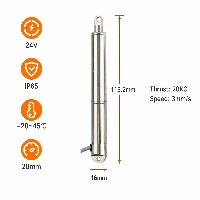
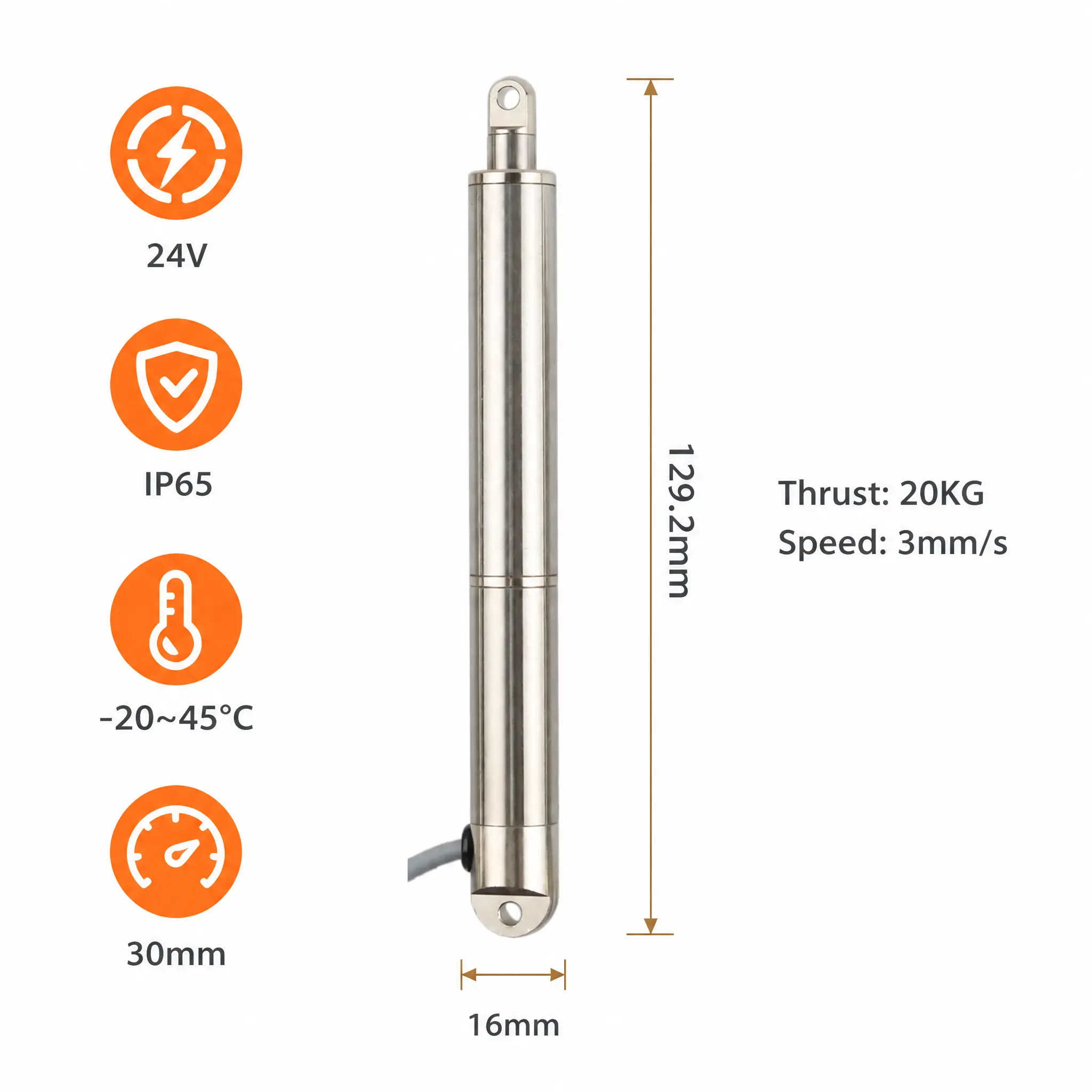

30 mm Miniature Linear Actuator
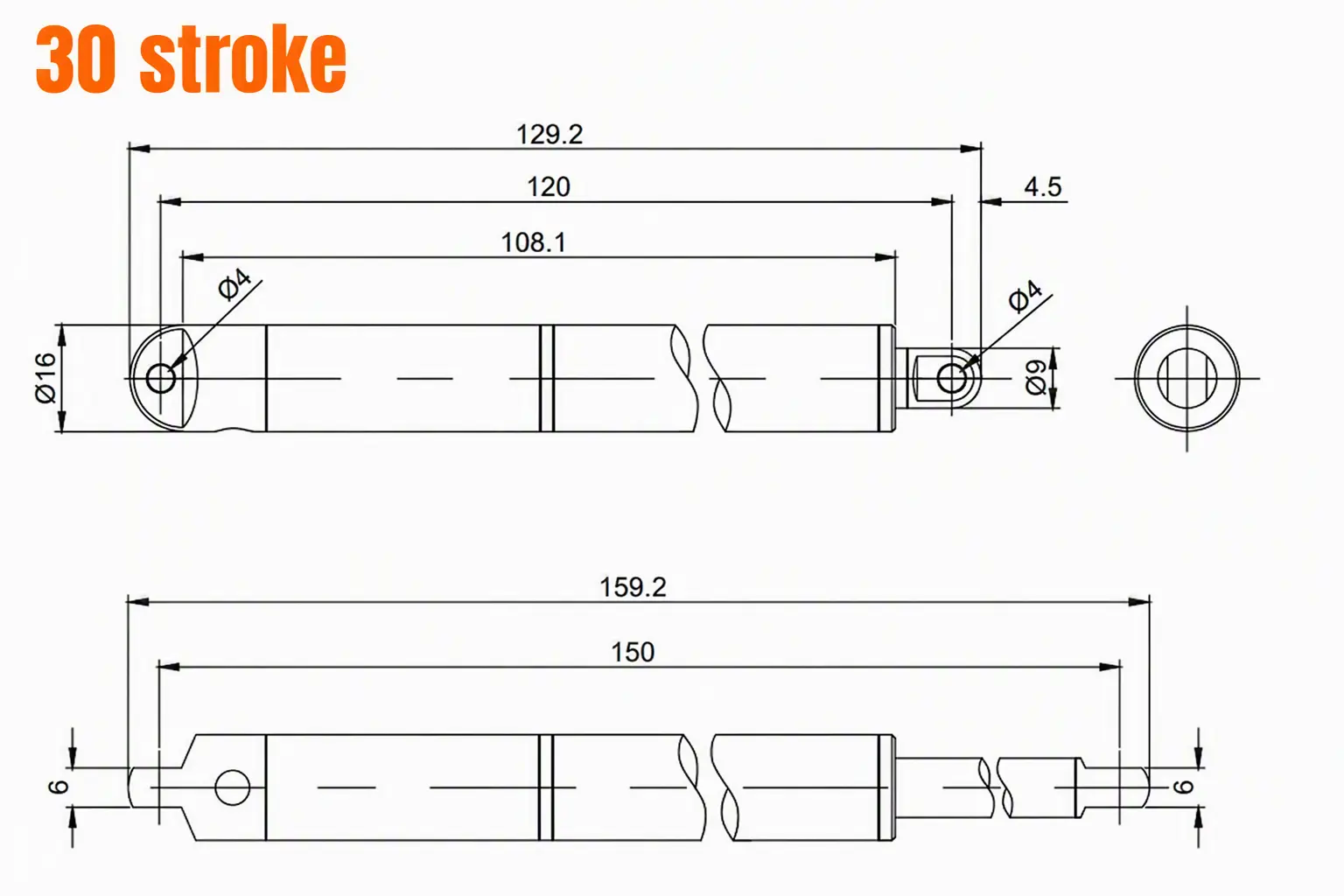
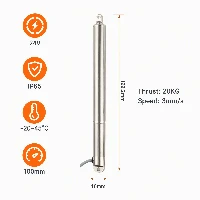
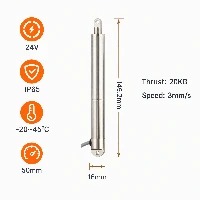
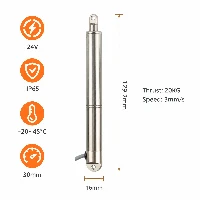
30mm Stroke Micro Electric Linear Actuator Parameter Map, DIY Automation Linear Motion Component
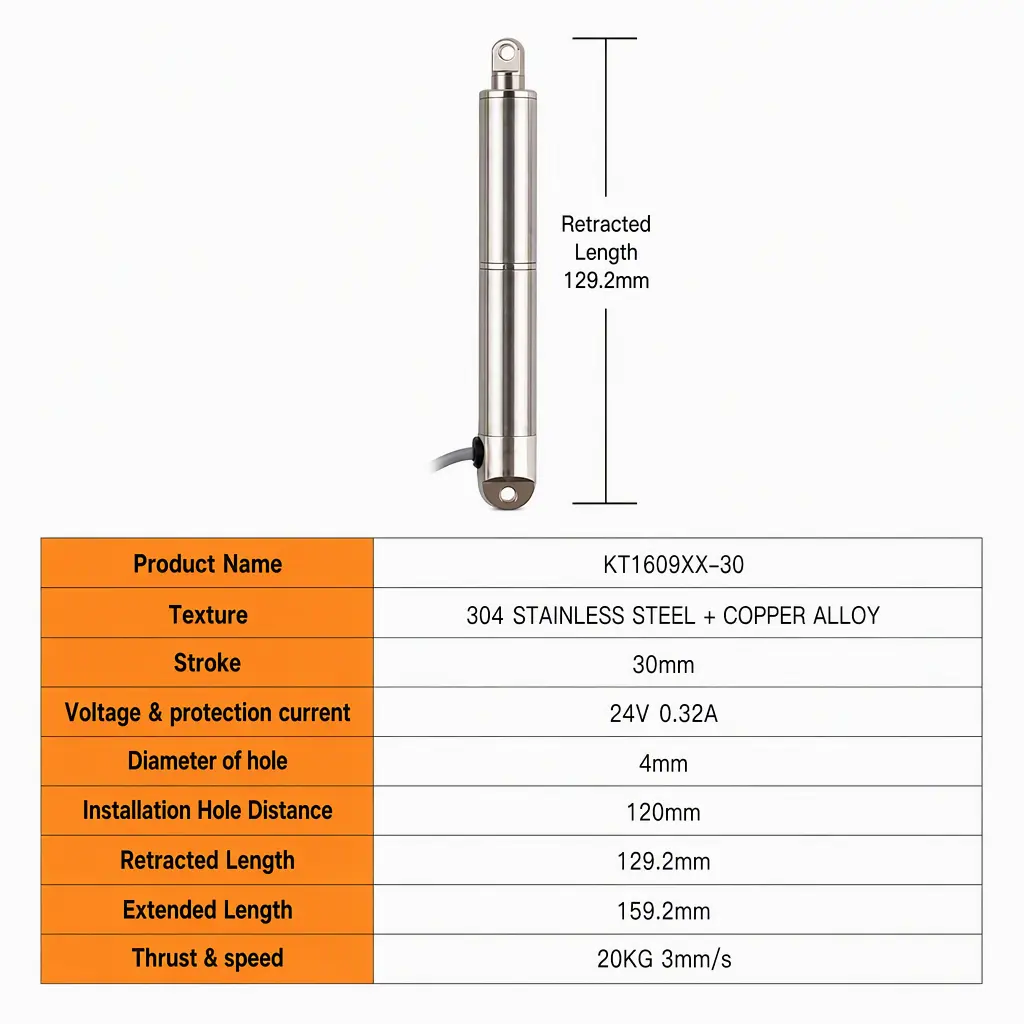
KT1609XX-30 Micro Linear Actuator 30mm Stroke 24V DC 129.2mm Retracted Length 304 Stainless Steel Electric Cylinder 20KG Thrust
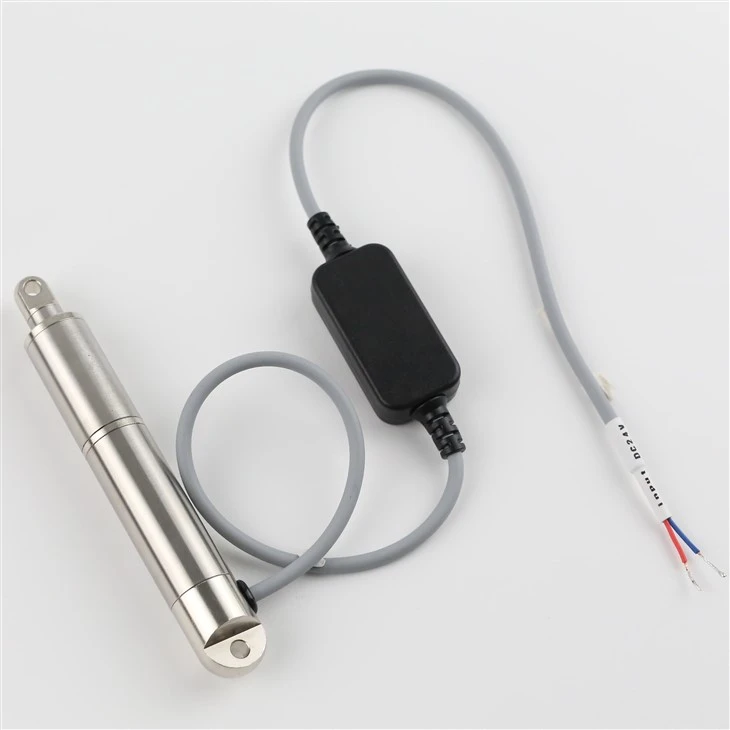
24V micro linear actuator with inline control box and exposed red and blue lead wires, clevis mounts
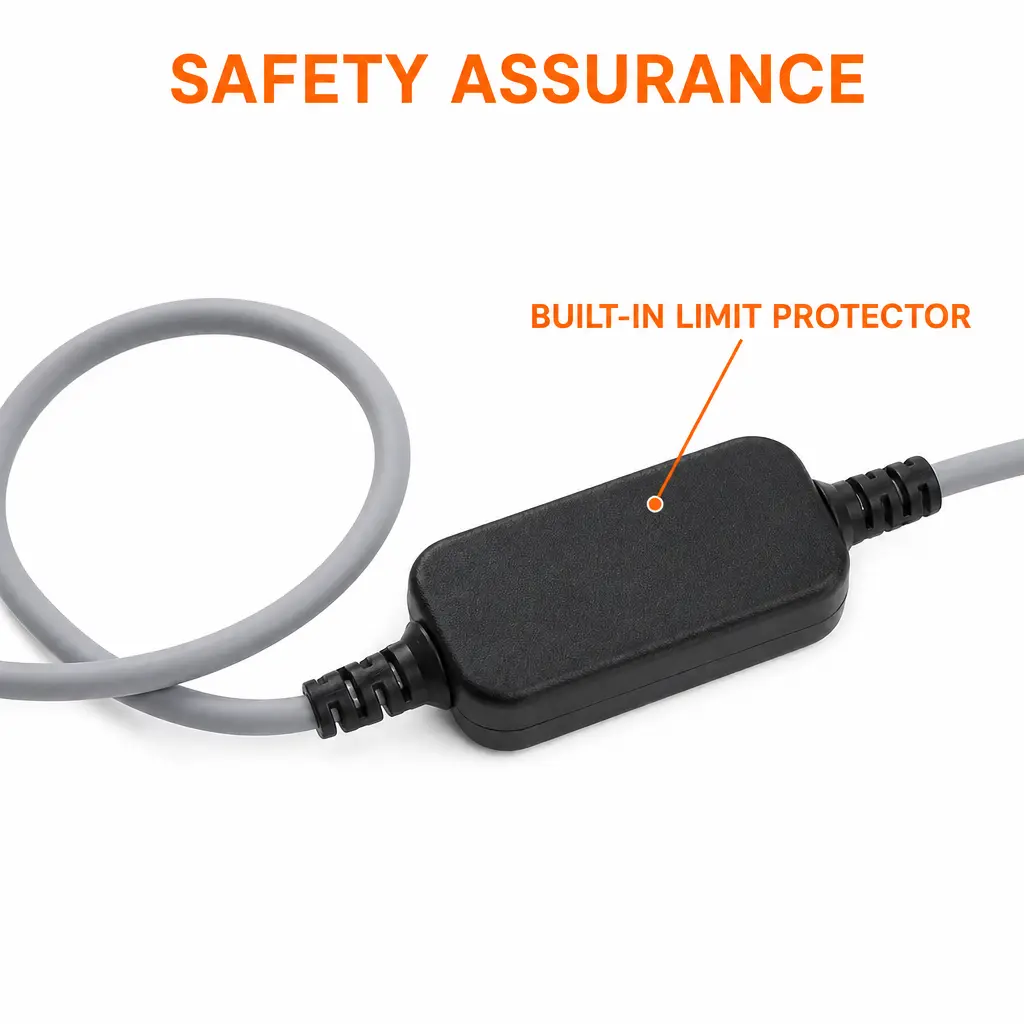
Close-up of built-in limit protector for micro linear actuator, ensuring safety assurance. Industrial detail shot with orange technical annotations on white background.
30 mm Miniature Linear Actuator
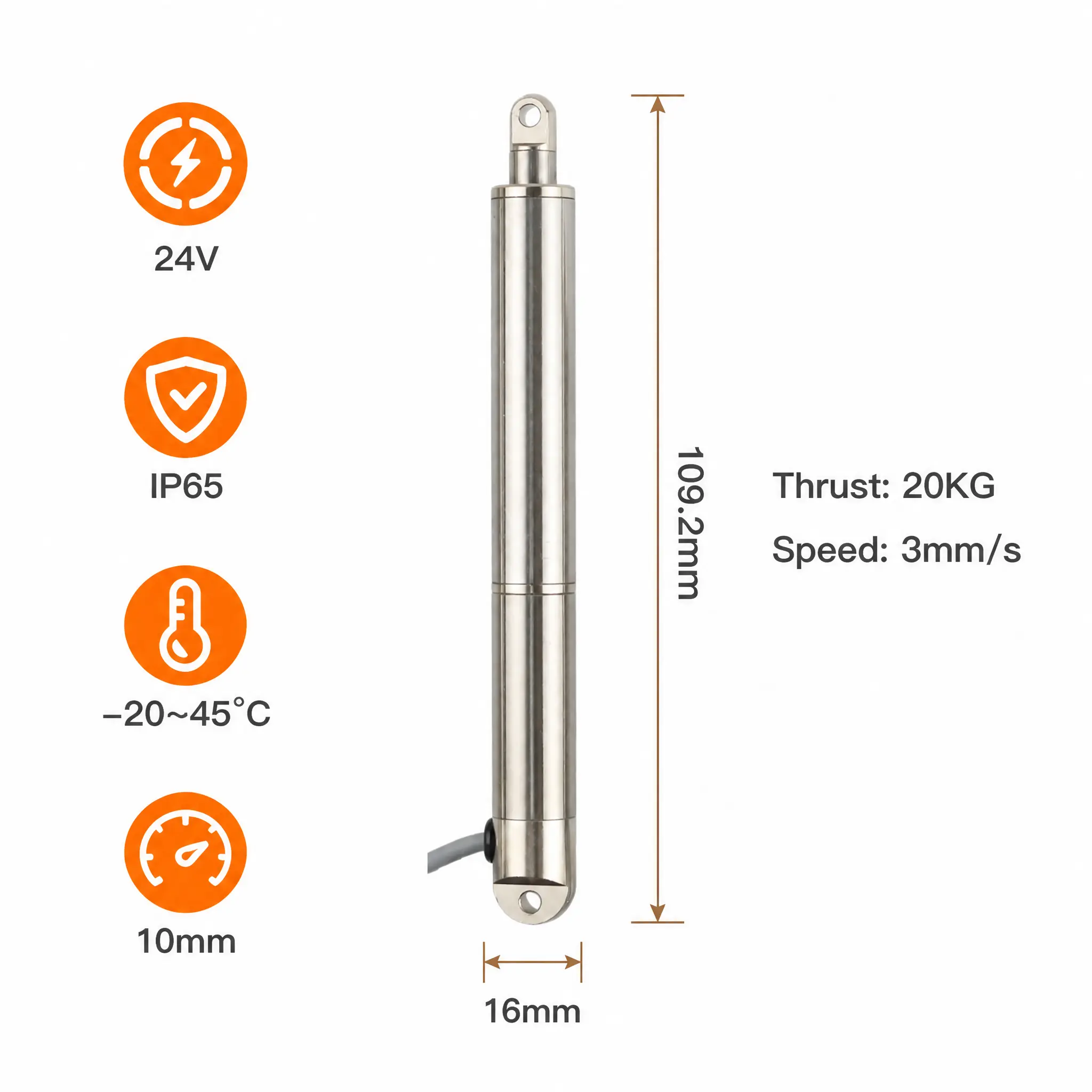
Outer rod :16mm
Inner rod :9mm
Products Description
The 30 mm miniature linear actuator opens and closes a cover that moves a short distance and then has to stay there. It expects the mechanism to carry that cover: a hinge, a slide or a bore takes the weight and the wind, and the extension rod pushes only along its own line. In return it gives auto stop at both ends, a current limit at 0.32 A that ends the stroke when the cover jams on a lead, and a closed position that holds with the cabinet isolated.
Where the opening has to clear a gasket, a filter frame or a bundle of leads, 30 mm is usually the number that works and 20 mm is the number that leaves the cover resting on the seal instead of compressing it. The extra travel adds 10 mm to retracted length. Where the opening only needs a pin to enter a bore, the shorter stroke does the same job in less space.
Technical Parameters
| Item | 30 mm variant |
|---|---|
| Series | KT1609XX, 24 V DC round-body platform |
| Stroke length | 30 mm |
| Standard stroke lengths | 10 / 20 / 30 / 50 / 100 mm |
| Outer diameter | Ø16 mm |
| Extension rod diameter | Ø9 mm |
| Supply voltage | DC 24 V |
| Push force / pull force | 20 kg (200 N) each |
| No-load speed | 3 mm/s |
| Full-load speed | 2 mm/s |
| Self-locking capacity | 300 N, power off |
| Duty cycle | 10% |
| Current limit | 0.32 A |
| End-of-travel protection | Limit protection board outside the tube, auto stop at both ends |
| Retracted / extended length | 129.2 mm / 159.2 mm |
| Body material | 304 stainless steel, copper alloy gear train |
| IP rating | IP65 |
| Operating temperature | −40 °C to +65 °C |
| Noise | Below 60 dB |
| Rated life | 8,000–12,000 cycles |
| Certification | CE, ISO9001 |
Device Fit: Port Cover on an Outdoor Cabinet
A cable entry port cover on an outdoor telecom or roadside cabinet does one thing: it slides clear of the port so the installer can pass the leads through, then comes back and presses the sealing gasket down again. Two positions, a handful of cycles a week, and the cabinet isolated for most of its working life.
- Stroke. The 30 mm is not a round figure. It is the gasket compression, plus the clearance the lead bundle needs, plus a few millimetres so the cover does not scrape the frame on the way out. Take 20 mm and the gasket stays loaded; take 50 mm and the cover reaches the inner wall or the door swing.
- Force. Compressing a gasket and moving a bundle is light work, well inside 200 N. The cover's own weight is the larger load, and that belongs to the hinge.
- Closing. At full-load speed the stroke takes about 15 s. The gasket is compressed gradually instead of being struck, and a lead caught in the gap shows up as current - the board cuts at the current limit of 0.32 A before the lead is cut through.
- Holding. With the cabinet isolated, the gear train holds 300 N and keeps the gasket compressed: no brake, no standby current, nothing to wind down.
- Mounting. A Ø16 mm round body clamps to a cabinet post or a frame member at any point along its length. No pocket to machine, no welded pad, and no change to the sheet metal when the stroke length changes.
- Division of work. The hinge takes the cover weight and the wind load; the extension rod carries axial force only, on the cover's line of travel.
Comparison: The Latch It Replaces
Many cabinets at this size close the port with a quarter-turn latch or two captive screws.
| Point | Quarter-turn latch or captive screws | 30 mm miniature linear actuator |
|---|---|---|
| Who opens it | An installer on site, with a key or a screwdriver | The machine, on command, cover closed |
| Gasket load | Set by hand; over-tightened or left loose | 200 N available at every unit, closed at 2 mm/s |
| Supply off | Stays latched | Stays where it was left, 300 N self-locking |
| Time per open-close | Seconds, by hand | About 15 s at full-load speed |
| Trapped lead | Felt, not measured | Cut at the 0.32 A current limit |
| Cost and wiring | Lowest, no supply | Higher, needs 24 V and a mount |
| Service points | Latch wear, lost keys | Extension rod wipe, seal check, clamp check |
The extra cost and the 24 V supply buy one thing: nobody walks to the cabinet to open or close this cover.
Stroke Selection
| Opening to be cleared | 20 mm | 30 mm | 50 mm |
|---|---|---|---|
| Port cover with a gasket to compress | ✗ | ✓ | △ |
| Filter frame or inspection window (panel thickness) | △ | ✓ | ✓ |
| Pin or bolt entering a bore | ✓ | △ | ✗ |
| Service opening you reach through | ✗ | △ | ✓ |
✓ direct fit △ check the margin ✗ insufficient or over-long
Mounting and Cable Routing
The body is a plain cylinder, so mounting is a clamp decision rather than a machining decision. Three things decide whether the installation stays dry and serviceable.
Clamp position. A tube clamp, a saddle bracket or a bored block will hold the body anywhere along its length; the clamp has to grip without deforming the tube. Leave room beside the tube for the limit protection board and for its lead - it sits outside the shell, not inside it.
Cable exit. The lead leaves the body at the bottom, so water runs off the entry instead of standing in it. Route the lead in a loop below the entry before it turns up into the cabinet, so a drip has somewhere to go other than into the gland.
Lead fixing. Clip the lead so that the cover's travel cannot pull on it, and keep it clear of the hinge and the door swing. A lead pulled tight at full extension works on the exit over time.
Service is a wipe of the exposed extension rod with a dry cloth and a look at the rod seal. Dust carried back and forth across the seal lip, and a cover that leans on the rod, decide seal life more than anything in the housing.
The 10% duty cycle sets the rhythm of the installation: 15 s of travel, then about 2¼ minutes before the next move.
Factory and Certification
Production runs to ISO9001, and every unit is loaded to its rating before packing rather than a sample from the batch. CE documents and the quality certificate sit on the certification page; the rigs used for load and life testing are listed under test equipment. The 6-month limited warranty covers defects in manufacturing and materials.
Related Pages
- 10 mm micro linear actuator - the shortest stroke in the same body
- 20 mm short stroke linear actuator - latch pins and door catches
- 24V tubular linear actuator series - shared data across all five stroke lengths
- Applications - selection by machine type
- Full actuator range - other body diameters and force classes
- Why us and about us - plant, process and warranty terms
- Contact us - drawings, samples and lead time
FAQ
Q: How do I confirm 30 mm is the right stroke length for a port cover?
A: Add three figures: the gasket compression, the clearance the lead bundle needs, and a couple of millimetres so the cover clears the frame on the way out. If the sum lands between 25 and 30 mm, this is the part. Under 20 mm, the 20 mm variant keeps retracted length shorter; over 35 mm, look at the 50 mm.
Q: Is 30 mm one of the standard stroke lengths?
A: Yes. The platform ships in five stroke lengths - 10, 20, 30, 50 and 100 mm - and the unit on this page is the 30 mm one. Retracted length follows the stroke, so choosing between them is choosing how much opening the cover clears.
Q: Will the cover creep back once the cabinet is isolated?
A: No. The gear train stops back-drive at 300 N, so the gasket stays compressed with no current drawn. That is self-locking, not braking - wind gusts and a slammed door belong to the hinge and the cabinet's own end stop.
Q: The gasket pushes back on the cover. Does that eat into the 200 N?
A: It does, and it is small: a compressed gasket returns only a fraction of the closing force. What to check is total resistance at the worst moment - cold gasket, bundle pressed against the frame - and 200 N leaves a wide margin on a port cover.
Q: Does the IP65 rating cover condensation inside the cabinet?
A: No. IP65 is dust and low-pressure jets on the outside; condensation forms on the inside of the enclosure and is a cabinet ventilation question, not a seal question. Keep the exit at the low point and let the cabinet's breather do its job.
Q: Fifteen seconds per stroke is slow. Does it matter here?
A: On a port cover, no. The cover moves while the installer is working, and the slow close is what stops the gasket being cut. If a cover has to open inside two seconds, this platform will not do it, and more force will not change that.
Q: How many cycles will one unit give at 20 cycles a day?
A: The 8,000–12,000 cycle rating is measured at rated load and room temperature; at 20 cycles a day, busy for a port cover, that band arrives in roughly 13 to 20 months. Dust on the extension rod and a cover that leans on the rod move the real number down, so wipe the rod at each service visit.
Quotation Details
Stroke length · quantity · cycles per day · mounting space and cover weight · ambient conditions at the cabinet.
Hot Tags: 30 mm miniature linear actuator, China 30 mm miniature linear actuator manufacturers, suppliers, factory, 18 inch linear actuator, adjustable linear actuator, battery powered linear actuator, hygienic linear actuator, linear actuator mounting, motorized linear slide
You Might Also Like



Send Inquiry