

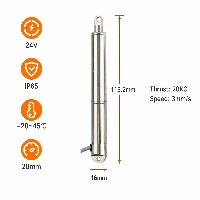
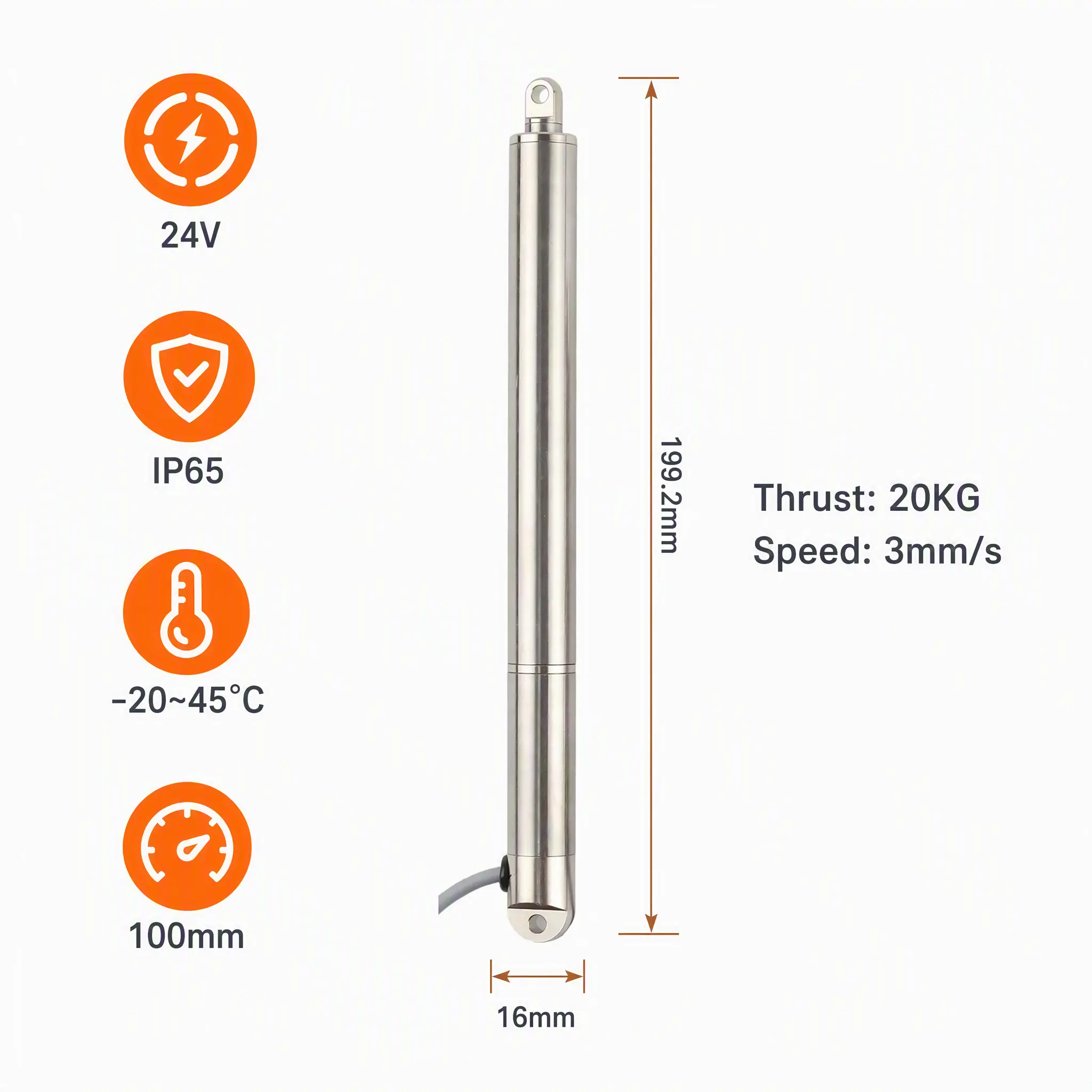

Small Linear Actuator 100 mm Stroke
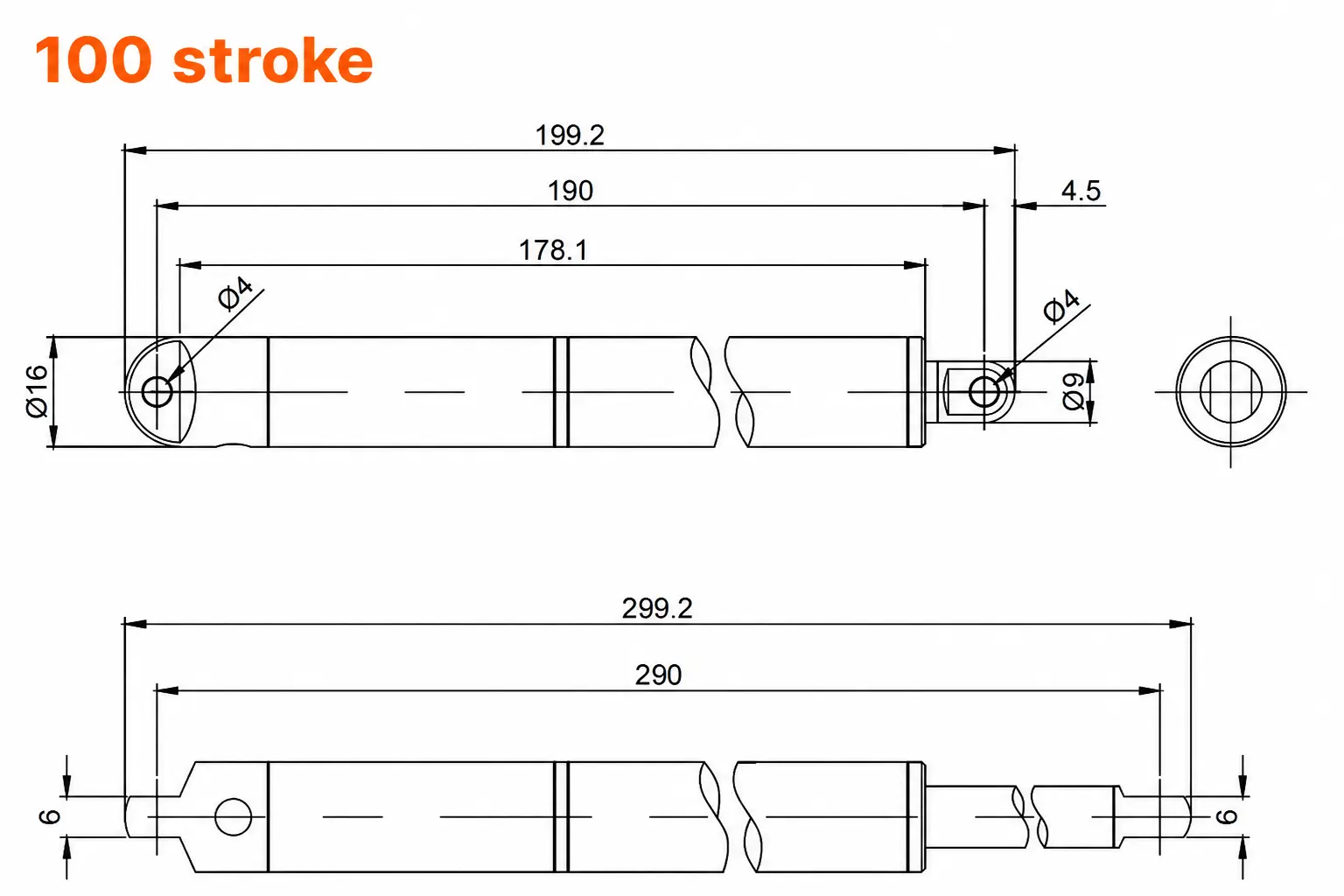
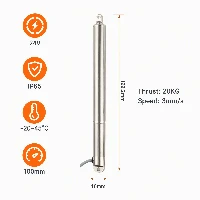
100mm Stroke Long Micro Linear Actuator Dimension Chart, OEM Custom Stroke Electric Linear Motor
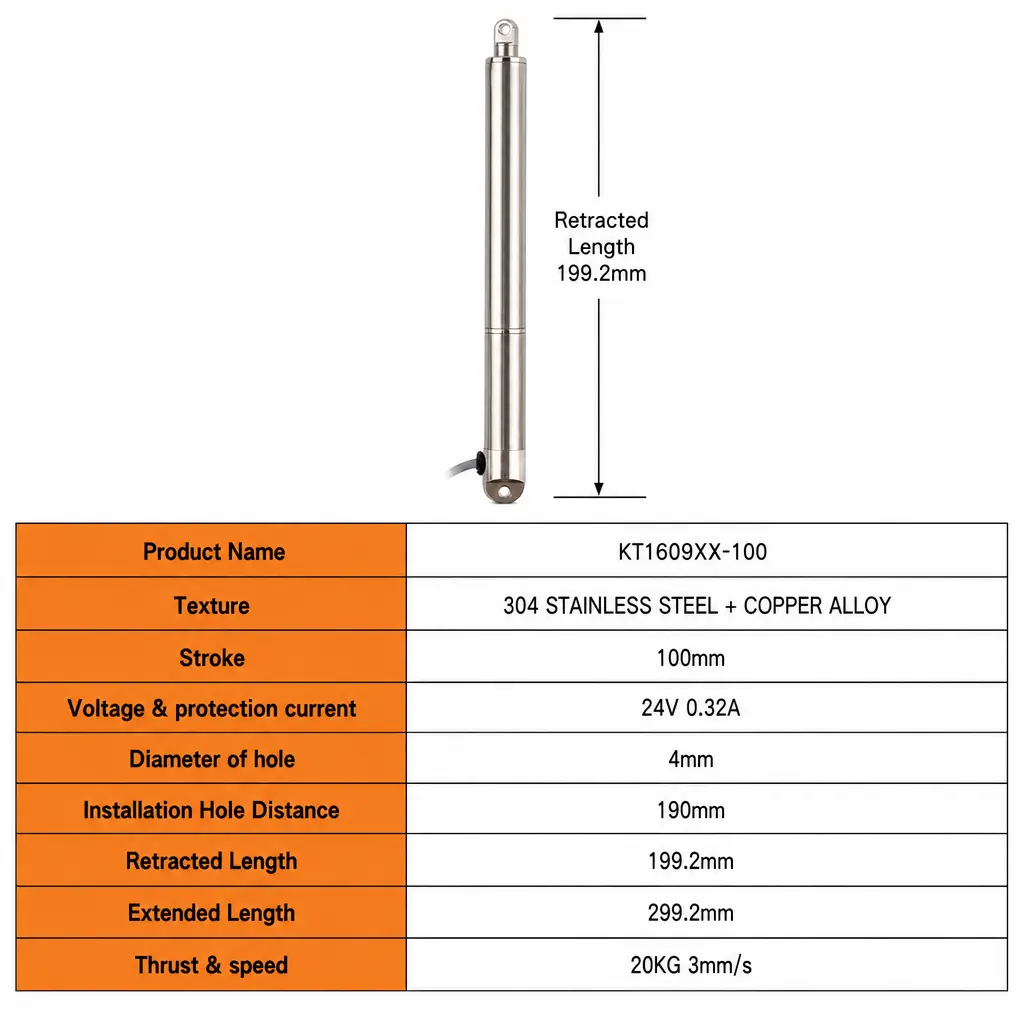
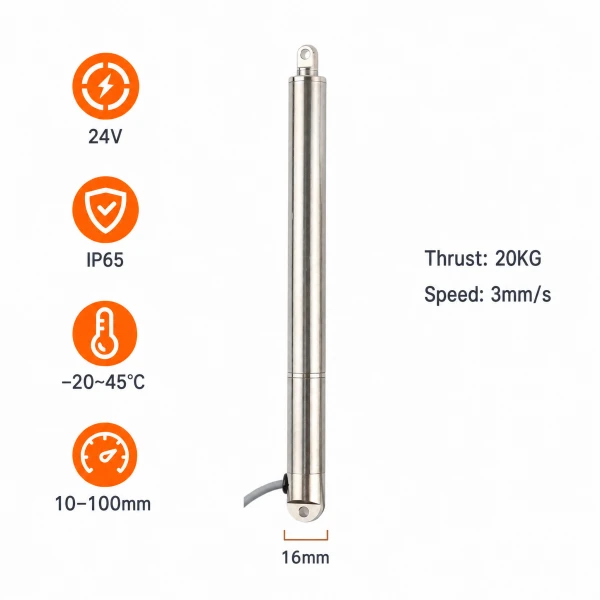
KT1609XX-100 Micro Linear Actuator 100mm Stroke 24V DC 199.2mm Retracted Length 304 Stainless Steel Electric Cylinder 20KG Thrust
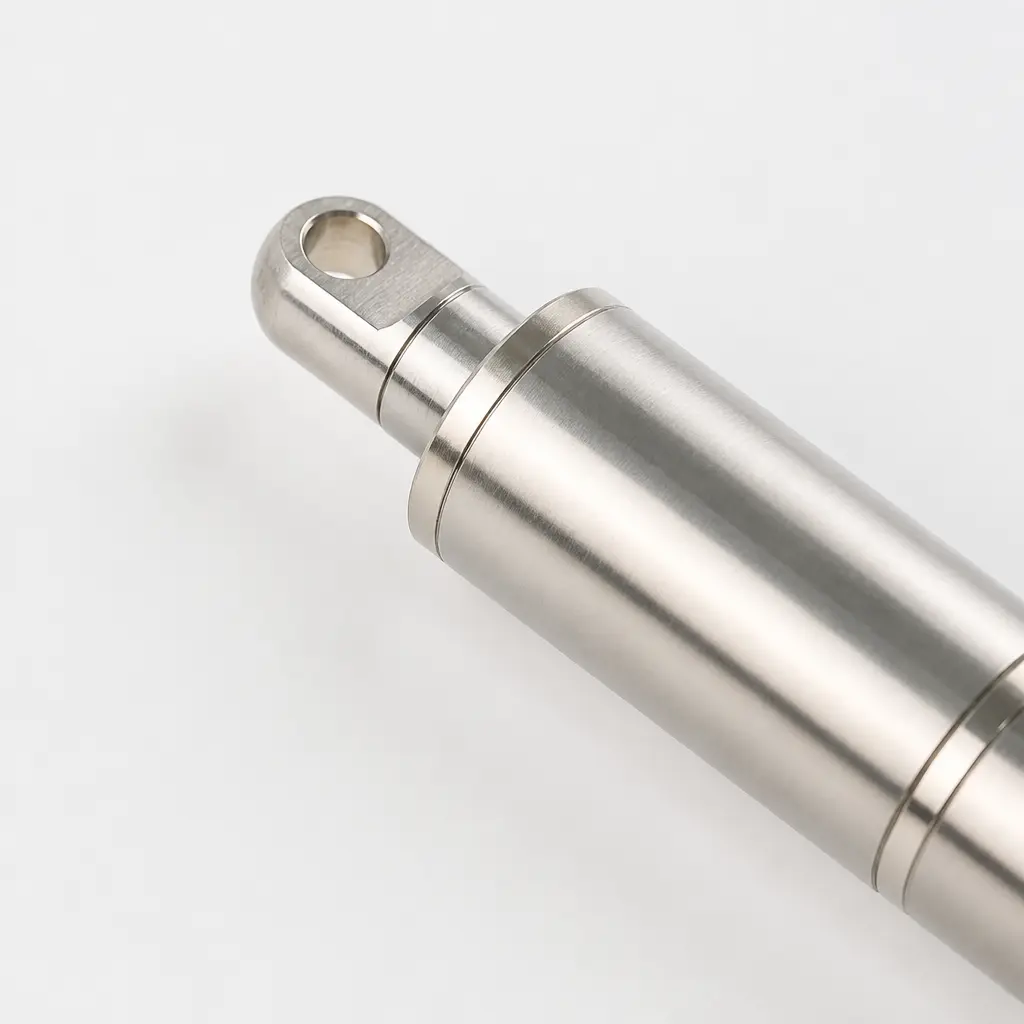
Close-up of durable stainless steel micro linear actuator rod and precision mounting hole showing metallic texture.
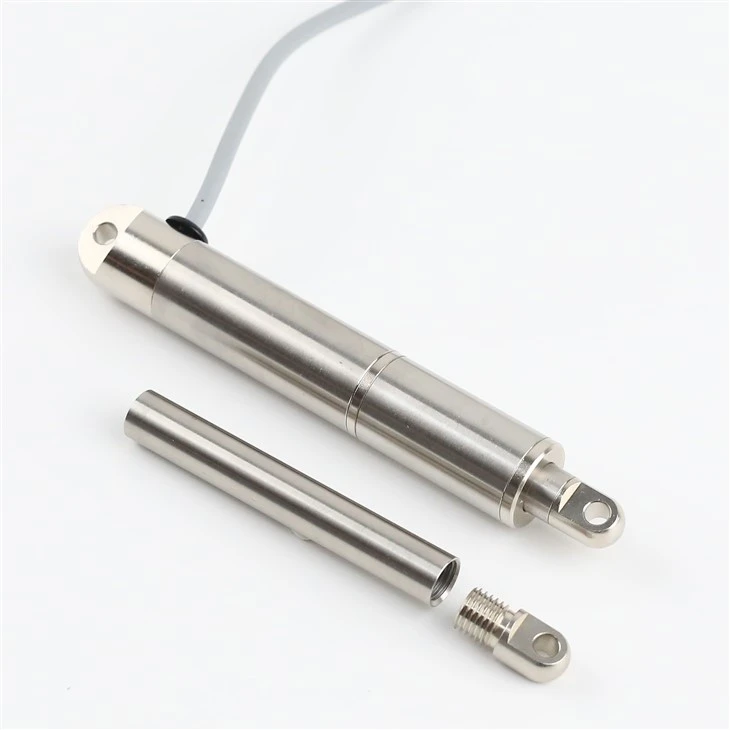
Disassembled micro linear actuator with threaded stainless steel end cap and hollow tube construction
Small Linear Actuator 100 mm Stroke
Products Description
The small linear actuator 100 mm stroke is chosen where the movement is an access movement, not an indexing one. A panel has to clear gasket compression, the overlap behind the weather hood and its own keyhole slots before a technician can reach the terminals - 70 to 95 mm in most cabinets. At 50 mm the slots are still engaged and the last 40 mm is lifted by hand, which is the motion the actuator was fitted to remove.
In place it does that travel without an air line, a brake or a standby draw. Panel weight stays with the hinge; the rod presses the gasket back into contact, breaks the panel off a gasket that has taken a set, and starts the lift. The tube sits behind the same skin as the terminals, and the pace is set for a panel opened a few times a shift rather than for a production cycle.
Product Features
- 100 mm service travel - gasket, hood overlap and keyhole slots cleared in one pass, with no second lift by hand.
- 200 N push and pull - an 8–12 kg panel needs 90–150 N to start, so the margin covers a stiff foam gasket.
- 300 N self-locking - the copper alloy gear train holds with the supply off, at no standby current. A static hold, not a prop.
- 2 mm/s under load - 100 mm in about 50 seconds; 3 mm/s unloaded returns in about 33.
- Ø16 mm 304 stainless tube - clamps at any point on its outside diameter, with no coating edge to chip.
- IP65 - one circular seal at each end and a wiped rod, with no bellows to tear.
- −40 °C to +65 °C - shares the compartment with the terminals; condensation is the condition that matters.
- 10% duty, 0.32 A limit - two openings a day sit far inside the rating, and a jam cuts before the winding heats.
Technical Parameters
| Item | 100 mm variant |
|---|---|
| Series | KT1609XX, 24 V DC round-body platform |
| Stroke length | 100 mm |
| Standard stroke range | 10 / 20 / 30 / 50 / 100 mm |
| Body outer diameter | Ø16 mm |
| Rod diameter | Ø9 mm |
| Supply voltage | DC 24 V |
| Push force / pull force | 20 kg (200 N) each |
| No-load speed | 3 mm/s |
| Full-load speed | 2 mm/s |
| Travel time over 100 mm | About 50 s on load, about 33 s unloaded |
| Self-locking capacity, supply off | 300 N static |
| Duty cycle | 10% |
| Current limit | 0.32 A |
| End-of-travel protection | Limit protection board outside the tube, auto-stop at both ends |
| Housing | 304 stainless steel tube |
| Gear train | Copper alloy |
| Ingress protection | IP65 |
| Operating temperature | −40 °C to +65 °C |
| Noise | Below 60 dB |
| Rated life | 8,000–12,000 cycles |
| Certification | CE, ISO9001 |
Device Fit: Charger Front Service Panel
A front service panel on a DC fast charger or a battery energy storage cabinet is a flat pressing with a gasket round its edge, two keyhole slots at the top and two quarter-turn fasteners at the bottom. Release the fasteners and the panel lifts until the slot heads clear; it then hangs forward on the slots, or comes off onto its hooks. The lift is the only driven part of that sequence, and it breaks into four components:
| Part of the travel | Range | What sets it |
|---|---|---|
| Compressing the gasket to seal | 6–10 mm | Gasket section and how much the panel can deflect |
| Clearing the hood or frame lip | 25–40 mm | How deep the panel sits behind the weather hood |
| Lifting the keyhole slot off its head | 20–35 mm | Slot length minus head diameter |
| Margin at the open end | 10–15 mm | So the panel is not riding the end stop every cycle |
The four add up to 61–100 mm, 70–95 on a typical cabinet. This is why the stroke exists in the series: a 50 mm variant seals and clears the lip but leaves the slots engaged, so the last 40 mm stays manual.
Two checks before the stroke is fixed. Force: a 9 kg panel with its centre of gravity 250 mm from the top hinge, driven 200 mm from it, asks for about 110 N at the start of the lift, and 200 N leaves margin for gasket breakout and slot friction. Guidance: the slots and the hinge have to keep the lift straight, because the rod pushes on one line and a panel that racks sideways loads the front bearing on a direction it was not sized for.
Supply and Duty at the Cabinet
Two numbers decide whether anything upstream has to change. Current draw stays under the 0.32 A cut-off, so a 24 V rail sees less than 8 W from the actuator - it can share the supply that already runs the controller, the meter or the door lock, without a dedicated converter. Duty is the other: 10% means 50 seconds of travel, then at least seven and a half minutes at rest. Two openings a day is 100 seconds of running time in 24 hours, against a rating that allows 10% of any window. The figure only starts to matter when a unit is cycled continuously on a test bench.
The closing sequence deserves the same attention as the opening one. Size the stroke so the panel meets its frame a few millimetres before the rod reaches the end of travel. The gasket is then compressed by the last part of the stroke and the board stops the rod on position. Size it long and the panel hits the frame early every cycle, the current climbs into the limit and the board ends the stroke on current instead - a gasket that is over-compressed and a board that works harder than it should. Size it short and the gasket never seals.
Installed Length at 100 mm
Travel and installed length move together on this platform: the body adds a fixed 99.2 mm to the stroke. That puts the 100 mm variant at 199.2 mm retracted and 299.2 mm extended, 70 mm longer at both ends than the 30 mm build (129.2 / 159.2 mm). Confirm on the 100 mm drawing before a pocket or bracket is cut.
Seventy millimetres is the price of the longest stroke, and where it goes decides whether the panel can stay as it is:
| Option | What it does | What to check |
|---|---|---|
| Mount the body in the plinth | Uses the space below the panel line that no one else wants | Floor clearance, standing water, and the lead exit pointing down |
| Offset bracket under the hood | Steps the tube back so the panel line stays unchanged | Bracket stiffness, and whether the panel still swings past it |
| Mount the body on the panel, rod to the frame | The tube travels with the panel, so the space is needed outside the cabinet | Lead flex and bend radius at every cycle |
| Reduce travel with a lever | A 2:1 arm halves the stroke and doubles the force demand | Whether the linkage has room and whether side load has somewhere to go |
Before choosing, measure the space the panel occupies when it is open, not when it is closed. On most cabinets the closed envelope is generous and the open one is where the tube and its lead collide with a door, a cable tray or the technician's forearm.
Model Selection
| Movement to be made | 30 mm | 50 mm | 100 mm |
|---|---|---|---|
| Panel lifted until its keyhole slots release | ✗ | △ | ✓ |
| Cover clearing a hood or lip before it swings | △ | △ | ✓ |
| Two-stage lift before a swing | ✗ | ✗ | ✓ |
| Locking pin entering a bore | ✓ | △ | ✗ |
| Flap with two positions and no access need | ✓ | △ | ✗ |
✓ fits as drawn △ confirm the margin ✗ travel short or excessive
Factory and Certification
The plant works to ISO9001. Each unit is loaded to its rated force before it is boxed - there is no sample-based release, so a unit that fails never reaches a carton. CE and RoHS paperwork and the quality certificate sit on the certification page; the load and life rigs behind those figures are shown under testing equipment; the plant itself is described under about us and why us. Warranty is six months and covers manufacturing and material defects only. For other body diameters, supply voltages and force classes, see the full actuator range; for selection by machine type, see applications.
frequently answer question
Q: Does the 200 N rating hold at full extension?
A: Yes. The force is rated across the whole stroke, not at the retracted end. A Ø9 mm rod out 100 mm is well inside the length where buckling starts, so the figure does not taper off as the panel rises.
Q: Where does the 300 N self-locking come from, and does it fade?
A: From the friction angle of the copper alloy gear train, so there is no friction disc to wear out or adjust. It is a static rating measured with the supply off: impact loads and a person leaning on the panel sit outside it.
Q: How loud is it inside a cabinet?
A: Below 60 dB at the unit. A large flat panel can turn that into a boom, so put the clamp on a rib or a stiffened area instead of mid-span, and keep it tight.
Quotation Details
Please include:
- Stroke length and quantity
- Panel or cover weight, and the lift it has to make
- Cycles per day, and how long the panel stays open
- Ambient conditions at the cabinet: dust, water, temperature range
- The space available for the retracted unit and for the lead exit
Hot Tags: small linear actuator 100 mm stroke, China small linear actuator 100 mm stroke manufacturers, suppliers, factory, 1 ton linear actuator, actuator ball screw, chain driven linear actuator, diy tv lift linear actuator, linear actuator with force feedback, variable speed linear actuator
Previous
No InformationYou Might Also Like


Send Inquiry