




24V Tubular Linear Actuator
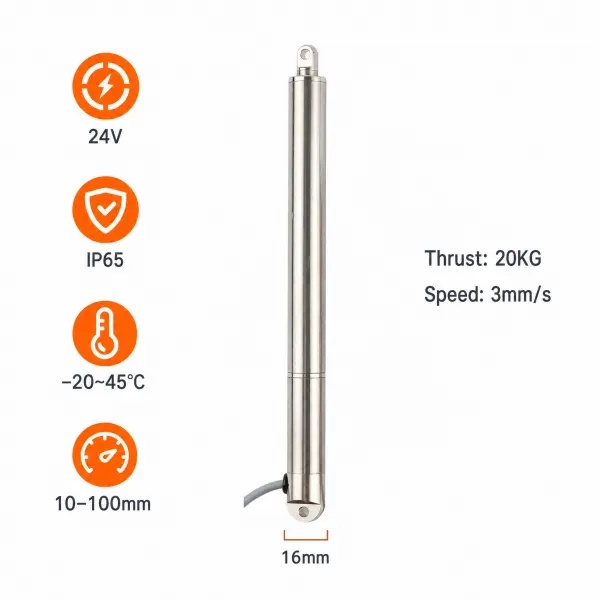
Trust:20kg/200N
Stroke:10 / 20 / 30 / 50 / 100 mm
Self-locking:30kg/300N
Voltage:24V
Product Description
The 24V tubular linear actuator is specified where a part has to move a short distance inside a machine that is already built, and stay there once the supply is removed: a lane stop on a sorter, a port cover on a roadside cabinet, an access lid on a machine frame. The load belongs to a hinge or a slide, so the rod only pushes and pulls along its own axis.
3 mm/s is deliberate. The part arrives without overshoot, stops where it was sent, and the gear train holds it at 300 N on a machine that has been switched off. Where the body has to live inside a frame tube, behind a cabinet skin or through a bulkhead, the round section is the shape that needs no change to the structure around it.
Technical Parameters
|
Item |
Specification |
|
Series |
KT1609XX tubular linear actuator |
|
Body outer diameter |
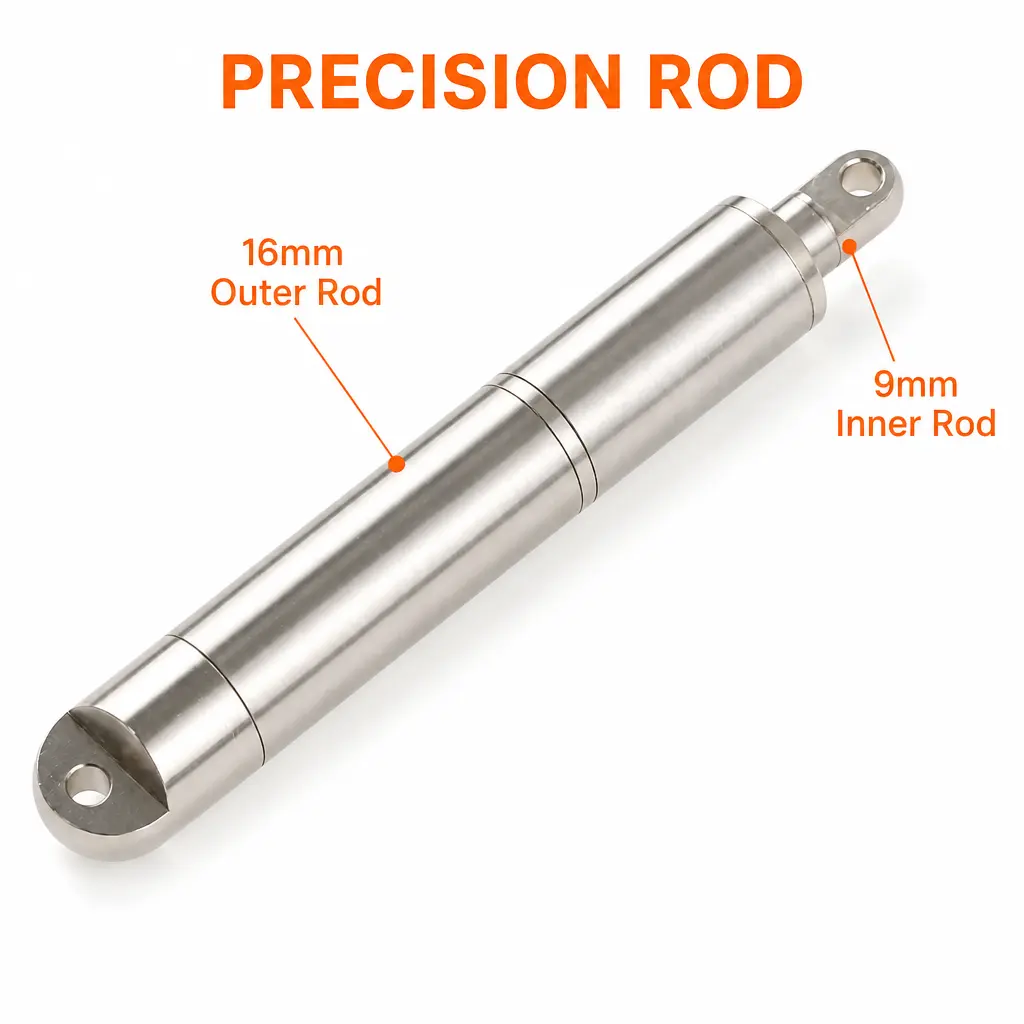
16 mm |
|
Rod diameter |
9 mm |
|
Input voltage |
DC 24 V |
|
Rated load (push / pull) |
20 kg (200 N) |
|
Static self-locking force |
300 N |
|
No-load speed |
3 mm/s |
|
Standard strokes |
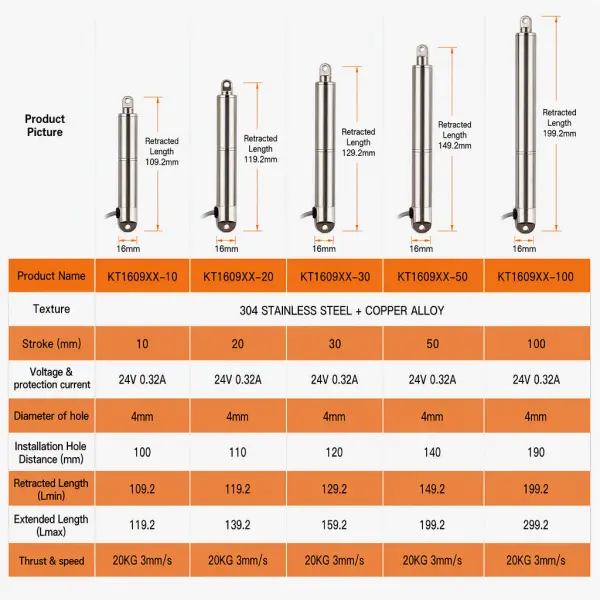
10 / 20 / 30 / 50 / 100 mm |
|
End-of-travel protection |
External limit protection board, auto-stop at both ends |
|
Overcurrent threshold |
0.32 A |
|
Housing material |
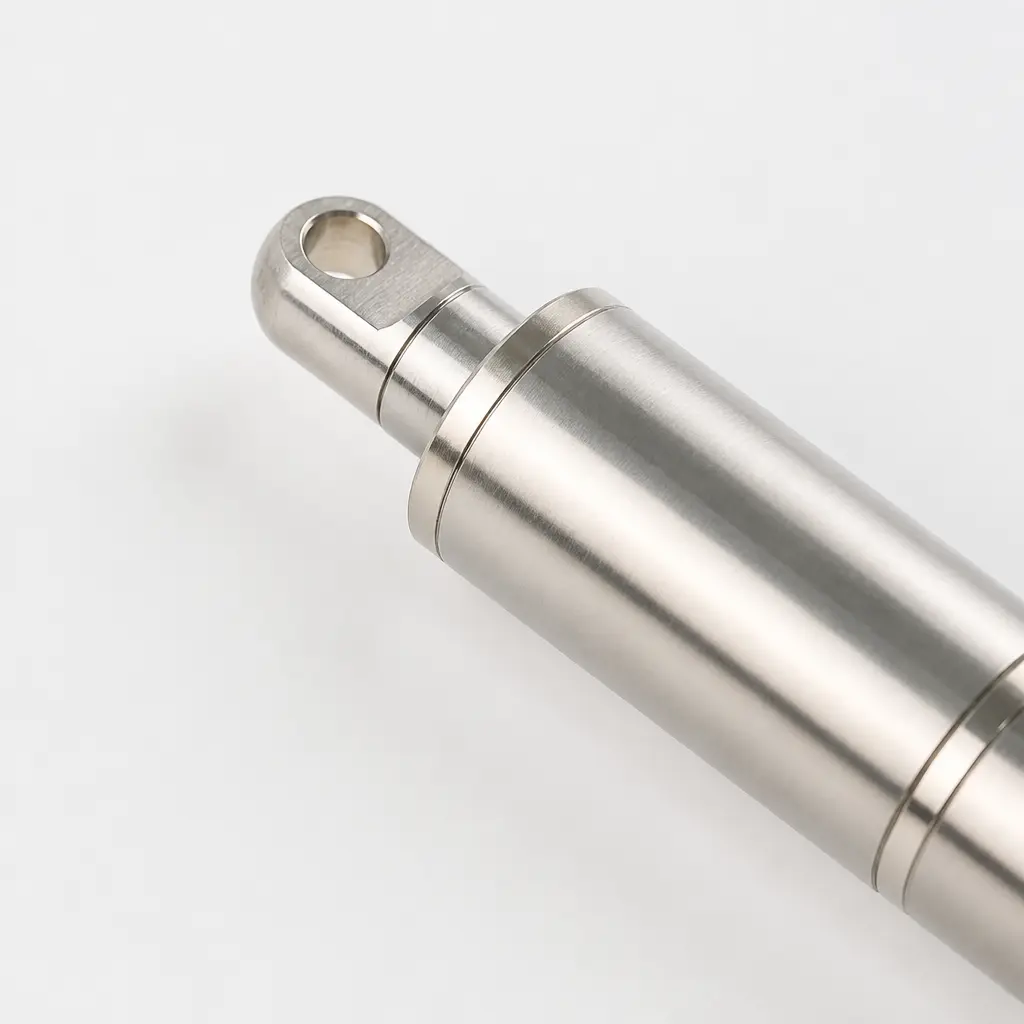
304 stainless steel |
|
Ingress protection |
IP65 |
|
Operating temperature |
-40 °C to +65 °C |
|
Noise level |
Below 60 dB |
|
Rated life |
8,000-12,000 cycles |
|
Certification |
CE, ISO9001 |
What the Tubular Form Factor Changes
- The housing is a round tube, not a folded plate enclosure. Four consequences follow, and each one decides whether this body fits the mechanism.
- Envelope. A 16 mm round body passes through a bore, a tube clamp, a drilled bulkhead or the inside of a linkage. A rectangular housing of the same face width will not, because it needs clearance at four corners. Inside a cylindrical guard, a handle tube or a truss member, the round section is usually the only shape that fits without remachining the frame.
- Sealing. One circular joint at each end, one concentric rod seal at the front. The sealing path is a single loop instead of four corners and a lid gasket, which is why this shell holds IP65 without a bellows.
- Load. The rod is built for concentric pull. Side load lands on the rod and the front bearing, not on a frame, so the machine has to guide the load: a flap on its hinge, a hatch on its pivot, a slide on its rail. No guidance, no long life.
- Mounting. A plain cylinder clamps anywhere along its length and re-clamps after a service swap without a machined pocket. All five strokes share the diameter, the clamp and the footprint; only travel and installed length change.
|
Criterion |
Tubular (KT1609XX) |
Box-frame actuator |
Rod with separate guide |
|
Fits a round bore, tube clamp or narrow channel |
✓ |
✗ |
△ |
|
Sealing path |
✓ |
△ |
✗ |
|
Side-load tolerance without external guidance |
△ |
✓ |
✓ |
|
Mounting without a machined pocket |
✓ |
△ |
△ |
|
One body diameter across the full stroke range |
✓ |
✗ |
✗ |
|
Access for inspection of the rod seal |
✓ |
△ |
✓ |
✓ good fit △ workable with design care ✗ poor fit
Construction, Sealing and End-of-Travel Protection
- The body is 304 stainless steel, not coated steel or aluminium extrusion. Two moments matter. Cleaning: it takes the same agents as the machine frame, and there is no paint edge to chip and start corrosion. Condensate: units in chilled cabinets, vented enclosures or glazed facade frames collect standing water, and bare austenitic steel tolerates that where a coating blisters.
- Internally the gear train is copper alloy. Metal teeth keep their profile under repeated load and do not creep when the unit is parked under static load for months.
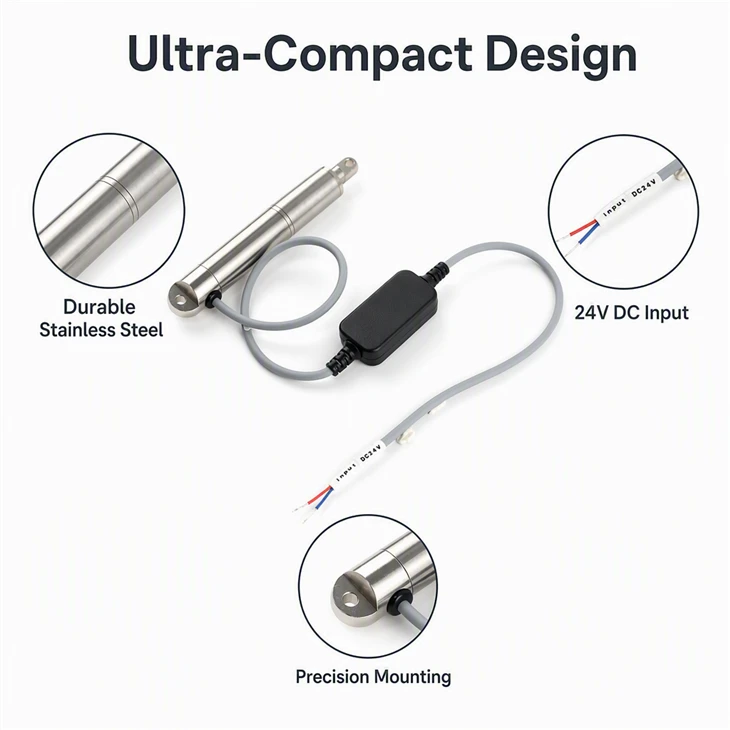
- Protection sits on a board outside the tube. It stops the rod at both ends of travel, so the stroke does not depend on external stops. It also cuts power at 0.32 A when current climbs because the mechanism has jammed. That is what protects the motor: a stalled DC motor turns electrical energy into heat in the winding before anything mechanical fails. A jammed flap, a hatch frozen shut or a slide packed with debris all show up as current.
- IP65 covers dust and low-pressure water jets, not immersion, and not sustained high-pressure or solvent washdown, which attacks the rod seal rather than the shell. The seal is the weakest part: grit carried past the wiper and side load that deflects the rod both shorten it. Service life follows rod cleanliness and load alignment, not wall thickness.
- The 8,000-12,000 cycles are rated-condition figures. Three variables pull them down: how much of the load is concentric, how continuous the cycling is, and the air temperature inside the enclosure.
What 300 N of Self-Locking Force Does
- With the power off, the gear train holds 300 N. That is what keeps a cover, flap or hatch where it was left, with no brake and no standby current.
- Three practical results. A battery-powered system does not spend capacity keeping a cover shut. A power cut leaves the mechanism where it was, not open. Holding costs no wear, because nothing turns.
- 300 N resists steady back-driving. It is not a brake: impact and shock belong to the mechanism stop, not to the gear train.
Application Scenarios

Window and Vent Automation
Smart factory exhaust windows, automatic basement vent covers, and Luxury Yacht Ventilation Windows.

Airflow Control Systems
Large-scale HVAC dampers, laboratory precision airflow distribution doors, and industrial exhaust baffles.

Smart Building Projects
Remote-controlled high-altitude airtight windows and motorized deployment for vertical curtain wall decorative elements.
Stroke Selection Across the Series
All five variants share the 16 mm body, the 24 V DC drive, the 20 kg rating and the 3 mm/s speed. Travel is the only variable in the part number, and five machine types account for most of what ships.
- 10 mm - Micro Linear Actuator 10 mm: lane stops and diverter gates on parcel sorters, flap doors on packaging machines. Short throw, high cycle count, two end positions.
- 20 mm - Mini Linear Actuator: latch pins and door catches on battery swap cabinets and pack housings, where the position has to hold with the cabinet unpowered.
- 30 mm - Compact Linear Actuator: cable-port covers and inspection windows on roadside and telecom cabinets, where dust and jet wash drive the design.
- 50 mm - Micro Linear Actuator 50 mm: access covers on agricultural and construction machinery, held closed against vibration and washed down at the end of a shift.
- 100 mm - Small Linear Actuator 100 mm: service doors on energy storage cabinets and charging units, where the door has to swing clear before the panel comes out.
Set the stroke from the movement the mechanism needs plus a small overlap at each end, not from the space left in the frame: extra stroke adds installed length and cost, not capability.
Each variant carries its own specification page: Micro Linear Actuator 10 mm, Mini Linear Actuator, Compact Linear Actuator, Micro Linear Actuator 50 mm and Small Linear Actuator 100 mm. The platform sits inside the wider electric linear actuator range, alongside other body diameters, voltages and force classes.
Quality System, Compliance and Warranty
Production runs under ISO9001, and full-load testing covers every unit, not a sample, so nothing ships without having been loaded to its rating. CE and RoHS documentation is kept on the certification page. The 6-month limited warranty covers manufacturing and material defects; the ISO9001 quality system and the test equipment behind it are documented on their own pages, and the full actuator range shows where this body lands against other diameters and force classes.
Frequently Asked Questions
Q: How is a tubular linear actuator different from a box-frame actuator?
A: The housing is a round stainless tube rather than a folded enclosure. It fits round bores and tube clamps, seals with a single circular joint instead of four corners, and holds one body diameter across all five strokes. It carries less side load than a box frame, so the machine should guide the load.
Q: Is IP65 enough for an outdoor installation?
A: IP65 covers dust and low-pressure water jets, so a sheltered outdoor position - under a canopy, inside a housing, behind a facade - is within scope. Direct rain driven at pressure, immersion and solvent washdown are outside it.
Q: What does the 300 N self-locking force actually hold?
A: It is a static hold. With power removed, the gear train resists back-driving, so a flap, hatch or cover stays where it was left. It is not a dynamic brake: shock loads, vibration and impact should be taken by a mechanical stop in the mechanism.
Q: Why is the no-load speed only 3 mm/s?
A: The platform trades speed for force and resolution. At 3 mm/s, travel time grows with stroke. Work that needs fast cycling belongs on a faster platform, not on this one.
Q: What happens when the mechanism jams?
A: Current rises and the protection board cuts power at 0.32 A, which protects the motor winding. The same board auto-stops the rod at both ends of travel, so external stops are not what ends the stroke.
Q: How should the 8,000-12,000 cycle rating be read?
A: It is a rated-condition figure. Concentric load, a clean rod, correct alignment and intermittent duty keep a unit inside it; side load, grit and continuous cycling move the real number down.
Q: What mounting does the 16 mm body need?
A: A clamp block, a saddle bracket or a bored tube clamp will hold it, because the body is a plain cylinder. Two rules apply: the clamp must grip the tube without crushing it, and the rod end must sit on the load line.
Q: How much noise does it make in a quiet installation?
A: The series is rated below 60 dB. In service, gear train noise is only part of what a user hears: the bracket and the panel the body is clamped to decide whether the sound is transmitted or damped. A compliant mount and a stiff, non-resonant bracket usually do more for perceived noise than the motor itself.
Hot Tags: 24v tubular linear actuator, China 24v tubular linear actuator manufacturers, suppliers, factory, 6v linear actuator, analog linear actuator, backdrivable linear actuator, linear actuator systems, linear actuator working, telescoping linear actuator
Previous
No InformationYou Might Also Like


Send Inquiry