





24 Volt Actuator
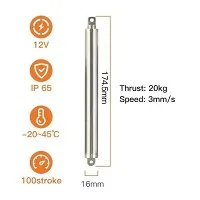
Stroke: 100mm (customizable)
Total length: 174mm
Push-pull force: 20N
No-load push-pull speed: 25mm/s
Protection current: 0.32A
Rated voltage: 24V (or 12V)
Noise: ≤60dB
Protection level: IP56
Product Introduction
24 volt linear actuator pairs a 16 mm 304 stainless steel outer tube with an all-metal screw drive. This configuration is built with a 100 mm stroke and reaches a no-load speed of up to 25 mm/s, in an IP56 sealed housing that resists dust and splashing water. In the standard 2 mm-lead configuration the static self-locking force is greater than twice the unit's rated thrust instead of trading that holding capacity away for speed, which is what keeps the arm in position overnight without an added brake.
Product Parameters
| Parameter | Specification |
|---|---|
| Rated Voltage | 24V DC standard; 12V DC available |
| Rated Thrust | 2 kg (20 N) |
| Stroke | 100 mm (this page's configuration); other strokes from 10 mm to 150 mm on request |
| Lead Screw Lead | 2 mm (standard) / 4 mm (high-speed option) |
| No-Load Speed | Up to 25 mm/s (standard) / up to 50 mm/s (high-speed option) |
| Static Self-Locking | Greater than 2× the rated thrust |
| Protection Current | 0.32 A |
| Noise | < 60 dB |
| Ingress Protection | IP56 |
| Outer Tube | 16 mm outer tube diameter / 10 mm rod diameter |
| Operating Temperature | -45°C to +60°C |
| Duty Cycle | Intermittent, approx. 10% duty cycle |
| Core Materials | 304 stainless steel housing + copper alloy drive components |
| Limit Protection | External limit protection board |
Product Details


Customization Options
Rated voltage - 24V DC standard, 12V DC on request
Stroke length - 100 mm on this configuration; other strokes from 10 mm to 150 mm on request
Lead screw lead - 2 mm standard, 4 mm for higher speed
Lead wire length and connector type, for routing along the tracker frame
Thread and mounting structure
End fitting shape, to match the arm and bracket pins
External limit protection board
Thrust rating matched to the panel area, arm length and wind load
Standard 25 mm/s vs High-Speed 50 mm/s: Which Configuration Fits the Arm
Both configurations use the same 16 mm KT1610 body, the same 304 stainless steel and copper alloy drivetrain, the same IP56 sealing and the same external limit protection board. The difference is the lead of the lead screw, and it changes the speed/holding balance:
| Parameter | Standard (2 mm lead) | High-speed (4 mm lead) |
|---|---|---|
| No-load speed | Up to 25 mm/s | Up to 50 mm/s |
That is the whole specification difference - the high-speed version is the same unit with a 4 mm lead screw instead of 2 mm, so it covers the same 100 mm stroke in half the time.
Both are good choices; the decision is about how the arm is driven in your control sequence:
Choose the standard 25 mm/s version when the stroke time is short compared with the interval between moves - the usual case for a tilt arm that steps through the day at a comfortable pace, and it keeps the widest margin between movements.
Choose the high-speed 50 mm/s version when the arm has to reach its next angle quickly: longer arms with more travel per move, or a control sequence that steps the panel often enough that stroke time starts to decide how much of the day is tracked. The same travel, in half the time.
Either way, check the duty cycle. The KT1610 is rated for intermittent operation (approximately 10% duty cycle), so pause time between movements is part of the control sequence.
The measured performance curves for both variants, the materials analysis and the thermal envelope are documented in the KT1610 engineering audit.
Certifications, Testing Equipment and Warranty
Every unit comes with documentation a purchasing or audit team can check: CE and RoHS conformity, an ISO 9001 quality system and more than 30 national patents are published on the certifications page, and each production batch is verified on the six in-house test stations shown on the testing equipment page. Units are built in our own Xiamen factory and supplied factory-direct, from one piece, with a 6-month warranty against manufacturing defects - see why KABASI.
Our Advantages
Digitalized Smart Factory
We promote the integration of digitalization and intelligentization, achieving digital control over the entire production, management, and quality process.
Advanced Production Equipment
We have introduced modern equipment such as Swiss-made lathes, electric press machines, and RoHS analyzers to ensure production precision and efficiency.
Strong Independent R&D Capabilities
We have a professional design and R&D team, continuously launching innovative miniature electric linear actuators and electric actuator products.
Extensive International Market Coverage
Our products are sold to more than 60 countries and regions worldwide, and we have established a stable international cooperation network.
Frequently Asked Questions
Q: What is the working principle of the 24-volt actuator?
A: It uses a DC motor to drive a screw, converting electrical energy into linear thrust to control the extension and retraction of mechanical components.
Q: What are the materials used?
A: The main body is made of 304 stainless steel, and the internal gears are made of copper alloy, which is wear-resistant and corrosion-resistant.
Q: Is installation easy?
A: Yes. It uses a standard interface structure, supports multi-angle installation, and is easy to install.
Q: Does it support customization?
A: Yes. It supports customization of stroke, thrust, cable length, and interface type.
Q: What are some common applications?
A: Widely used in mechanical equipment, medical devices, smart homes, and new energy systems.
Hot Tags: 24 volt actuator, China 24 volt actuator manufacturers, suppliers, factory, 1 ton linear actuator, acme screw linear actuator, hydraulic piston actuator, adjustable linear actuator, servo ball screw actuator, industrial linear actuator
Previous
Compact 12V Linear ActuatorNext
Actuator 24VYou Might Also Like



Send Inquiry