





12 Volt Dc Actuator
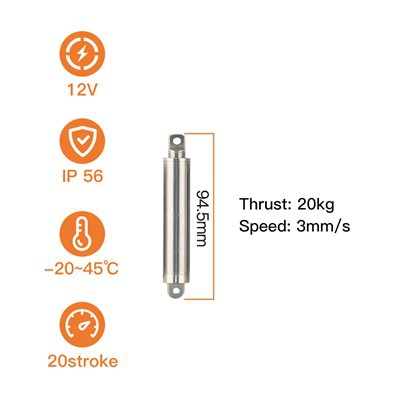
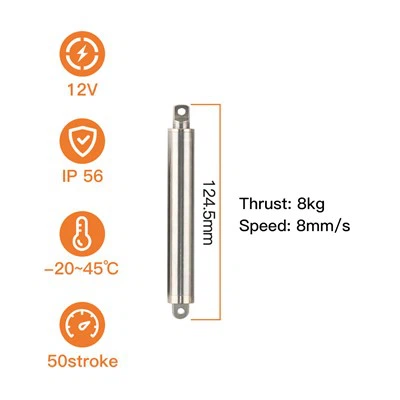
Product model: KT1610-30-8KG
Stroke: 30mm (customizable)
Total length: 104.5mm
Push-pull force: 80N
No-load push-pull speed: 8mm/s
Protection current: 0.64A
Rated voltage: 12V (or 24V)
Product introduction
On a small battery-powered robot, this 12 volt DC actuator drives the hatch that closes the battery and electronics bay. The body's front ear pins to the bay wall and the rod's front ear pins to the cover's lever arm, so extending the rod swings the hinged cover up and retracting it pulls the cover down onto its gasket. The cover's own weight and the gasket decide how much rod force the mechanism needs, and the distance between the hinge and the rod pin decides how much of the 30 mm stroke arrives at the lid as opening angle.
Product Parameters
| Parameter | Specification |
|---|---|
| Product Model | KT1610-30-8KG (12 V standard build) |
| Rated Voltage | 12 V DC standard; 24 V DC available on the same body |
| Rated Push / Pull Force | 8 kg (80 N) |
| Stroke | 30 mm (this build); 10 / 20 / 30 / 50 / 100 mm standard, longer strokes on request |
| Retracted Length | 104.5 mm (30 mm stroke build) |
| Extended Length | 134.5 mm (30 mm stroke build) |
| Outer Tube | Ø16 mm outer tube diameter / Ø10 mm rod diameter |
| Rod End Fitting | Front ear with a Ø4.0 mm pin hole at both ends |
| No-Load Speed | 8 mm/s on this standard build |
| Speed at Rated Load | 5 mm/s on this standard build |
| Time per 30 mm Stroke | about 3.8 s no-load / about 6 s at rated load |
| Lead Screw Lead | 2 mm (standard) / 4 mm (high-speed option) |
| High-Speed Option | Same 8 kg / 16 mm unit, up to 15 mm/s no-load / 10 mm/s at rated load |
| Static Self-Locking Force | Greater than 2× the rated thrust (more than 16 kg / 160 N) |
| Protection Current | 0.64 A at 12 V DC / 0.32 A at 24 V DC |
| Motor Control | Two-wire DC motor, direction by polarity; no internal controller |
| Speed Adjustment | Optional PWM drive board |
| End-of-Stroke Protection | External limit protection board, auto power-off at both ends |
| Duty Cycle | Intermittent, about 10% |
| Ingress Protection | IP56 |
| Noise | < 60 dB |
| Operating Temperature | −45 °C to +60 °C |
Standard build or high-speed build
| Standard (this page) | High-speed | |
|---|---|---|
| Model | KT1610-30-8KG-12V | KT1610-30-8KG-12V (high-speed) |
| No-load speed | 8 mm/s | 15 mm/s |
| Speed at rated load | 5 mm/s | 10 mm/s |
| Rated push / pull | 8 kg (80 N) | 8 kg (80 N) |
| Time for one 30 mm stroke | about 3.8 s no-load / about 6 s at rated load | about 2 s no-load / about 3 s at rated load |
| Suits | a bay opened a few times a shift, where the cover should move quietly | a bay that has to finish its move inside a shorter cycle, such as one on a timed sequence |
Both builds are the same 16 mm unit: the same 8 kg rating, the same envelope and the same pin positions, so a bay drawn around one accepts the other. All that changes is how quickly the rod covers its 30 mm.
Key Features
One mechanical design, both robot rails. The unit is 12 V DC as standard and is built to 24 V DC on the same body, so a 12 V platform and a 24 V platform can share the same mounting, pin positions and stroke.
Holds the cover open with no current. Static self-locking is more than twice the rated thrust, so the cover stays where it stopped when the robot is powered down - no holding current, no brake, and no cover settling onto a technician's hands during service.
Driven from the robot's own battery rail. 0.64 A at 12 V DC is low enough to be switched by a relay pair or a small H-bridge on the robot's controller; PWM gives speed control where the controller supports it.
Stops itself at both ends. The external limit protection board cuts the motor at the end of each stroke, so the travel does not have to be timed by the robot's software.
Customization Options
Most robots take this 16 mm actuator as it comes: the standard strokes and the two pin holes already suit the bay. Where a bay needs something else, the same platform is machined to your drawing.
Travel - cut to the stroke the cover actually needs, not to the nearest catalogue length.
Lead and connector - made to the length of your harness, with the plug you already crimp.
Thread - external or internal, to the size and direction your linkage takes.
End fitting - the front ear produced to your pin size and lug width.
Application Scenario
The battery and electronics bay hatch on a small battery-powered robot. The bay has to stay sealed while the robot works and open fully when a technician or an operator swaps a pack, and on most small robots that cover is held by hand or by a prop. Here the actuator is the cover's driving link: the body ear pins to the bay wall below the hinge and the rod ear pins to a lever arm on the cover, so one 30 mm extension lifts the cover and retraction closes it onto the gasket. Two geometry numbers set the whole design. The opening angle is the 30 mm of travel divided by the distance from the hinge to the rod pin - a 40 mm arm turns the full stroke into roughly 43°, and a shorter arm gives more angle at the cost of force. The force the rod has to supply is the cover's own torque divided by that same arm: lifting a hinged cover is a gravity load, so the demand peaks while the cover is still near horizontal and falls away as it passes vertical, which means a light cover with a 40 mm arm sits comfortably inside the 80 N rating. Past vertical, gravity stops fighting the rod and starts trying to hold the cover open, and that is the load the self-locking screw carries with the robot powered down.
The gripper linkages, finger demonstration mechanisms and other equipment this platform drives are listed on the applications index.
Certifications, Testing and Warranty
Each unit is assembled and load-checked in our own Xiamen factory under an ISO 9001 quality system and ships with a CE declaration and RoHS documents for the configuration you order. The document list is published on the certification page, the checks each production batch goes through are listed on the testing equipment page, and purchasing teams that need a supplier file rather than a datasheet can start from why customers work with KABASI. Units ship factory-direct, evaluation orders start at a single piece, and every unit carries a 6-month warranty against manufacturing defects.
Frequently Asked Questions
FAQ
Q: Does the cover stay open when the robot is powered down?
A: Yes. Static self-locking holds more than twice the rated thrust - over 160 N - with no current in the motor, so a cover that has been lifted stays where it stopped, including on a robot that is switched off or has a flat pack. The actuator will not release on its own: if the bay has to fall open when the supply drops, that behaviour has to come from the hinge geometry or a return spring.
Q: Can the robot's own controller drive it, and how often can it cycle?
A: Yes. It is a plain two-wire DC motor drawing 0.64 A at 12 V DC, so a reversing relay pair or a small H-bridge in the robot's cabinet is the entire drive, and rod speed can be varied with PWM where the controller supports it. One 30 mm move takes about 3.8 s, and at roughly 10% duty allow a cycle period of at least 38 s - around 34 s of pause between moves, which suits a bay opened a few times a shift rather than continuously.
Q: How do I check whether 8 kg and 30 mm are enough for my hatch?
A: Work it out at the hinge: multiply the cover's weight by the distance from the hinge to its centre of mass to get the torque, then divide that by the distance from the hinge to the rod pin to get the rod force it has to beat - check that figure against the breakout peak, not the running force. For more travel in the same 8 kg / 16 mm body, the same platform is built at 50 mm and 100 mm; for a heavier cover, the same platform is built at 20 kg (200 N). Send the hinge layout and the cover weight and we will size it.
Related Selection
- Driving a gripper linkage instead of a cover? See the 30 mm gripper-build actuator.
- Need the same 8 kg force with more travel? See the 50 mm 12 V build.
- Need more force in the same 16 mm body? See the 20 kg high-thrust actuator.
- Need a different shape or fitting for the same bay? See the compact adjustable 12 V actuator.
- Starting from the mechanism rather than the model? Browse applications by mechanism or the full product range.
- Need the platform's measured curves and material analysis? Read the KT1610 engineering audit.
Hot Tags: 12 volt dc actuator, China 12 volt dc actuator manufacturers, suppliers, factory, 12V Dc Linear Actuator, manual linear positioner, electromagnetic linear actuator, circular actuator, 1000 lb linear actuator, single acting pneumatic actuator
Previous
Linear Actuator 12VYou Might Also Like




Send Inquiry