





Miniature Linear Motor
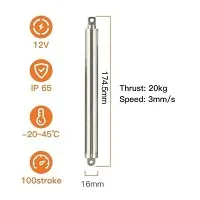
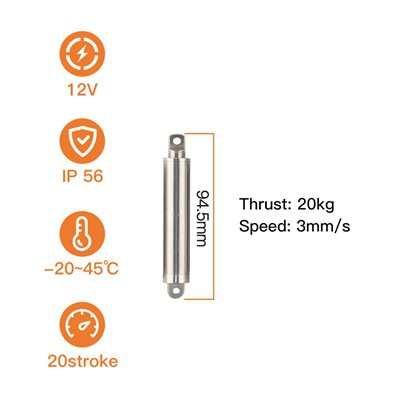
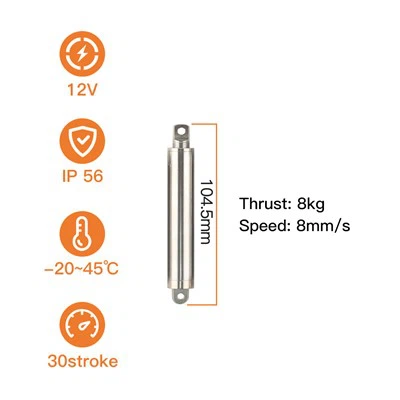
Product model: KT1610-20-8KG
Stroke: 20mm (customizable)
Total length: 94.5mm
Push-pull force: 80N
No-load push-pull speed: 8mm/s
Protection current: 0.66A
Rated voltage: 12V (or 24V)
Product introduction: inside a rehabilitation training arm
A miniature linear motor is what carries the patient's forearm through the training arc on this device: pinned between the upper-arm bracket and a short swing link, its 20 mm of travel becomes rotation about the elbow, its 8 mm/s becomes a speed the patient can follow, and its screw holds the trained angle during the rest between repetitions. This section sets out what the training arm has to do; the section that follows takes the actuator into the linkage - where it is pinned, what one repetition looks like, and the geometry and safety layer that decide the build.
After a stroke or a joint operation, the therapy is repetition: the forearm is carried through flexion and extension again and again, at a controlled speed, stopping at the same angle every time, with a rest between repetitions. The therapist sets the range and the rhythm; the device reproduces them. That puts four demands on the small drive inside the arm - it has to fit in the space beside the elbow, it has to move slowly and smoothly rather than quickly, it has to stop at a repeatable angle, and it has to hold that angle while the drive is idle. It also has to be quiet, because the patient is sitting at arm's length from it for twenty minutes.
The two geometry numbers that decide the build
Everything about how this actuator behaves in the arm comes down to one dimension: the distance from the elbow pivot to the rod's pin on the swing link. That number sets both how much angle a 20 mm stroke produces, and how much force the rod has to supply.
| Pivot-to-pin arm | Movement used | Forearm angle per stroke | Peak torque available from the 80 N rod |
|---|---|---|---|
| 30 mm | full 20 mm stroke | about 38° | about 2.4 N·m |
| 40 mm | full 20 mm stroke | about 29° | about 3.2 N·m |
| 60 mm | full 20 mm stroke | about 19° | about 4.8 N·m |
The trade-off is visible in the table: a shorter arm gives a larger angle for the same 20 mm but needs more rod force to produce it, and a longer arm is gentler on the actuator but delivers less rotation. Both figures are calculated the same way - angle = stroke ÷ arm length, and rod force = load torque ÷ arm length - so a designer can check any linkage before the drawing is frozen.
There is one more number worth working out at the drawing stage. A 2 kg forearm and hand held 250 mm from the elbow asks for roughly 4.9 N·m of gravitational torque when the arm is near horizontal, which is already at the level the rod can supply on a 60 mm arm and beyond it on a 40 mm arm. That is exactly why the training arm carries the limb through its frame and counterbalance and uses the actuator for the movement and the difference - not as the sole support of a patient's arm.
Why the KT1610-20-8KG suits this linkage
It fits inside the arm. A Ø16 mm cylindrical body pinned at both ends sits between the side plates of an upper-arm or forearm section without needing a flat mounting face or an external rail.
8 mm/s is a therapy speed, not a machine speed. Twenty millimetres of travel in about 2.5 s is a movement a patient can watch and follow, and it keeps the reaction load on the training arm low.
It holds the trained angle with nothing drawing current. Static self-locking carries more than 30 kg, so the dwell between repetitions needs no holding power, the motor stays idle and cool, and the arm does not sag onto the patient while the therapist talks.
It is quiet in a room where people are talking. ≤50 dB is measured on the unit itself; in a therapy room that means the movement is heard as a soft whir rather than a mechanism engaging.
It runs from the device's own rail. Two wires, 0.66 A at 12 V DC, direction set by polarity - a small H-bridge or a reversing relay pair on the training arm's controller is the whole drive circuit, and the same body is built to 24 V DC for devices on a 24 V supply.
It can be wiped down between patients. IP56 keeps splashes and dust out of the tube; the surface handling and the choice of cleaning agent stay with the device design, and the unit is not intended to be immersed or steam-cleaned.
If the arm geometry changes, the platform does not. The same Ø16 mm body is built at 10, 20, 30, 50 and 100 mm, so a longer training arc or a paediatric version is a stroke change rather than a new mechanism.
Complete specifications
| Parameter | Specification |
|---|---|
| Product model | KT1610-20-8KG |
| Rated voltage | 12 V DC (24 V DC on the same body) |
| Rated push / pull force | 8 kg (80 N) |
| No-load push/pull speed | 8 mm/s |
| Speed at rated load | about 5 mm/s |
| Stroke (this build) | 20 mm (customizable) |
| Retracted length (total length) | 94.5 mm |
| Extended length | about 114.5 mm |
| Body / rod | Ø16 mm outer tube, Ø10 mm rod |
| End fitting | Front ear with a Ø4.0 mm pin hole at both ends |
| Protection current | 0.66 A at 12 V DC |
| Motor and control | Two-wire DC motor; direction set by polarity; no internal controller |
| End-of-stroke protection | External limit protection board, auto power-off at both ends |
| Lead screw lead | 2 mm standard / 4 mm on the high-speed option |
| Static self-locking force | greater than 30 kg |
| Ingress protection | IP56 |
| Noise | ≤50 dB |
| Duty cycle | Intermittent - about 10 %, pause between moves sized from the cycle |
| Materials | 304 stainless steel + copper alloy |
| Operating temperature | −45 °C to +60 °C |
| Series coverage | KT1610-10/20/30/50/100 - 10 / 20 / 30 / 50 / 100 mm strokes, longer strokes on request |
Build options
Most machines take the KT1610-20-8KG as it comes, because the 20 mm of travel and the two ear pins already suit a short linkage. Where the mechanism is designed differently, the same 16 mm platform is machined to your drawing.
Travel - a shorter movement on a compact mechanism or a longer one on a bigger linkage: 10, 20, 30, 50 or 100 mm from the standard set, or cut to the travel the linkage needs.
Force - the same body is also built at 20 kg (200 N) where the load is heavier or the pivot-to-pin distance is short.
Speed - a higher-lead screw takes the unit to about 15 mm/s no-load and 10 mm/s at rated load, for machines that have to complete the movement inside a shorter cycle.
Drive choice - tell us whether the dominant requirement is quiet repeated start-stop or peak force at the linkage, and the motor configuration is specified against your duty.
Voltage - 12 V DC or 24 V DC on the same body, so a battery-powered machine and a mains-powered one can share the same mechanism.
End fitting - the front ear produced to your pin diameter and lug width, so the linkage on the side plate stays as drawn.
Thread, lead and connector - internal or external thread as your linkage takes it, lead length matched to the harness route inside the machine, and the plug you already crimp.
Drive electronics - an external limit protection board for both ends of the travel; PWM speed control where the controller supports it.
Documents, testing and warranty
Every KT1610-20-8KG is assembled and load-checked in our own factory under an ISO 9001 quality system, and leaves with a CE declaration and RoHS documents for the configuration on the order. The instruments each batch passes through - low-resistance, insulation-resistance, insertion-force, salt-spray, wire-bending and dimensional checks - are listed on the testing equipment page, the certificates are collected on the certification page, and purchasing teams that need a supplier file rather than a datasheet can start from why customers work with KABASI. Units ship factory-direct, evaluation orders start at a single piece, and each unit carries a six-month warranty against manufacturing defects.
Frequently asked questions
Q: What is the difference between a miniature linear motor and a standard linear actuator?
A: Nothing in the working principle - both convert rotation into a straight push or pull. In this size class the difference is the envelope: a Ø16 mm body with a pin joint at each end instead of a base plate and a mounting bracket, a 20 mm stroke as a standard build, and a screw drive that holds the position when the power is off.
Q: How much rotation will one 20 mm stroke give me?
A: It is set by the distance from the pivot to the rod pin: 20 mm of travel on a 40 mm arm turns the link about 29°, on a 60 mm arm about 19°, and on a 30 mm arm about 38°. A shorter arm buys angle with force, so the two numbers should be checked together against the torque the linkage needs.
Q: Will the actuator carry the load on its own?
A: No, and it should not be designed to. On a rehabilitation arm, for example, a 2 kg forearm and hand held 250 mm from the elbow already represents roughly 4.9 N·m of gravitational torque near horizontal, which is at or above what the rod supplies at ordinary arm lengths. The frame, the pivot bearing and the counterbalance carry the load; the actuator supplies the movement and the remaining torque.
Q: Does it stay where it stopped when the power is switched off?
A: Yes. Static self-locking is rated at twice the rated thrust - about 16 kg (160 N) - with no current in the motor, so a position is kept on a machine that has been powered down. It is a holding function only: where the mechanism should end up after a power failure is a decision for the machine's linkage and safety design.
Related builds and next steps
Need the same 8 kg force with a shorter envelope for a compact trainer? See the 10 mm build.
A longer training arc, or a link that needs more travel? See the 30 mm, 50 mm and 100 mm builds on the same body.
Heavier arm section, or a short pivot-to-pin arm? See the 20 kg high-thrust actuator.
Starting from the mechanism instead of the model number? Browse applications by mechanism on the applications index, or the full product range.
Need the measured curves and material analysis behind this platform? Read the KT1610 engineering audit.
Send the pivot-to-pin distance, the limb load and the session rhythm through the inquiry form and we will confirm the build against your linkage.
Hot Tags: miniature linear motor, China miniature linear motor manufacturers, suppliers, factory, 4 wire actuator, 20 inch linear actuator, linear actuator with potentiometer, servo actuator linear, roller screw actuator, linear actuator
Previous
12 Volt Dc ActuatorYou Might Also Like




Send Inquiry