





Micro Linear Actuator 12V
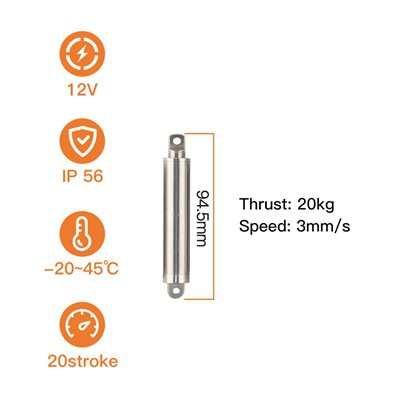
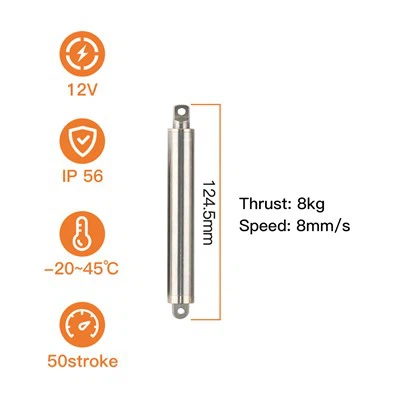
Product model: KT1610-10-8KG
Stroke: 10mm (customizable)
Total length: 86mm
Push-pull force: 80N
No-load push-pull speed: 8mm/s
Protection current: 0.66A
Rated voltage: 12V (or 24V)
Where the 10 mm of travel is used
A benchtop dosing or filling machine is where the 10 mm of travel of this Micro Linear Actuator 12V is used. The machine dispenses a small, repeatable volume of liquid - a cosmetic serum, a food flavouring, a laboratory reagent - through a flexible tube, and it opens and closes the line by pinching that tube rather than by turning a valve. The tube sits in a channel, a clamp bar comes down across it, and it flattens shut - so cleaning between products means replacing a length of tube, not stripping a valve.
The actuator drives that clamp bar. Its rod is coupled to the bar, directly or through a short lever, and the 10 mm of travel matches the job: most of the stroke is what the bar needs in order to clear the tube so the line runs open, and the last part of it is the squeeze that seals the line. Extending the rod closes the line; retracting it opens it. Between doses, and between shifts, the closed tube stays closed because the screw self-locks - the machine holds the line shut with nothing drawing current and no motor heat building up inside the enclosure.
Datasheet - KT1610-10-8KG
| Item | Value |
|---|---|
| Model | KT1610-10-8KG (10 = stroke in mm, 8KG = force build) |
| Stroke (this build) | 10 mm, customizable |
| Retracted length (total length) | 86 mm |
| Extended length | About 96 mm |
| Rated push / pull force | 8 kg (80 N) |
| No-load speed | 8 mm/s |
| Speed at rated load | About 5 mm/s |
| Rated voltage | 12 V DC (24 V DC available on the same body) |
| Protection current | 0.66 A at 12 V DC |
| Motor and control | Two-wire DC motor, direction set by polarity, no internal controller |
| End-of-stroke protection | External limit protection board, power cut at both ends |
| Static self-locking force | Twice the rated thrust - 16 kg (160 N) |
| Duty cycle | Intermittent, around 10 % |
| Body and rod | Ø16 mm outer tube, Ø10 mm rod |
| End fitting | Pin ear with a Ø4.0 mm hole at both ends |
| Ingress protection | IP56 |
| Noise | ≤50 dB |
| Operating temperature | −45 °C to +60 °C |
| Lead screw | 2 mm lead standard; 4 mm lead on the high-speed option |
| High-speed option, same 8 kg body | Up to 15 mm/s no-load / about 10 mm/s at rated load |
| Machining accuracy on the rod | ±0.02 mm on the machined parts |
| Force options on the same body | 8 kg (80 N) and 20 kg (200 N) |
| Series coverage | KT1610-10 / 20 / 30 / 50 / 100 - 10, 20, 30, 50 and 100 mm travel, longer strokes on request |
12 V DC or 24 V DC, and 8 kg or 20 kg, on the same body
Same mechanism, two supplies
| Item | 12 V DC build | 24 V DC build (same body, same stroke) |
|---|---|---|
| Supply | 12 V DC | 24 V DC |
| Protection current (this build) | 0.66 A | 0.32A |
| Rod speed | 8 mm/s no-load / about 5 mm/s at rated load | Unchanged by the supply |
| Rated force | 8 kg (80 N) | 8 kg (80 N) |
| Static self-locking | Twice the rated thrust - 16 kg (160 N) | Twice the rated thrust - 16 kg (160 N) |
| What the harness has to carry | The full 0.66 A of this build | The full 0.32 A of this build |
Same body, two force builds
| Item | KT1610-10-8KG (this build) | 20 kg (200 N) build |
|---|---|---|
| Rated push / pull force | 8 kg (80 N) | 20 kg (200 N) |
| Stroke set, body and mounting | 10 / 20 / 30 / 50 / 100 mm, Ø16 mm body, Ø4.0 mm pin ears | The same |
| Speed | 8 mm/s no-load at the standard lead, about 5 mm/s at rated load | The same |
| Static self-locking | Twice the rated thrust - 16 kg (160 N) | The same |
| Where it fits | Loads that stay under 80 N at the start of the move, with room in the linkage | The same |
| What to send us | Travel, load at the start of the move and the cycle rhythm | The same, plus the force the linkage actually needs |
If the choice is not obvious from the drawing, send the load at the start of the move and the space the unit has to us through the inquiry us.
Failure modes on a dosing machine
A clamp actuator on a dosing machine rarely fails because the tube is heavy; it fails because of what the mechanism around it asks it to do. The failures worth designing out early fall into seven groups, and each of them is visible on the machine drawing before anything is built.
- A rod that is pushed sideways. Where the clamp bar has no guide of its own, the bar's weight and the tube's reaction arrive at the rod as a bending load instead of a straight push. The symptom is a machine that grows slower and noisier over months, and a tube that is squeezed more on one side than the other. The fix belongs to the mechanism: give the bar its own slot or bushings so the rod has nothing to do but push, keep the two pin axes parallel, and keep the push as close to the rod axis as the linkage allows.
- A rod stopped by something other than its own end. An external hard stop set inside the travel, a tube that has swollen, or a bar that jams leaves the motor stalled with the supply still on - the condition end-of-stroke protection exists to interrupt, not a position to work in. The symptom is a unit that cuts out at the same point of every cycle, or a machine that smells hot at the end of a shift. Leave the ends of the travel to the unit's own limit board, set external stops clear of them, and check that the tube channel cannot close up on the bar.
- A cycle rhythm the duty cycle was never sized for. The unit is built for intermittent duty, around 10 %: a 2 s squeeze at the rated load wants roughly 20 s of cycle period. That is a comfortable fit for a machine dosing every half minute and a poor one for a machine dosing every five seconds. Running beyond it is not an instant failure but heat that accumulates in the winding and the screw, and a life measured in months rather than years. Give the machine the pause it needs, or shorten the working part of the cycle with the 4 mm-lead high-speed build rather than by driving the standard build faster.
our company
Founded in 2015, our company has over 10 years of experience specializing in the research, development, and production of miniature electric linear actuators and electric actuator systems.
Build quality, documents and warranty
Every KT1610-10-8KG is assembled and load-checked in our own factory under an ISO 9001 quality system, and leaves with a CE declaration and RoHS documents for the configuration on the order. The company has been making miniature electric linear actuators since 2015, and the instruments each production batch passes through - low-resistance, insulation-resistance, insertion-force, salt-spray, wire-bending and dimensional checks - are listed on the testing equipment page. Certificates are collected on the certification page, and purchasing teams that need a supplier file rather than a datasheet can start from why customers work with KABASI. Units ship factory-direct, evaluation orders start at a single piece, and each unit carries a six-month warranty against manufacturing defects.
Frequently asked questions
Q: What is the difference between the 12 V and the 24 V version of this actuator?
A: The mechanism, the 10 mm stroke, the 8 kg (80 N) force and the rod speed are the same; the winding is what changes. This build draws 0.66 A at 12 V DC; where the same body is built to 24 V DC the current is about half that for the same work at the rod, so a 24 V machine can run a thinner conductor with less voltage drop over a long cable run, and a battery machine can stay on its own pack. Specify the voltage when the mechanism is ordered, since it is not something that is changed afterwards.
Q: How do I know whether 8 kg (80 N) is enough for my device?
A: Work out the force at the point where the rod acts, at the start of the movement rather than during it - that is where friction is highest and where a distorted gasket, a tube under pressure or a stiff detent is felt. Then check the figure against 80 N with something in reserve, remembering that a short lever arm multiplies the load the rod sees. If it does not clear, change the linkage ratio or take the same body in the 20 kg (200 N) build; self-locking is a holding figure, not extra moving force.
Q: Does it stay where it stopped when the power is switched off?
A: Yes. Static self-locking is twice the rated thrust - 16 kg (160 N) - with no current in the motor, so the clamp bar of a dosing machine keeps the tube closed on a machine that has been powered down or unplugged. It is a holding function only, and the safe position after a power failure remains a decision for the machine's linkage.
Q: How often can a machine cycle it?
A: One full 10 mm stroke takes about 1.25 s unloaded and about 2 s at the rated load. Duty is intermittent at about 10 %, so the cycle period follows the move time rather than the travel: a 2 s move wants roughly 20 s between starts. Machines that need a quicker cycle take the 4 mm-lead option on the same 8 kg unit, at up to 15 mm/s no-load.
Hot Tags: micro linear actuator 12v, China micro linear actuator 12v manufacturers, suppliers, factory, 2 stage linear actuator, actuator pneumatic, linear actuator 220v, fast acting linear actuator, in line actuator, hydroworks actuator
Previous
Miniature Linear MotorNext
No InformationYou Might Also Like




Send Inquiry