

APPLICATIONS & OEM ACTUATOR SELECTION
Find an actuator for the part you need to move
Explore compact push-and-pull mechanisms for electronics and smart home panels, small vents and louvers, luggage and portable equipment. For auxiliary mechanisms in portable medical equipment, laboratory instruments and optical or sensor assemblies, share your requirements with KABASI for a project-specific review before selecting a model.
Discuss actuator selection Compare productsExplore seven application areas
Find the mechanism closest to your OEM project, from gripper linkages and hidden panels to equipment covers, sensor deployment and small louvers. Each application highlights a different motion requirement. Product references support initial comparison; suitability depends on the exact mechanism and operating conditions.

Product reference: model actuator |
GRIPPER LINKAGES · FINGER DEMONSTRATIONS · ROBOT HATCHES Micro Linear Actuators for Small Robots and GrippersPush or pull a linkage to open an educational gripper, move a finger demonstration mechanism or operate a small robot hatch. The actuator supplies linear travel, while the linkage determines the resulting jaw opening or joint movement. For actuator selection, share the required movement, linkage geometry and load. Identify whether the mechanism needs simple opening and closing, controlled gripping force or intermediate positions so sensing and control requirements can be discussed. Explore robots & grippers → View model actuator |

Product reference: 5V linear actuator |
HIDDEN PANELS · INTERFACE COVERS · CATCH RELEASE Micro Linear Actuators for Electronics and Smart HomeOperate a concealed access panel, lift a small interface cover or release a catch inside a product enclosure. These mechanisms place the actuator behind the visible surface, connected directly to the moving part or through a linkage. Compare the available installation space with the full movement of the actuator, mounting ends and wiring. Include hinge, seal or return-spring resistance in your OEM inquiry, together with any noise and manual-access requirements. Explore electronics & smart home → View 5V linear actuator |
|
Product reference; configuration requires project review. |
EQUIPMENT COVERS · ACCESSORY TRAYS · AUXILIARY MOTION Micro Linear Actuators for Portable Medical EquipmentDiscuss compact linear motion for equipment covers, accessory trays and other auxiliary mechanisms in portable medical equipment. The scope here is movement of equipment components; dosing, therapy delivery and patient-support functions require separate assessment. Share the mechanism's function, load, operating sequence and cleaning environment, along with the required behavior when power is lost. Model selection depends on the device requirements and supporting documentation for the proposed configuration. Explore portable medical equipment → Discuss equipment requirements |
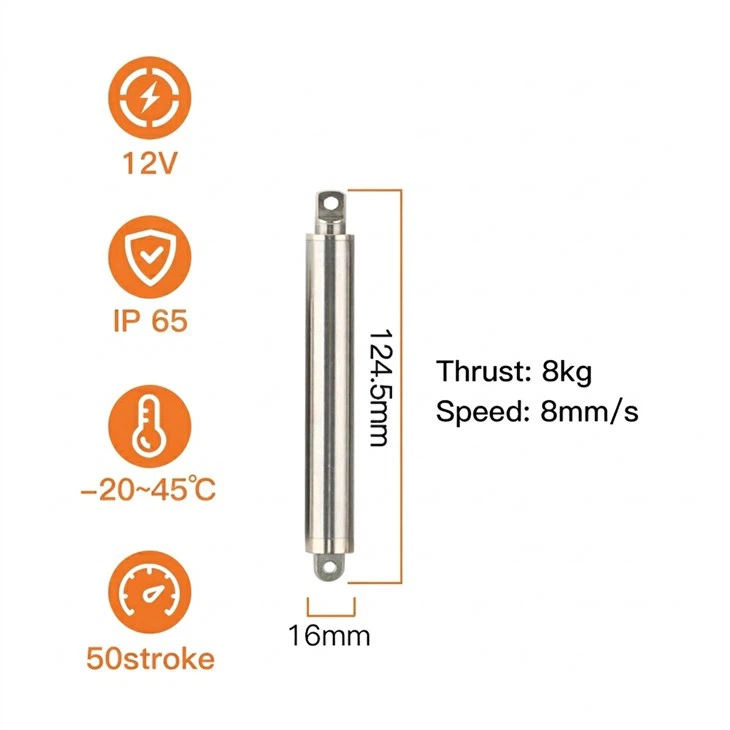
Product reference; configuration requires project review. |
ACCESS COVERS · RACK RELEASE · GUIDED TRAYS Micro Linear Actuators for Laboratory EquipmentEvaluate push-and-pull motion for an access cover, a sample-rack release or a small tray supported by its own guides. These auxiliary movements can be reviewed separately from the instrument's measurement or sample-processing functions. Start with intermittent mechanisms and provide the actual cycle timing, load and guidance arrangement. Continuous cycling, high-throughput handling and precision dispensing need performance evidence beyond a general actuator specification. Explore laboratory equipment → Review your operating cycle |
|
Product reference; configuration requires project review. |
SENSOR DEPLOYMENT · PROBE COVERS · OPTICAL COVERS Micro Linear Actuators for Optical and Sensor MechanismsDiscuss extending and retracting a sensor, moving a probe cover or opening a protective cover over an optical path. These mechanisms move a component between working and protected positions within a compact assembly. Specify the required endpoints, alignment and allowable movement at the deployed position. Deployment and precision focusing are different selection tasks: fine focus or repeatable intermediate positioning requires configuration- specific evidence for feedback and motion performance. Explore optical & sensor mechanisms → Discuss deployment requirements |
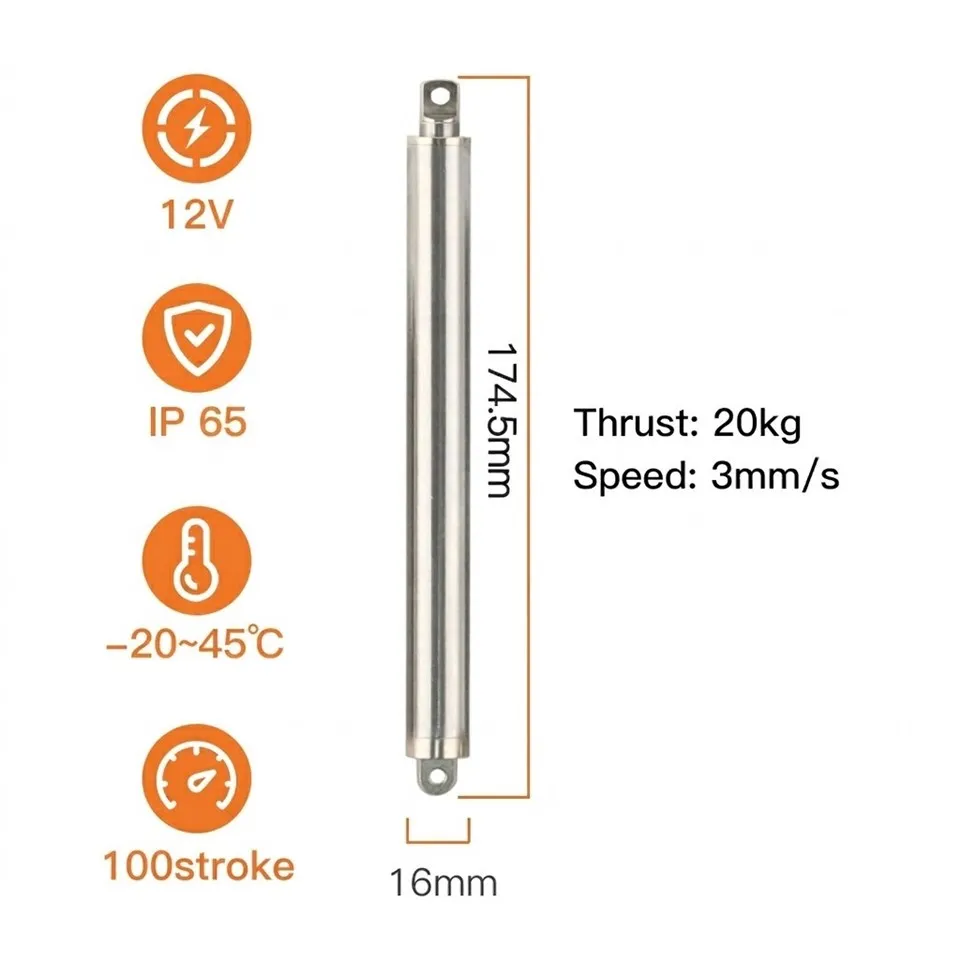
Product reference: ventilation actuator |
LOUVER LINKAGES · AIR FLAPS · VENT COVERS Micro Linear Actuators for Vents and LouversMove a connecting rod or lever to open a small louver, reposition an air flap or operate a ventilation cover. The installation converts actuator travel into the required opening angle on the equipment enclosure. Identify whether the opening has two operating positions or needs adjustment between them. Share linkage resistance, air-pressure conditions and operating temperature. PWM compatibility alone does not establish position feedback or accurate airflow control. Explore vents & louvers → View ventilation actuator |
|
Product reference: compact 12V actuator |
LATCH PINS · COMPARTMENT COVERS · RETRACTABLE PARTS Micro Linear Actuators for Luggage and Portable EquipmentRelease a luggage latch pin, operate a compartment cover or retract a small protective part in a portable enclosure. The actuator drives the moving component, while the surrounding mechanism determines how it locks, releases and handles external loads. For a battery-powered design, share the supply voltage range and the required access method when power is unavailable. Include dust, moisture and impact exposure. An actuator's IP rating alone does not establish protection for the finished product. Explore luggage & portable equipment → View compact 12V actuator |
Compare a listed actuator or discuss a custom configuration
If a listed product is close to your design, use its model or product link as the starting point for an OEM inquiry. Ask for the current specification and mounting drawing for the exact configuration you intend to evaluate.
If the fit depends on a different stroke, lead wire length or connector, include those requirements with your drawing. Available changes depend on the selected model. Position feedback and controller compatibility also need confirmation for that configuration.
For prototype evaluation, describe what the mechanism must demonstrate under load. For production sourcing, identify the agreed configuration and any documents needed for purchasing approval.
Request actuator selection support or a quotation
Send KABASI a mechanism drawing, CAD view or annotated photo. Show the mounting points, required action and start and end positions. Include the working load, available space, power supply and expected operating frequency.
For a quotation, add the product or model you are considering, requested configuration, prototype quantity or estimated production volume, and required delivery date. If the load is still unknown, describe what needs to be pushed, pulled or held.
Send application requirements sale8@kabasi.cn