

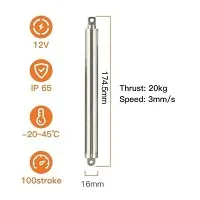


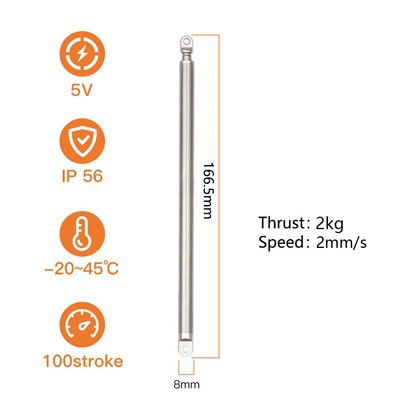
Electric Actuator
Electric Actuator: High-Torque 12V/24V Motion Control Solutions
Industrial-Grade Reliability: Fully CE and RoHS certified, our actuators support standard 12V/24V voltages, providing stable performance for demanding industrial environments.
Silent & Smooth Operation: Precision-engineered gear ratios ensure ultra-quiet running (<50dB), ideal for high-end laboratory equipment and smart home integration.
Rapid Development Support: Standardized modular interfaces allow for quick prototyping, significantly reducing your product’s time-to-market.






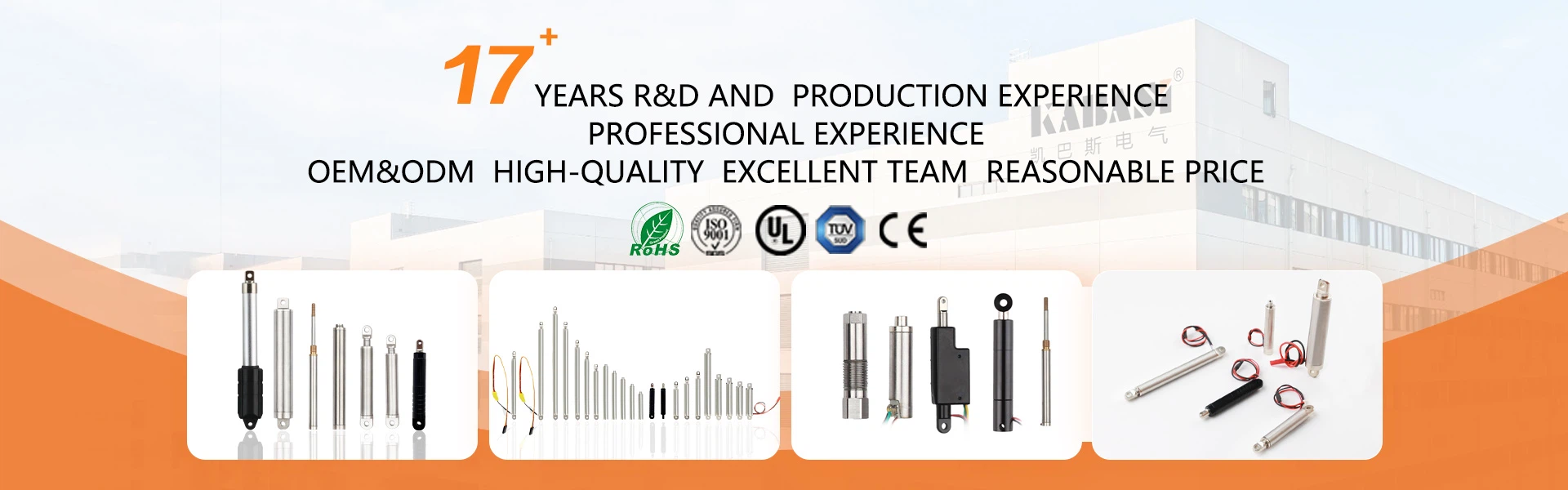
Why Choose Us
Quality Assurance
We have 100% quality guarantee to customers. We will be responsible for any quality problem.
Our Certificate
The products have passed CE, RoHS, CCC, TUV and other certifications, and have more than 30 national patents.
Sale Market
The company is based in China and has a global vision. At present, its products have been exported to more than 60 countries and regions around the world.
Our Service
We assist customers in selecting suitable products, develop new products in line with customer needs, and provide technical support and suggestions.
Electric Actuator - Overview
An electric actuator is a device that can create movement of a load, or an action requiring a force such as clamping, using an electric motor to create the necessary force.
Product Specification
We offer the following Specifications
|
Product Name |
Product Model |
|
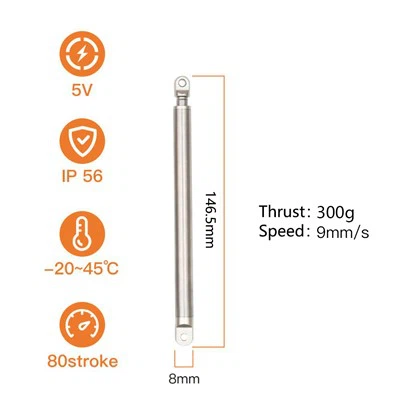
Mini ELectric Actuator |
KT0805-30/50/80/100/120 |
|
Product Materia |
Product Stroke |
|
304SS+Copper Alloy |
30/50/80/100/120mm(Longerstroke can be customized) |
|
Protection Current |
Rated voltage |
|
0.25A |
6V DC |
|
Noise |
Self-locking force |
|
<50DB |
>10KG |
Advantages of Electric Actuator

Easy Integration
Electric actuators are more straightforward to integrate compared to hydraulic or pneumatic systems. They often come with programmable controllers and microprocessors that facilitate the operation of modern industrial equipment.
Precision Levels
Electric actuators provide exceptional precision in motion control. They allow for precise adjustments in torque, speed, and force at various stages throughout thae motion process.

Safety and Convenience
Unlike their hydraulic and pneumatic counterparts, electric actuators are not prone to contamination or leaks. This makes them cleaner and more secure, offering a more convenient solution for many applications.

Cost Efficiency
In the long term, electric actuators are often more cost-effective compared to other types. They require minimal maintenance, are simple to operate and install, and are built to endure various environmental conditions. Their durability and reliability further contribute to their overall value.
Types of Electric Actuator
The slider type moves the slider linearly, mainly using ball screws and linear guides. Due to the high positioning accuracy and fast response time, this product is mainly used in general transport processes and assembling machines.
For the rod type, a ball screw is used mainly to expand and contract the piston rod. Used for press fitting processes and lifting applications, etc., since the piston rod contracts and is compatible with offset workpieces with built-in guides.
Electric actuator for gripping workpieces. Generally there are two-finger and three-finger types, the former is suitable for gripping square workpieces and the latter for gripping round workpieces.
Electric actuator equivalent to a pneumatic components guided cylinder. High rigidity and durability are achieved by using the same body as the pneumatic components.
Electric actuator that can rotate. Multi-point positioning during rotation, reverse operation, indexing operation, etc. Acceleration and deceleration settings enable soft starts and stops, eliminating the need for shock absorbers.
Application of Electric Actuator
Manufacturing
Used in all over the factory, electric actuators are in automated machinery for assembly lines to move products, position parts, or perform lifting and rotating tasks. Their integration into production lines boosts productivity while reducing human error.
Medical Devices
Found in hospital beds, surgical tables, and prosthetics, electric actuators offer fine control over movement, aiding in patient comfort and enhancing surgical precision.
Robotics In Plant
In robotic arms and systems, electric actuators move parts with exceptional precision. Whether picking up objects, welding, or assembling components, they are central to robotic efficiency and accuracy.
Solar Power Systems
Electric actuators tilt solar panel positions, optimizing their exposure to sunlight and improving energy generation.
Automotive and Aerospace
From vehicle seat adjustments to landing gear mechanisms for aircraft, electric actuators are found in a wide range of applications that require controlled motion.
Structure of Electric Actuator
Motor: The motor receives the switching power output from the servo amplifier or electric actuator and converts electrical energy into mechanical energy to drive the actuator's movement.
Reducer: The reducer includes manual components, output shaft, and mechanical limit block. It transforms the high speed and small torque of the motor into low speed and high torque output power to drive the movement of the valve mechanism.
Controller: The control unit receives and outputs 4-20mA analog signals and digital signals for automatic control of the actuator. It includes the servo amplifier and position transmitter. Recent developments in intelligent technology allow functionalities such as setting actuator functions, self-diagnosis of faults, status alarms and recording, display, and communication.
Position Transmitter: The position transmitter consists of power transformers, differential transformers, printed circuit boards, and other components. As the output shaft of the reducer moves, the cam rotates with it. The axial displacement generated by the iron core of the differential transformer, pressed on the cam slope, changes the position of the iron core in the differential transformer coil. This converts the voltage output of the differential transformer corresponding to the position into a standard DC current signal (4-20mA).
Servo Amplifier: The adjustment principle of the fluorine amplifier is similar to that of a pure integral action control valve. As long as the deviation between the command type and the feedback type of the valve position exceeds the range of insensitive adjustment, the servo amplifier will continue to issue open or close commands. It accepts the standard type of the regulating instrument (4-20mA) and the feedback signal of the actuator, amplifying and outputting 220V AC power to drive the servo motor for continuous adjustment of the valve position opening.
Packaging & Delivery

Certifications

FAQ