

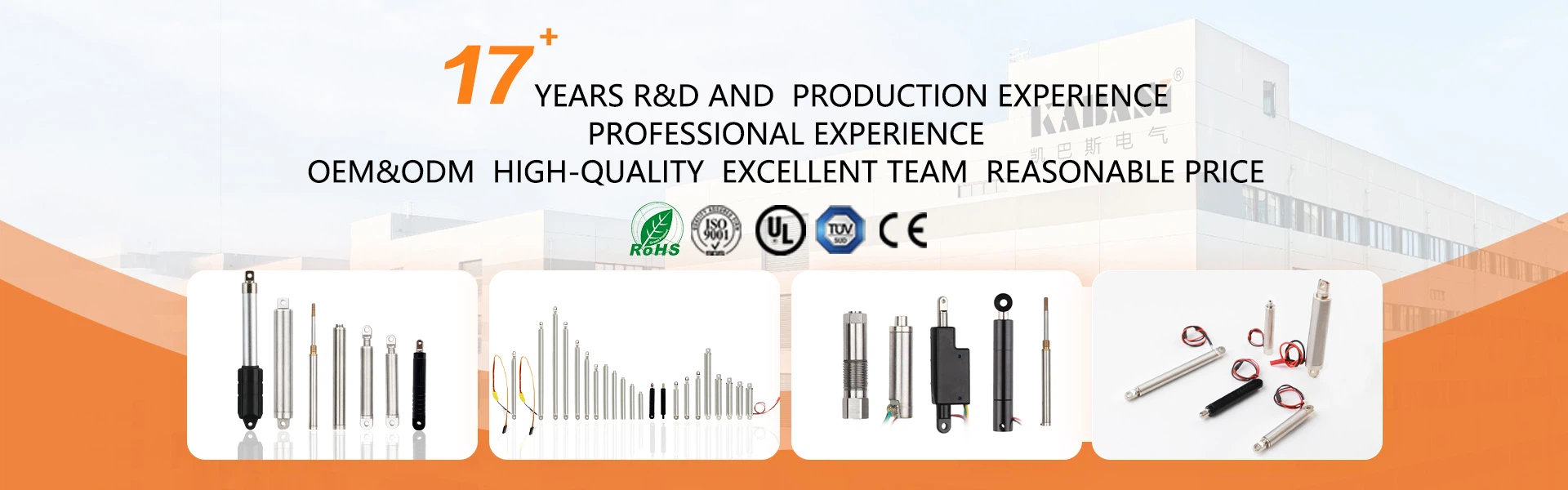
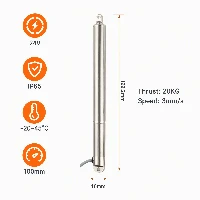


Electric Motor Linear Actuator
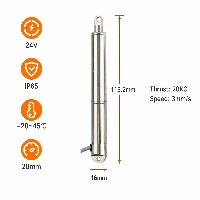
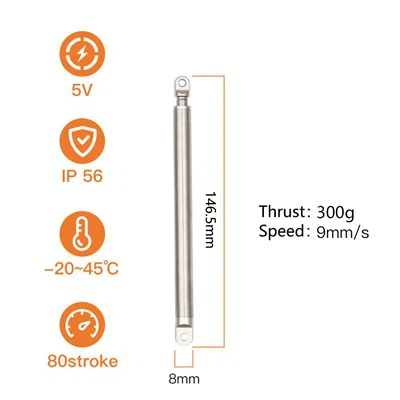
Product model: KT0805-30H
Product material: 304 stainless steel + copper alloy
Stroke: 30mm (customizable)
Total length: 96.5mm
Push-pull force: 300G/3N
No-load push-pull speed: 9mm/s
Protection current: 0.2A
Rated voltage: 5V
Noise: ≤50dB
Protection level: IP56
Self-locking force: greater than 10KG/100N
Product Overview
Electric motor linear actuator KT0805-30H arrives as one sealed assembly with its travel already set, which is the part a bezel-mounted door cares about: nothing to adjust inside the appliance, nothing to line up once the moulding is closed. An 8 mm tube and a 96.5 mm body fit beside a lens in a front panel with about 110 mm of depth, and the 5 mm rod pushes the shutter along the same axis as its rails.
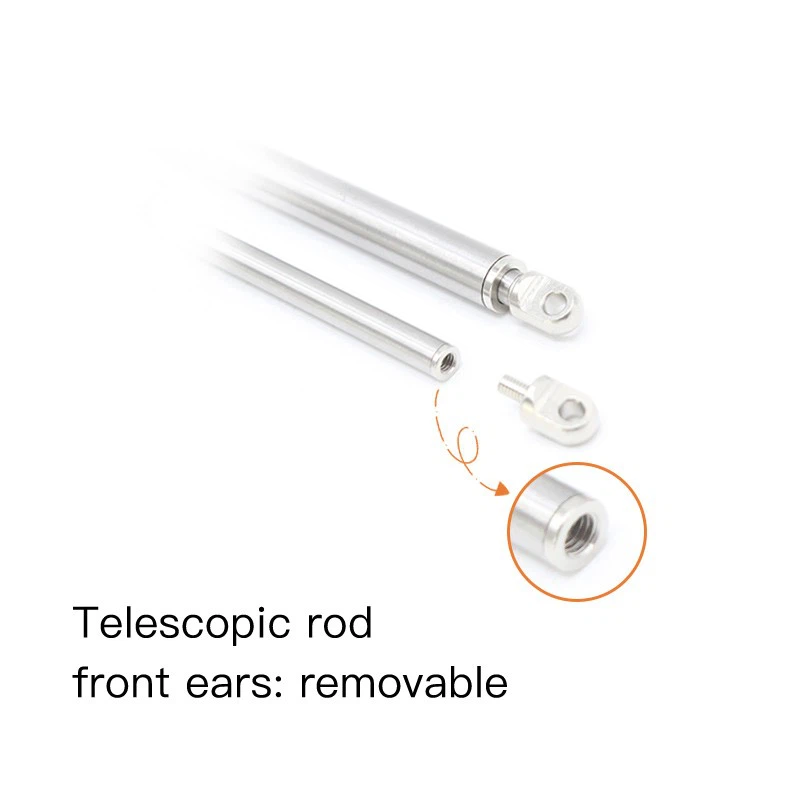
The head is the end that meets the appliance. It unscrews, so a bracket already tooled for a 3 mm pin or an M3 stud takes the rod without a new moulding; where a cradle will not fit, the outer tube can be threaded and locked through the panel with a nut.
Two versions share the tube and the 30 mm stroke. The H version is the fast one: 0.3 kg at 9 mm/s unloaded and 6 mm/s under load, which puts a shutter clear of the lens in 3.3 s. The L version is the thrust one: 2 kg at 2 mm/s unloaded and 1.4 mm/s under load, 15 s and 21 s for the same 30 mm. The choice is made by the mechanism - how quickly the movement has to finish against how much mass it has to move.
No encoder and no position output are fitted, and travel is not adjustable in service: the length is ordered to the drawing, 30 mm to 120 mm as standard and longer on request.
Key Specifications
| Item | Value |
|---|---|
| Product model | KT0805-30H |
| Version | Fast version (H): speed priority, light load |
| Rated voltage | 5 V DC |
| Stroke | 30 mm standard |
| Stroke options | 30 / 50 / 80 / 100 / 120 mm standard; longer by customization |
| Overall length | 96.5 mm, rod in |
| Extended length | 126.5 mm, rod out |
| Push-pull force | 0.3 kg / 3 N across the whole stroke |
| Speed, no load | 9 mm/s, 3.3 s for the full 30 mm |
| Speed, full load | 6 mm/s, about 5 s for the full 30 mm |
| Self-locking force | 100 N / 10 kg with the supply removed |
| Protection current | 0.2 A, about 1 W at the rated figures |
| Noise | ≤50 dB |
| Protection level | IP56, dust protected and protected against water jets |
| Outer tube diameter | 8 mm |
| Telescopic rod diameter | 5 mm |
| Head | 7 mm, two 3 mm holes, detachable |
| Thread | M3 internal, 5 mm deep; M4 and M5 on request |
| Outer tube thread | M9 external, on request |
| Materials | 304 stainless steel tube and housing, copper alloy lead screw |
| Drive | 5 V DC motor with a lead screw, rotary to linear |
| End of stroke | Automatic stop at both ends |
| Limit protection | External board, fixed on the outside of the tube |
| Working duty | 10%, six seconds of running in any minute |
| Mounting | Any orientation, with the load guided along the rod axis |
| Warranty | 6 months or 10,000 cycles from manufacture, whichever comes first |
| Customization | Stroke, thread, lead length, head style |
Operating Characteristics
- 3.3 s for 30 mm. Unloaded the full stroke takes 3.3 s; at the rated 0.3 kg it takes about 5 s. The gap between the two figures is the first thing a designer notices, because it sets how light the moving part has to be for the start-up sequence to stay short.
- 0.3 kg (3 N) across the whole stroke. Force holds to the far end, so a door that drags slightly on its rails finishes its travel instead of stalling short of the stop.
- 100 N of holding resistance. The lead screw resists back-driving, so the door stays where it was left with nothing energised and no heat inside a closed chassis.
- About 1 W. A 0.2 A draw at 5 V sits on the standby rail most appliances keep alive, which is what allows a shutter to close after the main board has powered down.
- 96.5 mm of body, 8 mm of tube. Most of the length is motor and screw; the rest is the head and the limit board, which sits outside the tube and needs clearance of its own.
- Under 50 dB. Quiet enough to be covered by the fan of the appliance during the seconds it runs.
- IP56 on 304 stainless steel. Indoors the rating does dust work: a dust-protected body that survives a wipe-down cloth, on a guide with no plating to wear through.
Projector Lens Door
The mechanism this model was sized around is the motorised lens door of a home projector. A front bezel carries a short shutter that slides across the lens while the projector idles and retracts before the image appears. Three requirements decide whether a given rod can do it.
Clearance before ignition. A shutter still across the lens when the lamp strikes is a plastic plate in the beam, and the result is a scorched door and a lens that never comes clean. Appliances avoid it by waiting, so 3.3 s is not a convenience but part of the start-up sequence, and every second of it is a second the lamp stays off.
Closed position without power. Projectors are unplugged, switched off at the wall and packed for a shoot. A door that falls open in transit exposes the lens to dust and to whatever is in the bag. The screw holds it: 100 N of resistance, no solenoid left energised, no current drawn for a closed door.
Gravity in either direction. Half the installations hang from a ceiling, so the rod works against the weight of the door rather than with it. A screw drive does not care: the same 0.3 kg lifts a 150 g shutter as easily as it slides it sideways.
The arrangement it usually replaces is a solenoid with a return spring, which works on a bench and shows its limits once shipped: the spring decides the resting state, the door arrives with a click that a quiet room hears, and both end positions come from rubber bumpers rather than from the drive.
| Requirement | Value |
|---|---|
| 30 mm between parked and clear of the lens | 30 mm of travel between two stops |
| Door out of the beam before the lamp strikes | 3.3 s unloaded, about 5 s at full load |
| Shutter closed with the appliance unplugged | 100 N of holding resistance, no current |
| Ceiling installation, door hanging down | Same holding force in any orientation |
| Door of 150 to 200 g on two short rails | 0.3 kg of thrust above the door and its friction |
| Roughly 110 mm of free depth in the bezel | 96.5 mm body, 8 mm tube |
| Quiet room, lens the owner looks into | Under 50 dB, dust-protected body |
Where the moving part is a flap, a louver linkage or a small hatch instead of a shutter, the neighbouring cases are grouped on the applications hub, and the household versions sit under electronics and smart home actuators.
Chassis Installation
Body clearance and door clearance. The two numbers are counted separately: 96.5 mm for the body with the rod in, and 30 mm of travel on top of that. A moulding that clears the retracted body but leaves nothing for the rod jams the door against the lens ring, and the correction is a different stroke rather than a shorter hole.
Door guidance. A 5 mm rod pushed sideways bows and puts the bend into the screw. Two short rails, or a drawer slide, take the side load from a hand or a packing case; the rod is asked only to push along its axis.
Limit board clearance. The board sits outside the tube, so the body is not a plain 8 mm cylinder. A cradle cut for a cylinder pinches it, and a pinched board stops the door in the wrong place.
Door sealing. IP56 protects the drive. Dust on the glass is the shutter's job and its own seal, and a design that leans on the rod's rating will find dust on the lens.
Model Selection
| Requirement | KT0905-15H (fast) | KT0905-30L | KT0805-30H | KT0805-50L | KT0805-80L |
|---|---|---|---|---|---|
| Exactly 30 mm of travel | ✗ 15 mm | ✓ 30 mm | ✓ 30 mm | ✗ 50 mm | ✗ 80 mm |
| Full stroke in under 4 s | ✓ 1.7 s | ✗ 15 s | ✓ 3.3 s | ✗ 25 s | ✗ 40 s |
| 3 N of thrust is enough | ✓ 3 N | △ 2 kg, over-specified | ✓ 3 N | △ 2 kg, over-specified | △ 2 kg, over-specified |
| More than 0.5 kg of thrust | ✗ 0.3 kg | ✓ 2 kg | ✗ 0.3 kg | ✓ 2 kg | ✓ 2 kg |
| Body of 100 mm or less | ✓ 69 mm | ✓ 84 mm | ✓ 96.5 mm | ✗ 116.5 mm | ✗ 146.5 mm |
| 10 kg hold with the supply off | ✓ | ✓ | ✓ | ✓ | ✓ |
| 5 V DC at 0.2 A | ✓ | ✓ | ✓ | ✓ | ✓ |
Customization Options
| Item | Standard | Options |
|---|---|---|
| Stroke | 30 mm | 50 / 80 / 100 / 120 mm in the same tube, longer by drawing; every extra millimetre of stroke adds a millimetre of body |
| Thread | M3 internal, 5 mm deep | M4 or M5 internal, cut to the screw the door bracket already uses |
| Outer tube thread | Plain | M9 external, matched to a panel boss or locknut |
| Head | 7 mm eye, two 3 mm holes | Eye removed; stud or clamp block on the same rod |
| Lead length | Standard pair of silicone leads | Cut to harness length, with the connector the appliance uses |
| Voltage | 5 V DC | Fixed in this tube |
Manufacturing and Inspection
Tube, screw, motor and limit board for this range are made and assembled in one plant, which makes a change of stroke or thread a production instruction rather than a sourcing exercise. Units are inspected under an ISO9001:2015 system that starts at incoming material and runs through dimensional checks, motor performance, electrical and insulation tests, salt spray and lead-bending, with a run to both stops before packing. The salt-spray step stays in even for an indoor part: it is the check that the stainless guide needs no plating.
CE and RoHS documentation is held on the certification page, the instruments used for those checks are listed under testing equipment, and the plant itself is described on about us. The inspection route from incoming goods to packing is set out on why us.
Frequently Asked Questions
Q: Is 0.3 kg enough for a moving door?
A: It is enough for the door this version was built around, and not more. A shutter of 150 to 200 g on two short rails, with a light seal, sits inside 3 N with room for friction. The rating follows from the 9 mm/s, so a heavier door or a stiff slide moves the answer to the thrust version at 2 kg, where the same 30 mm takes 15 s unloaded and 21 s under load.
Q: Will the door creep open on a ceiling installation?
A: The screw resists back-driving at 100 N, many times the weight of a shutter hanging downward, so the door does not descend on its own and no solenoid has to be held on to keep it shut. Play in worn rails is a different matter: the door can shift within that play, and that is a bezel tolerance rather than a drive fault.
Q: How many times can it open and close?
A: The working duty is 10%, six seconds of running in any minute. One open-and-close cycle takes 6.6 s unloaded, so a duty-respecting pattern is about one cycle per minute; a projector that moves its door twice a session is far below that. An appliance that cycles the door for every viewer, for hours, needs a larger unit, and that decision belongs before the bezel is moulded.
Q: What thread comes on the head, and can the head be changed?
A: M3 internal to a depth of 5 mm as standard, with M4 and M5 cut on request, and an M9 external thread available on the outer tube for a locknut fixing. The 7 mm head with its two 3 mm holes unscrews, so the same rod takes a stud or a clamp block when the door bracket is already tooled.
Q: Can the unit sit next to the lamp exhaust?
A: No, and no high-temperature version of this motor is offered. Heat from an exhaust duct reaches the grease in the screw and the winding in the motor before anything else, and both age faster than the specification allows. The body belongs on the intake side of the airflow or on the opposite wall of the chassis, with the air temperature measured there during a full session rather than at switch-on. The 304 tube survives a hot corner; the grease and the motor do not.
Q: What does the warranty cover?
A: Six months or 10,000 cycles from the date of manufacture, whichever comes first, against defects in workmanship under normal use. It does not cover water forced into an IP56 body, a rod bent by side load, travel driven past a stop by an external force, or a unit dropped during assembly. The delivery note carries the batch number, and the production record for that batch is what a claim is checked against.
Hot Tags: electric motor linear actuator, China electric motor linear actuator manufacturers, suppliers, factory, electric linear valve actuator, electric screw cylinder, 3 way electric ball valve, 1 4 turn actuator, electric actuated butterfly valve price, flow control valve electric actuator
Previous
Electric Actuator 6VYou Might Also Like



Send Inquiry