



Dc Linear Actuator
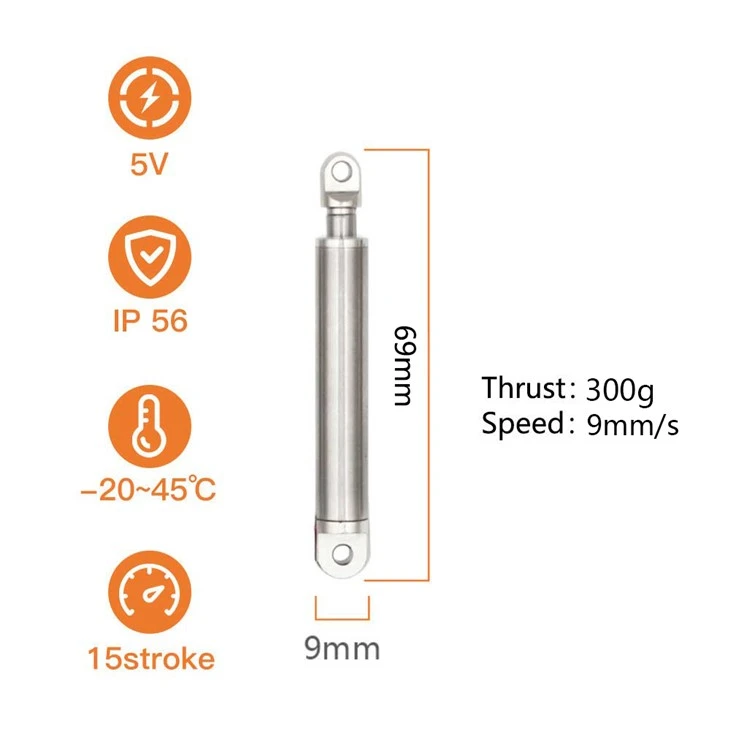
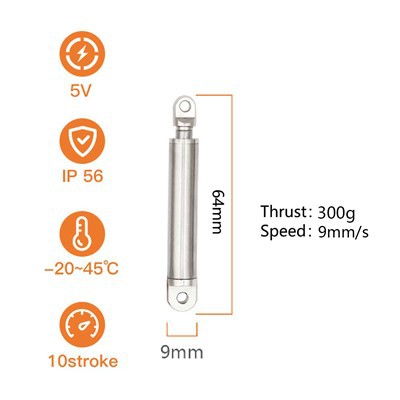
Product model: KT0905-15H
Stroke:15mm (customizable)
Total length: 69mm
Push-pull force: 300G/3N
No-load push-pull speed: 9mm/s
Protection current: 0.2A
Rated voltage: 5V
Self-locking force: greater than 10KG/100N
Product Introduction
DC linear actuator KT0905-15H is the fast version of the KT0905 micro rod family: a screw-driven 5 V unit that trades force for speed, so a light guided part can be moved across its full travel in about 1.7 s and then held there mechanically, with no current left on. It is the model to specify when the movement is short, the part is light, the housing is tight and nobody wants to hear the mechanism working.
Key Specifications
| Item | Value |
|---|---|
| Product model | KT0905-15H |
| Version | Fast version (marked H): speed priority, low force |
| Stroke | 15 mm standard; 10 / 15 / 20 / 25 / 30 mm across the family, longer made to order |
| Overall length | 69 mm with the rod retracted, about 84 mm fully extended |
| Tube sizes | 9 mm outer tube around a 5 mm telescopic rod |
| Push-pull force | 300 g / 3 N, held across the whole stroke |
| Speed | 9 mm/s with no load, 6 mm/s at full load |
| Self-locking force | 10 kg / 100 N with the supply removed |
| Rated voltage | 5 V DC |
| Protection current | 0.2 A (about 1 W at the rated figures) |
| Noise | ≤50 dB |
| Protection level | IP56 - dust protected and protected against water jets |
| Materials | 304 stainless steel tube and housing, copper alloy lead screw |
| Drive | 5 V DC motor with a screw drive, rotary to linear |
| End of stroke | External limit protection board mounted outside the tube; the drive stops itself at both ends |
| Working duty | 10%; long periods of repeated operation are not recommended |
| Connection | Two silicone leads, positive and negative; direction set by reversing the polarity |
| Mounting | Horizontal or vertical, with the load guided in line with the rod |
| Customization | Stroke, speed, force and lead length |
Product Features
- 15 mm of travel in about 1.7 s with no load, about 2.5 s at full load
- 300 g of push-pull force available across the whole stroke, not only at the start
- 10 kg self-locking hold after the power is removed, drawing no current
- A 69 mm body on a 9 mm outer tube, so it fits housings that have almost no spare room
- 5 V DC at 0.2 A - roughly 1 W, on the rail your board already has
- Two leads only: polarity sets the direction, so no driver, no encoder and no position routine
- Both end positions set by the external limit protection board, mounted outside the tube
- 304 stainless steel and copper alloy throughout, sealed at the factory to IP56
- Running noise stays below 50 dB
The Device It Was Built Around
The part that has to move is small. On a smart toilet or a bidet seat the wash nozzle sits behind a shutter in the bowl wall, and that shutter has to slide clear before the nozzle presents itself, then close again when the seat goes idle - partly for appearance, and partly to keep the nozzle out of the splash and residue that any bathroom produces. The movement is short, it happens several times a day, and it happens in a room where somebody may be standing at three in the morning.
The actuator body is fixed to the frame inside the seat housing and the 15 mm rod is coupled to the shutter, either directly or through a short lever. The controller applies 5 V DC to the two leads and the rod extends, clearing the port in about 1.7 s with no load; reversing the polarity closes it again. Both ends of the travel are decided inside the unit by the external limit protection board, so the seat's control board never has to track the position. Because the drive is a screw rather than a solenoid, the shutter is carried to its position instead of being thrown against a stop, and the movement stays quieter than the water it precedes.
Applications
KT0905-15H fits one pattern: a short, repeatable movement of a light part inside a product that is compact, quiet and often damp. Each of the cases below needs the same three things - about 15 mm of travel, a position that survives a power cut, and a mechanism the user never hears.
- Smart toilet and bidet seat - the shutter that covers the wash nozzle and clears the port before the nozzle presents itself, then closes again when the seat goes idle.
- Bathroom and kitchen dispensers - the nozzle shutter that opens for a dose and shuts against splash straight afterwards.
- Small appliance covers and port doors - a cover that has to clear an opening, stay out of the way while the user works, and be shut again when they have finished.
- Household electronics - a pop-out sensor housing, a retractable panel or a concealed interface cover that presents itself on demand.
- Personal-care and home-care devices - a lid, catch or sliding cover that has to close properly in an enclosure that gets wiped down.
- Coffee and beverage machines - a small door, chute cover or drip-tray latch that opens on command and stays shut between uses.
- Air-treatment appliances - a flap or sliding cover over an outlet that must be opened on start-up and held open without drawing current.
- Desktop instruments and equipment - a small access cover, tray release or protective shutter that moves on its own guide.
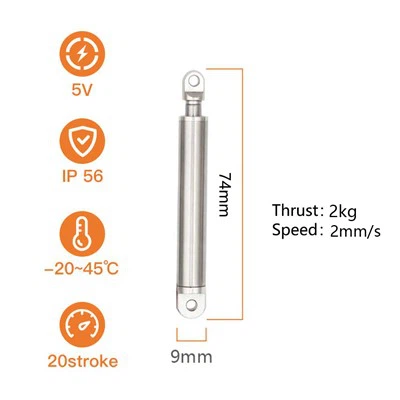
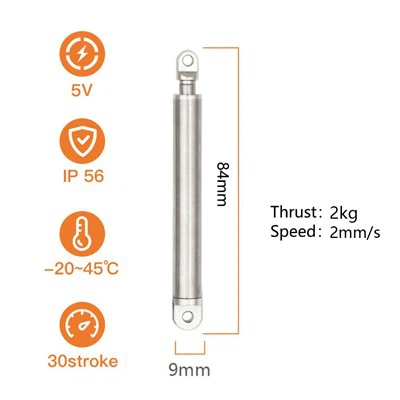
Mechanisms that are heavier, that fight a return spring, or that need more than 15 mm of travel belong to another member of the same family - see the thrust versions at 2 kg. More mechanism types are grouped on the applications hub, with the enclosure cases collected under electronics and smart home actuators.
Comparing Drive Technologies
Most small shutters in consumer products are moved by a solenoid, a geared motor with a cam or rack, a screw-drive rod, or a thermal motor. The choice decides how the finished product behaves far more than any single force figure does.
Legend: ✓ meets the requirement · △ only under conditions · ✗ does not meet it.
| Requirement | Solenoid | Geared motor + cam or rack | Screw drive (KT0905-15H) | Thermal / wax motor |
|---|---|---|---|---|
| Clears the full 15 mm travel in about two seconds | ✓ | ✓ | ✓ | ✗ |
| Holds its position with the power removed, drawing no current | ✗ | △ | ✓ | ✗ |
| Repeats both end positions without a cam profile or extra switches | ✗ | ✗ | ✓ | ✗ |
| Quiet enough for a bathroom or a bedroom at night | ✗ | △ | ✓ | ✓ |
| Runs from the product's existing 5 V rail at about 1 W | ✗ | △ | ✓ | △ |
| Force available across the whole stroke, not only at the start | ✗ | △ | ✓ | ✗ |
| Few wearing parts, and no gear backlash | △ | ✗ | ✓ | ✓ |
No other route holds its position with no current, repeats both ends without extra hardware, and stays quiet - the screw drive is the only one that does all three.
How to Compare Quotations From Other Suppliers
These six points are where datasheets quietly stop being comparable, and they are worth putting to any supplier before you shortlist.
| What to ask | The answer you want ✓ | The answer that should worry you ✗ |
|---|---|---|
| Is the length quoted with the rod retracted or extended? | ✓ "69 mm retracted, about 84 mm with the rod out" - the stroke is stated on top of the retracted figure | ✗ A single length with no indication of which position it describes |
| Is the force a push figure or a holding figure? | ✓ Both, stated separately with units | ✗ One number used for both, in the datasheet and in the sales conversation |
| Is a duty cycle stated? | ✓ An explicit figure, such as 10%, with a note on repeated operation | ✗ No duty or frequency figure anywhere on the sheet |
| How is the end of travel handled, and where does that part sit? | ✓ The arrangement named, with the mounting position and the clearance it needs in your housing | ✗ An answer that does not say where the limit sits or how much room it takes |
| What does the IP rating cover? | ✓ "This component; the sealing of the finished product is set by your own housing" | ✗ "IP56, so your product will be waterproof" |
| Was the noise figure measured, and at what distance and load? | ✓ A stated measurement condition, or an honest "not specified" | ✗ A dB figure with no indication of how it was obtained |
The figures on this page come from the same line that ships the parts, and we will confirm a duty cycle, a limit arrangement and a noise figure against your mechanism rather than quote a brochure number.
Manufacturing, Quality and Service
Tubes, screws, drives and limit boards for this range are produced and assembled in our own plant rather than bought in as finished modules, which is why a change of stroke, speed or force is a production instruction here rather than a sourcing exercise. Units are inspected in-house inside an ISO9001:2015 quality management system, so dimensional accuracy, motor performance, electrical reliability and corrosion resistance are checked before a unit is packed. The range carries CE, RoHS and TUV certification and more than 30 national patents, published on the certification page; the instruments used in inspection are listed under testing equipment; the manufacturer behind the range, building miniature actuators since 2015 and supplying equipment makers in more than 60 countries, is described under about us; and the service commitments that sit behind an order are collected under why us.
Frequently Asked Questions
Q: Is 300 g enough force?
A: For a light part running on its own guide, yes - that covers most covers, shutters, flaps and gates in this size class. It will not compress a gasket, beat a return spring or free a jammed mechanism; those duties belong to the thrust version of the same stroke, KT0905-15L, at 2 kg.
Q: How fast is the 15 mm stroke, and how often can it run?
A: About 1.7 s with no load (15 mm at 9 mm/s) and about 2.5 s at full load, so one open-and-close cycle takes roughly 3.4 s with no load. These are calculated values from the parameter table. The working duty is 10%, which means about 15 s of rest after a 1.7 s stroke if the mechanism is going to be run repeatedly - comfortable for a shutter that moves a handful of times a day.
Q: What happens to a part held in position when the power is cut?
A: Nothing moves. The screw drive is self-locking at 10 kg, so the rod keeps the position it was left in and draws no current while it does. A power failure or a flat backup battery does not let the port drift open.
Q: Does it need a driver, a limit switch or a position sensor?
A: No position sensor and no special driver. Two leads reverse the direction of travel, the drive voltage sets the speed, and the external limit protection board ends the stroke at both ends. Any board that can drive a small DC motor in both directions can drive this rod.
Q: Is IP56 enough for a bathroom, and how should it be cleaned?
A: IP56 means the component is dust protected and protected against water jets, so splash, spray and a wipe-down routine are covered. It is not an immersion rating, so the unit should not be submerged or left standing in water, and run-off should be kept away from the rod exit. Wipe with a soft damp cloth and dry it, and keep abrasive cleaners off the surface. Remember that weather protection for the finished appliance is decided by its housing, gasket and cover geometry rather than by the rating of one component inside it.
Q: Can the stroke, speed, force and cable be changed?
A: Yes. Standard strokes are 10, 15, 20, 25 and 30 mm, and stroke, speed, force, voltage, lead length and connector can all be adapted for a programme, with longer strokes available on request. Send the mechanism and the supply available in your product and we will come back with the version that fits.
Hot Tags: dc linear actuator, China dc linear actuator manufacturers, suppliers, factory, electric servo actuator, electric linear actuators, electro pneumatic actuator, electric jack screw actuator, electro hydraulic actuator, Ip56 Linear Actuator
Previous
Fast Linear ActuatorYou Might Also Like



Send Inquiry