





Linear Actuator Control
Product model: KT0905-25H
Product material: 304 stainless steel + copper alloy
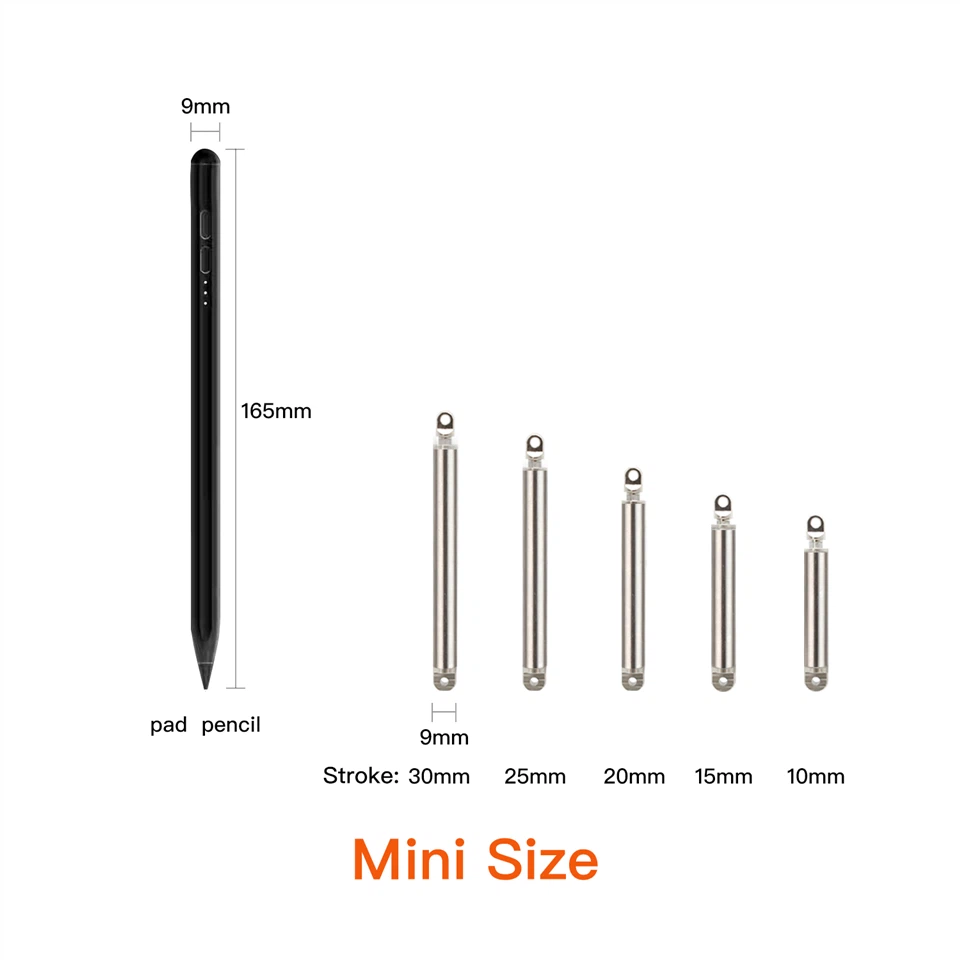
Stroke:25mm (customizable)
Total length: 79mm
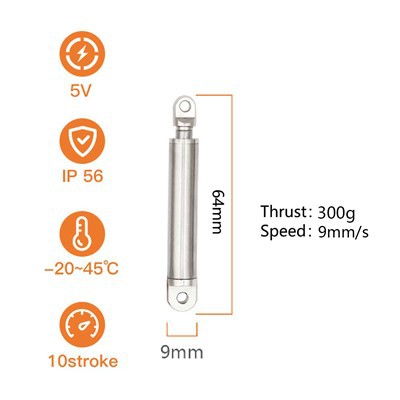
Push-pull force: 300G
No-load push-pull speed: 9mm/s
Protection current: 0.2A
Rated voltage: 5V
Noise: ≤50dB
Protection level: IP56
Self-locking force: greater than 10KG
Product Introduction
The delivery flap of a vending machine or a self-service kiosk asks for a movement that is short, light and repeatable, and that is the KT0905-25H in one line: 25 mm of travel in about 2.8 s with no load, 300 g of push-pull force, and a 10 kg hold that keeps the flap where it was left once the power is off. It runs on the 5 V DC the kiosk already carries, at 0.2 A.
The opening sits where customers reach in and where drinks spill, so the tube and housing are 304 stainless steel and the unit is sealed to IP56 - wipe-down and spray, not immersion - and the drive runs below 50 dB in a public lobby. Behind the panel it takes 79 mm with the travel closed, about 104 mm open.
Product Parameters
| Item | Value |
|---|---|
| Stroke | 25 mm standard |
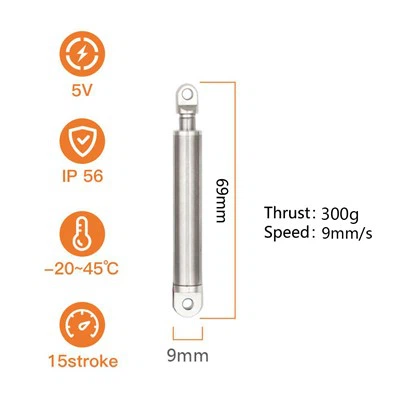
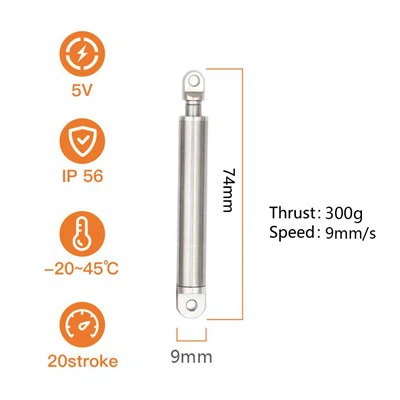
| Stroke options | 10 / 15 / 20 / 25 / 30 mm across the family; longer strokes made to order |
| Overall length | 79 mm with the rod retracted, about 104 mm fully extended (calculated) |
| Push-pull force | 300 g / 3 N, held across the whole stroke |
| Speed | 9 mm/s with no load; about 6 mm/s at full load (fast-version figure for this drive) |
| Travel time | About 2.8 s for the 25 mm stroke with no load, about 4.2 s at full load (calculated from the speed figures) |
| Self-locking force | 10 kg / 100 N with the supply removed |
| Rated voltage | 5 V DC |
| Protection current | 0.2 A - about 1 W at the rated figures (5 V × 0.2 A) |
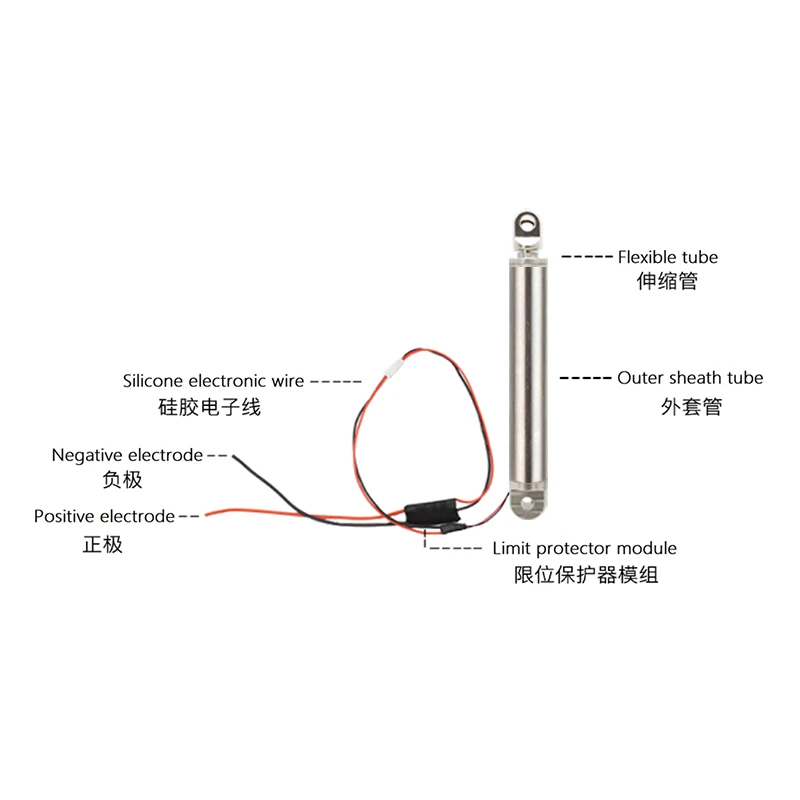
| End of stroke | External limit protection board mounted outside the tube; the drive stops itself at both ends |
| Working duty | 10%; long periods of repeated operation are not recommended |
| Noise | ≤50 dB |
| Protection level | IP56 - dust protected and protected against water jets |
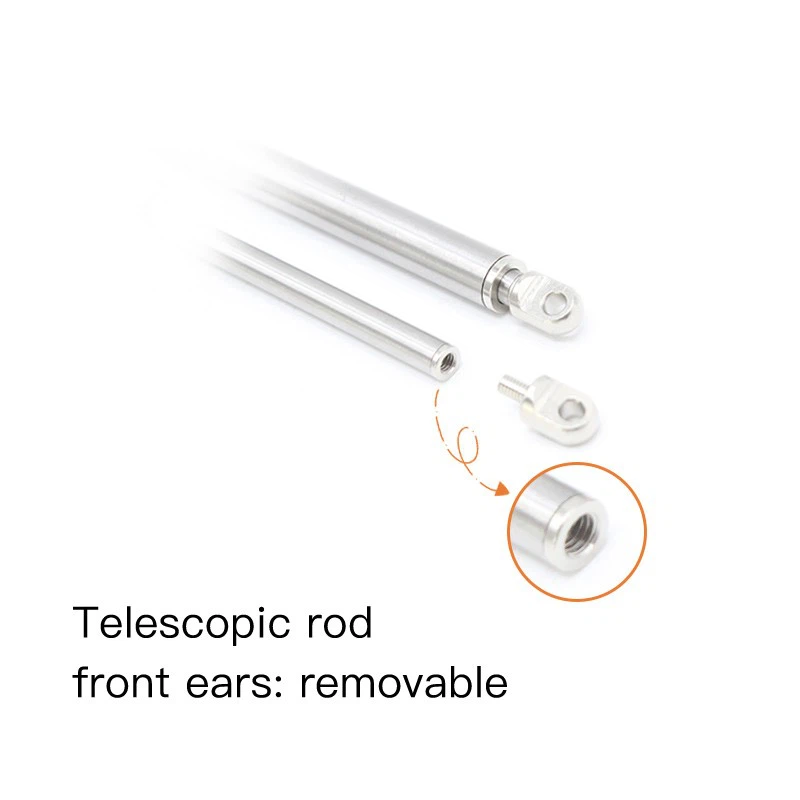
| Materials | 304 stainless steel tube and housing, copper alloy lead screw |
| Drive | 5 V DC motor with a screw drive, rotary to linear |
| Mounting | Horizontal or vertical, with the load guided in line with the rod |
Product Features
- 25 mm of travel in about 2.8 s with no load, about 4.2 s at full load - fast enough that a delivery flap or a shutter clears its opening before the customer decides something has gone wrong
- A 5 V DC, 0.2 A drive - roughly 1 W - so the rod runs from the rail the appliance already carries instead of a separate 12 V or 24 V supply
- A 10 kg self-locking hold after the power is removed, drawing no current while it holds - a flap stays where it was left through a power cut
- 300 g of push-pull force across the whole stroke, not only at the start, so a shutter that stiffens halfway still finishes its travel
- Both end positions set by the external limit protection board, mounted outside the tube, so the 25 mm stroke repeats unit after unit without a stop to adjust on the line
- 79 mm retracted on a body that fits the space behind a panel, with about 104 mm needed in the extended position
- A 304 stainless steel tube and a copper alloy lead screw, for equipment that is wiped down, sprayed or left in a humid room
- Sealed to IP56 at the factory and running below 50 dB, so it can sit next to a customer in a lobby rather than inside a machine room
- Stroke matched to the space rather than the other way round: 10 / 15 / 20 / 25 / 30 mm from stock, longer travel made to order, so the linkage does not have to be redesigned around the rod
- A body and stroke that repeat across the family in 5 mm steps, so a change of travel becomes a change of model number rather than a redesign of the mechanism
- Held at 10 kg with no current, so no brake, no detent and no standby power are needed to keep a flap shut overnight
Applications
KT0905-25H fits one pattern rather than a list of industries: a short, repeated movement of a light part on the appliance's own 5 V rail, where the movement has to be finished and repeatable before the next step in the sequence starts. The device that makes it concrete is the delivery flap of a vending machine or a self-service kiosk. Payment clears, a 25 mm shutter or latch clears the pickup opening, the vend mechanism releases the product, and the flap closes again behind it.
One detail decides whether the flap works in the field: the whole sequence is gated on the movement finishing, so a flap that arrives short or late is a jam rather than a slow sale. A jam in a lobby is a service call over a part worth a few dollars.
- Payment and ticketing terminals - a receipt or ticket shutter that opens on a command from the terminal and stays closed between transactions.
- Food and beverage equipment - a cup-port cover, an access hatch or a dump-door latch on a machine wiped down at the end of every shift.
- Test and laboratory instruments - a port cover, a sample hatch or a probe flap on a bench instrument used on a shared 5 V rail.
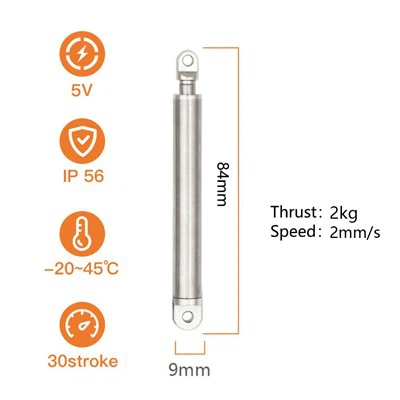
Heavier parts, mechanisms that fight a return spring or a gasket, and movements that need more than 25 mm of travel belong to another member of the same family - the thrust versions move 2 kg over the same strokes, as set out in the model matrix below. Cases grouped by the equipment they serve are collected on the applications hub, with enclosure and smart-device work under electronics and smart home actuators and airflow work under vent and louver actuators.
Model Selection
| Requirement from the programme | KT0905-25H (this page) | KT0905-25L (same 25 mm stroke) | Rest of the KT0905 family (10-30 mm) |
|---|---|---|---|
| A light part that must clear 25 mm in under 3 s | ✓ 9 mm/s, about 2.8 s | ✗ about 12.5 s at 2 mm/s | △ shorter strokes are quicker still; 30 mm takes longer |
| A part that fights a spring, seal or gasket | ✗ 300 g will not compress a seal | ✓ 2 kg | △ thrust versions only |
| Position held with no current after a power cut | ✓ 10 kg self-locking | ✓ 10 kg self-locking | ✓ the same hold across the range |
| Fit inside a housing with under 80 mm of depth | ✓ 79 mm retracted | ✓ 79 mm retracted | △ 10-20 mm bodies are shorter, 30 mm is longer |
| Travel beyond 30 mm | ✗ another family or a made-to-order stroke | ✗ another family or a made-to-order stroke | ✗ made to order |
| A mechanism that must be quiet next to customers | ✓ ≤50 dB | ✓ ≤50 dB | ✓ ≤50 dB |
| Continuous operation, cycle after cycle | ✗ 10% duty, with a rest between strokes | ✗ 10% duty | △ the same limit across the family |
Our Advantages
Every change in the tables further up goes through as a production instruction rather than a sourcing exercise, because the tube, the screw, the drive and the limit board are parts we make ourselves, not bought-in modules carrying someone else's lead time. In practice that shows up at three moments. When a drawing change has to come back with a date rather than a request for a quotation. When the twentieth unit of a batch has to behave exactly like the first, which is what the dimensional, motor, electrical and corrosion checks before packing are for. And when something does fail in the field, when the useful answer is which part of the appliance failed, not a discussion about whose part it was. The range is built under an ISO9001:2015 quality management system and carries CE and RoHS certification; the certificates sit on the certification page, the instruments used in inspection are listed under testing equipment, the plant itself is described under about us, and the warranty and after-sales terms you would be ordering under are collected under why us.
Frequently Asked Questions
Q: How does the rod stop exactly at 25 mm?
A: A: The external limit protection board cuts the drive at the end of the stroke, so the rod stops itself at both ends without a mechanical stop. That is what keeps the end position repeatable over a batch: the setting travels with the stroke, so a made-to-order length arrives with its own end positions rather than with a stop to adjust on the line.
Q: How much force is available, and where in the stroke?
A: A: 300 g / 3 N, held across the whole 25 mm rather than only at the start, so a shutter that stiffens halfway through its travel still finishes. Programmes that have to overcome a return spring, a seal or a gasket are in thrust-version territory, where the same stroke moves 2 kg - the matrix below sets out that trade.
Q: How fast does the rod move, and how often can it run?
A: A: 9 mm/s with no load in about 2.8 s over the 25 mm, and about 6 mm/s at full load, or about 4.2 s. The working duty is 10% and long periods of repeated operation are not recommended, which means about 25 s of rest after a 2.8 s stroke. A kiosk handling a few transactions an hour sits far inside that figure; a machine that has to cycle every few seconds does not. The background to this limit is set out in our note on intermittent operation.
Q: What happens if the flap is blocked, or if the power is cut?
A: A: A blocked flap stalls the drive against its protection current of 0.2 A, which protects the drive rather than the mechanism. On a power cut nothing moves: the screw drive is self-locking at 10 kg, so the rod keeps the position it was left in and draws no current while it does.
Q: Will it survive a kiosk that gets wiped down, or a wet room?
A: A: The tube and housing are 304 stainless steel with a copper alloy lead screw, and the unit is sealed to IP56 in the factory - protected against dust and against water jets, which is what a wipe-down or a spilled drink amounts to. It is built for that, not for immersion.
Q: Which model should I compare before deciding?
A: A: The 25 mm stroke comes in two versions and the choice is between speed and force. KT0905-25H moves 300 g in about 2.8 s; KT0905-25L moves 2 kg at 2 mm/s instead. Strokes of 10, 15, 20 and 30 mm are covered by the rest of the family, and the matrix above shows where each one stops being the right answer. With the load, the travel and the cycles per day known, the choice usually falls out of that matrix without a sample; if one of those three is still open, it is worth settling before the model number is.
Ordering and Contact
Actuators are packed in plain brown kraft cartons, shipping can be arranged by sea, air or land, and the production window of 20-30 days starts after the advance payment is received. For a quotation, send the mechanism drawing or an annotated photo, the mounting points, the required action and the start and end positions, plus:
- The model you are considering - KT0905-25H or the version we recommend for your load
- Working load, and whether the part also fights a spring, seal or gasket
- Expected cycles per day and the target service life of the mechanism
- Available space behind the panel, including clearance for the external limit protection board
- The environment the unit works in, if it is wiped down, sprayed or parked in a humid room
- Prototype quantity or estimated production volume, and your required delivery date
Hot Tags: linear actuator control, China linear actuator control manufacturers, suppliers, factory, actuator electric motor, 6 Volt Linear Actuator with Remoteactuators, Ip56 Linear Actuator, rodless linear actuator, electric hydraulic linear actuator, Fast Linear Actuator
Previous
Stainless Steel Linear ActuatorYou Might Also Like


Send Inquiry