






Stainless Steel Linear Actuator
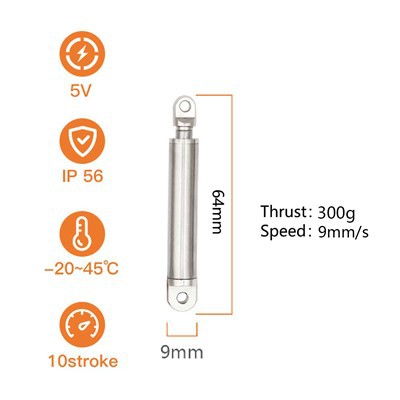
Product model: KT0905-20H
Product material: 304 stainless steel + copper alloy
Stroke:20mm (customizable)
Total length: 74mm
Push-pull force: 300G/3N
No-load push-pull speed: 9mm/s
Protection current: 0.2A
Rated voltage: 5V
Noise: ≤50dB
Protection level: IP56
Self-locking force: greater than 10KG/100N
Product Introduction
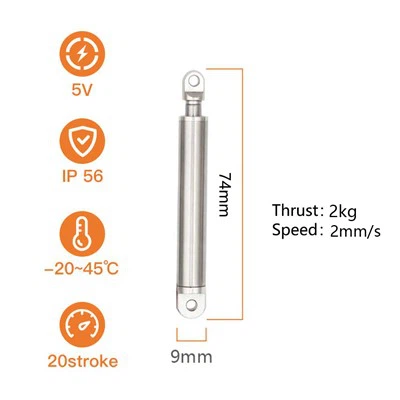
Stainless steel linear actuator KT0905-20H is the fast version of the KT0905 micro rod family at the 20 mm stroke: the same 5 V DC screw drive as the rest of the range, set up to trade force for speed so that a light guided part crosses its full travel in about 2.2 s and is then held there mechanically, with no current left on. The "H" in the model number marks that choice - the thrust version of the same stroke is the KT0905-20L, which moves 2 kg at 2 mm/s. At 20 mm the difference is visible to whoever is holding the glass: about 2.2 s to clear the chute with the fast version against about 10 s with the thrust version.
What separates this model from its neighbours is where it is expected to live. The tube, the housing and the lead screw are 304 stainless steel and copper alloy, and the unit is sealed at the factory to IP56, so it can be mounted inside appliances that are wiped down, sprayed, sanitised or run in a room that is permanently damp - an ice and beverage dispenser, a dispenser over a washroom basin, a food-service hatch - without the housing being the weakest point in the design. It is the model to specify when the movement is short, the part is light, the surroundings are wet and nobody wants to hear the mechanism working.
Product Parameters
| Item | Value |
|---|---|
| Stroke | 20 mm standard |
| Stroke options | 10 / 15 / 20 / 25 / 30 mm across the family; longer strokes made to order |
| Overall length | 74 mm with the rod retracted, about 94 mm fully extended (calculated) |
| Tube sizes | 9 mm outer tube around a 5 mm telescopic rod |
| Push-pull force | 300 g / 3 N, held across the whole stroke |
| Speed | 9 mm/s with no load; about 6 mm/s at full load (fast-version figure for this drive) |
| Travel time | About 2.2 s for the 20 mm stroke with no load, about 3.3 s at full load (calculated from the speed figures) |
| Self-locking force | 10 kg / 100 N with the supply removed |
| Rated voltage | 5 V DC |
| Protection current | 0.2 A - about 1 W at the rated figures (5 V × 0.2 A) |
| Noise | ≤50 dB |
| Protection level | IP56 - dust protected and protected against water jets |
| Materials | 304 stainless steel tube and housing, copper alloy lead screw |
| Drive | 5 V DC motor with a screw drive, rotary to linear |
| End of stroke | External limit protection board mounted outside the tube; the drive stops itself at both ends |
| Working duty | 10%; long periods of repeated operation are not recommended |
| Connection | Two silicone leads, positive and negative; direction set by reversing the polarity |
| Mounting | Horizontal or vertical, with the load guided in line with the rod |
| Weight | About 22.4 g |
Product Features
- 20 mm of travel in about 2.2 s with no load, about 3.3 s at full load - fast enough to clear an opening while the user is still waiting
- 300 g of push-pull force across the whole stroke, not only at the start, so a door that stiffens halfway still finishes its travel
- A 10 kg self-locking hold after the power is removed, drawing no current while it holds
- A 304 stainless steel tube and a copper alloy lead screw, chosen for equipment that is damp, sanitised or washed down
- A 74 mm body on a 9 mm outer tube, for appliance housings that have almost no spare room
- 5 V DC at 0.2 A - roughly 1 W - on the rail the appliance already carries, so no second supply is needed
- Two leads only: polarity sets the direction, so no driver, no encoder and no position routine
- Both end positions decided by the external limit protection board, mounted outside the tube
- Sealed to IP56 at the factory, with running noise below 50 dB
Product details


Customization Options
Stainless steel linear actuator KT0905-20H is a standard model, but very few programmes actually ship the standard version: the stroke, the speed or the lead length usually shifts by a few millimetres or a few centimetres to suit the mechanism that already exists on the drawing. Every change in the table below is meant to land on our side of the drawing rather than yours: a programme should not have to re-cut a housing because a standard rod came up 5 mm short.
| What can be adapted | Standard state | For your programme |
|---|---|---|
| Stroke | 10 / 15 / 20 / 25 / 30 mm across the family | Matched to the travel your mechanism actually needs, including longer strokes |
| Speed class | 9 mm/s fast version (H) or 2 mm/s thrust version (L) | Matched to the time the movement has to take |
| Push-pull force | 300 g (H) or 2 kg (L) | Re-matched to the load and the coupling you are using |
| Rated voltage | 5 V DC | Adapted to the rail the appliance already carries |
| Lead wire | Two silicone leads at a fixed length | Length and connector set to your terminal definition |
| End of stroke | Set by the external limit protection board | Adjusted with the stroke, so both end positions stay repeatable |
| Marking and packing | Plain brown kraft cartons | Labelled and packed to your programme's requirement |
The stroke and the lead length are the two changes that go through with the least disruption. Re-matching the speed or the force depends on the drive and screw specification, and we will say which of them is achievable on the existing tooling and which needs a new drive before either of us talks about dates. The specification is frozen after a sample has been proven in your own build, not before.
Applications
KT0905-20H fits one pattern rather than a list of industries: a short, repeated movement of a light part inside equipment that is damp, sprayed or wiped down, where the part has to be somewhere predictable when the power goes off. Each case below needs the same three things - roughly 20 mm of travel, a closed position that survives a power cut, and a mechanism the user never notices.
- Ice and beverage dispensers - the chute door that clears the ice outlet when a portion is called for and seals again straight afterwards.
- Coffee and hot-beverage machines - a milk or brew-chamber cover, a drip-tray latch or a grounds hatch that opens on command and stays shut between cycles.
- Countertop food-service equipment - a nozzle cover, a portion flap or a small access hatch on a machine that is sanitised at the end of every shift.
- Wash-down and wet-area cabinets - a cover or shutter on a dispenser, sanitiser unit or panel that sits in a permanently humid room.
- Public washroom equipment - a nozzle shutter or service cover on a dispenser housing that gets splashed and cleaned daily.
- Commercial ice machines - an internal baffle, bin door or deflector that has to clear a passage and then hold its position without drawing current.
- Water-treatment and dosing cabinets - a flap over a sensor, probe or service port on a unit exposed to spray and condensation.
Desktop and portable instruments - a small protective shutter or access cover on a device that is stored and cleaned in a damp environment.
Heavier parts, mechanisms that fight a return spring, and movements that need more than 20 mm of travel belong to another member of the same family - the thrust versions move 2 kg over the same strokes, as set out in the selection matrix below. Cases grouped by the equipment they serve are collected on the applications hub, with electronics and enclosure work under electronics and smart home actuators and airflow work under vent and louver actuators.
Our Advantages
Every change in the table further up goes through as a production instruction rather than a sourcing exercise, because the tube, the screw, the drive and the limit board are parts we make ourselves, not bought-in modules carrying someone else's lead time. In practice that shows up at three moments. When a drawing change has to come back with a date rather than a request for a quotation. When the twentieth unit of a batch has to behave exactly like the first, which is what the dimensional, motor, electrical and corrosion checks before packing are for. And when something does fail in the field, when the useful answer is which part of the appliance failed, not a discussion about whose part it was. The range is built under an ISO9001:2015 quality management system and carries CE and RoHS certification; the certificates sit on the certification page, the instruments used in inspection are listed under testing equipment, the plant itself is described under about us, and the warranty and after-sales terms you would be ordering under are collected under why us.
Frequently Asked Questions
Q:Is 300 g enough force to move a chute door?
A:For a light door running on its own guide, yes - that covers most chute covers, flaps, baffles and small hatches in this size class. It will not compress a gasket, beat a return spring or free a door that has jammed on compacted ice; those duties belong to the thrust version of the same stroke, KT0905-20L, at 2 kg.
Q:How fast is the 20 mm stroke, and how often can it run?
A:About 2.2 s with no load (20 mm at 9 mm/s) and about 3.3 s at full load, so a complete open-and-close cycle takes roughly 4.4 s with no load. These are calculated values from the parameter table. The working duty is 10%, which means about 20 s of rest after a 2.2 s stroke if the door is going to be run repeatedly - comfortable for a dispenser that cycles now and then through service.
Q:What happens to the door if the power is cut?
A:Nothing moves. The screw drive is self-locking at 10 kg, so the rod keeps the position it was left in and draws no current while it does. A power failure, a flat backup battery or an idle machine overnight does not leave the chute standing open, which is the failure the melt-water and hygiene problems start from.
Q:Why 304 stainless steel, and what does IP56 actually cover?
A:304 stainless steel and the copper alloy lead screw are specified because the unit sits inside equipment that is wiped down, sprayed or sanitised, where a painted or plated body would be the first thing to fail. IP56 means this component is dust protected and protected against water jets, so splash, spray and a wipe-down routine are covered - it is not an immersion rating, and the unit should not be submerged or left standing in water. Weather protection for the finished appliance is decided by its housing, gasket and cover geometry rather than by the rating of one component inside it.
Q:Does it need a driver, a limit switch or a position sensor?
A:No position sensor and no special driver. Two leads reverse the direction of travel, the drive voltage sets the speed, and the external limit protection board ends the stroke at both ends. Any board that can drive a small DC motor in both directions can drive this rod.
Q:Can the stroke, speed, force and cable be changed?
A:Yes. Standard strokes are 10, 15, 20, 25 and 30 mm, and stroke, speed, force, voltage, lead length and connector can all be adapted for a programme, with longer strokes available on request. Send the mechanism and the supply available in your appliance and we will come back with the version that fits.
Ordering and Contact
Actuators are packed in plain brown kraft cartons, shipping can be arranged by sea, air or land, and the production window of 20–30 days starts after the advance payment is received. For a quotation, send the mechanism drawing or an annotated photo, the mounting points, the required action and the start and end positions, plus:
- The model you are considering - KT0905-20H or the version we recommend for your load
- Working load, and whether the part also fights a spring, seal or gasket
- Available space behind the panel, including clearance for the external limit protection board
- Supply available in the appliance, expected cycles per day and target service life
- Prototype quantity or estimated production volume, and your required delivery date
Hot Tags: stainless steel linear actuator, China stainless steel linear actuator manufacturers, suppliers, factory, electro hydraulic actuator, Stainless Steel Linear Actuator, linear magnetic actuator, fail safe actuator, electric over hydraulic linear actuator, electric lift piston
Previous
Dc Linear ActuatorYou Might Also Like




Send Inquiry