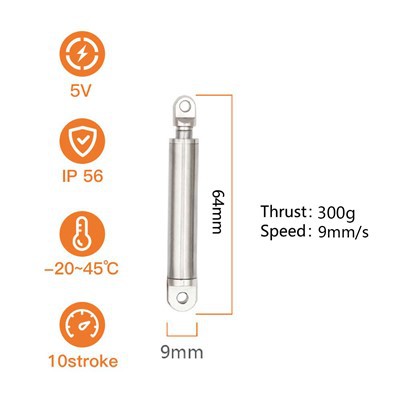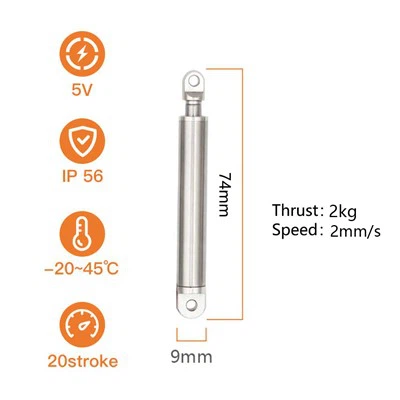
As a supplier of fast linear actuators, one of the most common questions we receive from our customers is about the temperature rise of these devices during operation. Understanding the factors that contribute to temperature rise is crucial for ensuring the long - term performance and reliability of fast linear actuators. In this blog, we will explore the causes of temperature rise, its potential impacts, and how to manage it effectively.
1. Causes of Temperature Rise in Fast Linear Actuators
1.1 Electrical Losses
Fast linear actuators often rely on electrical power to operate. When current flows through the electrical components such as the motor windings, there are resistive losses. According to Joule's law, the power dissipated as heat in a resistor is given by (P = I^{2}R), where (I) is the current and (R) is the resistance. In the context of a linear actuator, the motor windings have a certain resistance, and as current passes through them, heat is generated. This is a fundamental source of temperature rise in electrically - powered fast linear actuators.
1.2 Frictional Forces
Another significant cause of temperature rise is friction. Inside the actuator, there are moving parts such as the screw, nut, and bearings. As these parts move relative to each other, frictional forces are generated. The work done against friction is converted into heat. For example, in a ball - screw linear actuator, the contact between the balls and the screw and nut threads creates friction. The higher the load and the faster the operation speed, the greater the frictional forces and, consequently, the more heat is generated.
1.3 Eddy Current Losses
In some types of linear actuators, especially those with magnetic components, eddy current losses can contribute to temperature rise. Eddy currents are induced in conductive materials when they are exposed to a changing magnetic field. These currents flow in circular paths within the material and result in power dissipation in the form of heat. This is particularly relevant in Linear Motor Actuator where magnetic fields are used for motion control.
2. Potential Impacts of Temperature Rise
2.1 Material Degradation
High temperatures can cause degradation of the materials used in the actuator. For instance, the lubricants used in the bearings and moving parts can break down at elevated temperatures. This reduces the lubricating properties, leading to increased friction and wear. Over time, this can result in premature failure of the actuator. Similarly, the insulation materials in the motor windings can be damaged by high temperatures, which may lead to short - circuits and electrical failures.
2.2 Performance Degradation
Temperature rise can also affect the performance of the actuator. As the temperature increases, the physical properties of the materials change. For example, the expansion of the metal components due to heat can lead to changes in the clearances between the moving parts. This can affect the accuracy and repeatability of the actuator's motion. In addition, the motor's efficiency may decrease with increasing temperature, resulting in reduced power output and slower operation speeds.

2.3 Safety Risks
Excessive temperature rise poses safety risks. If the actuator reaches very high temperatures, it can pose a burn hazard to operators. Moreover, in some applications where the actuator is used in a flammable or explosive environment, high temperatures can be a potential ignition source, leading to serious safety incidents.
3. Measuring Temperature Rise
3.1 Thermocouples
Thermocouples are a commonly used method for measuring temperature in fast linear actuators. A thermocouple consists of two different metals joined together at one end. When there is a temperature difference between the junction and the other ends of the wires, a voltage is generated. By measuring this voltage, the temperature can be determined. Thermocouples are relatively inexpensive, have a wide temperature range, and can be easily installed on the actuator.
3.2 Infrared Thermometers
Infrared thermometers are non - contact temperature measurement devices. They work by detecting the infrared radiation emitted by an object. This method is useful for quickly measuring the surface temperature of the actuator without the need for physical contact. Infrared thermometers are especially handy for measuring the temperature of hard - to - reach or moving parts.
4. Managing Temperature Rise
4.1 Cooling Systems
One of the most effective ways to manage temperature rise is by using cooling systems. There are several types of cooling systems available for fast linear actuators.
- Air Cooling: Air cooling is a simple and cost - effective method. It involves using fans to blow air over the actuator to dissipate heat. The fans can be either internal or external to the actuator. Internal fans are integrated into the actuator design, while external fans can be added as an accessory.
- Liquid Cooling: Liquid cooling is more efficient than air cooling. It uses a coolant, such as water or a special coolant fluid, to absorb heat from the actuator. The coolant is circulated through channels in the actuator body and then passed through a heat exchanger to dissipate the heat. Liquid cooling is often used in high - power and high - performance fast linear actuators.
4.2 Proper Sizing and Selection
Selecting the right actuator for the application is crucial for managing temperature rise. An undersized actuator will have to work harder to meet the load and speed requirements, resulting in higher current draw and more heat generation. On the other hand, an oversized actuator may be more expensive and less efficient. Therefore, it is important to accurately calculate the load, speed, and duty cycle requirements of the application and choose an actuator with appropriate specifications.
4.3 Lubrication and Maintenance
Proper lubrication is essential for reducing friction and heat generation. Using high - quality lubricants that are suitable for the operating temperature range of the actuator can significantly reduce frictional losses. Regular maintenance, including lubricant replacement and inspection of the moving parts, can also help ensure that the actuator operates at optimal conditions and minimize temperature rise.
5. Application - Specific Considerations
5.1 Industrial Automation
In industrial automation applications, fast linear actuators are often used in high - speed and high - load operations. These conditions can lead to significant temperature rise. For example, in a pick - and - place robotic system, the actuator needs to move quickly and accurately to pick up and place objects. In such applications, it is important to use actuators with high - power ratings and effective cooling systems. The Tiny Linear Actuator may be suitable for applications where space is limited but the load requirements are relatively low.
5.2 Medical Equipment
In medical equipment, temperature rise can be a critical issue. For example, in surgical robots or diagnostic equipment, the actuator needs to operate with high precision and reliability. High temperatures can not only affect the performance of the actuator but also pose a risk to the patient. Therefore, medical - grade fast linear actuators often have strict temperature control requirements and may use advanced cooling and insulation techniques.
5.3 Automotive Applications
In the automotive industry, fast linear actuators are used in various applications such as electric power steering and active suspension systems. These applications require actuators to operate under a wide range of temperatures and environmental conditions. For instance, in an electric lift system, such as the Electric Lift Cylinder, the actuator needs to be able to withstand high loads and rapid movements while maintaining a stable temperature.
6. Conclusion
Understanding the temperature rise of fast linear actuators during operation is essential for ensuring their reliable and efficient performance. By identifying the causes of temperature rise, measuring it accurately, and implementing appropriate management strategies, we can extend the lifespan of the actuators and improve their overall performance.
As a supplier of fast linear actuators, we are committed to providing high - quality products and technical support to our customers. If you have any questions about temperature rise or need assistance in selecting the right actuator for your application, please feel free to contact us for procurement and further discussions. We are here to help you find the best solutions for your specific needs.
References
- [1] Johnson, R. C. (2015). Linear Actuator Handbook. McGraw - Hill Professional.
- [2] Smith, A. B. (2018). Electrical Machines and Drives: Fundamentals, Design, and Application. Wiley.
- [3] Brown, C. D. (2020). Mechanical Design of Machine Elements and Machines: A Failure - Prevention Perspective. CRC Press.