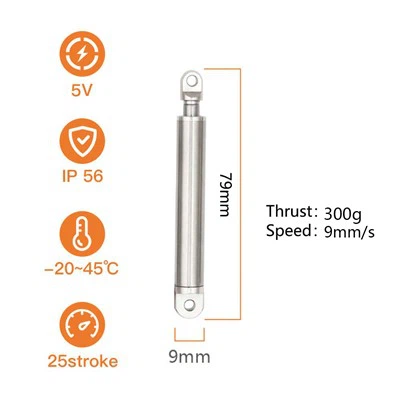
If you’re in the business of moving heavy loads or automating linear motion systems, you’ve likely asked yourself: Can an electric lift cylinder be used in high-altitude areas? As a supplier of electric lift cylinder solutions, I’ve fielded this question more times than I can count, and the answer isn’t a simple yes or no—it depends on understanding how high-altitude conditions interact with the core technology of these devices, paired with smart design and operation adjustments. Let’s break this down, using real-world experience from our team’s work with clients operating in mountainous regions, alpine logistics hubs, and high-altitude construction sites across the globe.
First, let’s ground ourselves in what high-altitude conditions actually do that impacts motion systems. At elevations above 1,500 meters (roughly 5,000 feet), atmospheric pressure drops significantly—for every 1,000 meters of gain, pressure falls by about 12%. This isn’t just a factor for human comfort; it affects the performance of every component that relies on air cooling, motor output, and even lubrication. Contrast that with sea-level operations, where standard actuators are tested, and you start to see the challenge. Early on, I saw clients try to take our off-the-shelf electric lift cylinder from a Denver warehouse (elevation ~1,600 meters) to a mine in Peru’s Cusco region (over 3,400 meters) without adjustments, and they came back with complaints of the motor overheating and the lifting speed dropping by 15%. That’s when we realized that standard components don’t always scale smoothly to high altitudes.
Let’s start with motor performance, the heart of any electric linear actuator. Electric lift cylinders use brushless DC motors (common in DC Linear Actuator products) that are designed to produce torque based on electrical input and cooling. At high altitudes, the thin air reduces the efficiency of passive air cooling—motors rely on moving air over their windings to dissipate heat, and with less air density, that heat transfer drops. The result: the motor can’t handle as much continuous load, or it risks overheating during prolonged use. For clients operating heavy machinery at 4,000 meters, this isn’t a minor inconvenience; a motor failure in a remote alpine location can halt operations for days.
But that’s not a showstopper. Our team’s solution here isn’t to replace the entire motor, but to adjust its rating and cooling method for high-altitude use. We’ve found that derating the motor’s continuous load capacity by 10-15% for every 1,000 meters above 1,500 meters works well. For example, a 5kW motor rated for 100% duty cycle at sea level becomes a 4.25-4.5kW motor at 3,500 meters, a adjustment we integrate into all our high-altitude Electric Lift Cylinder configurations. We also add optional fans that are integrated into the motor housing, using a small, dedicated power supply to pull air directly over the windings—this eliminates reliance on ambient air density, making the cooling consistent regardless of elevation.
Next, let’s talk about actuation speed, a common concern for clients that use fast-moving motion systems. Many of our clients in material handling and assembly lines want rapid cycle times, so they opt for Fast Actuators Linear or Fast Linear Actuator models. At high altitudes, the reduced air density also impacts the performance of any auxiliary systems, like brake fans or solenoids, that might be part of the lift cylinder. I’ve worked with a client in the Swiss Alps that runs a high-speed packaging line at 2,200 meters; when they first deployed our standard fast actuators, the brake solenoid wasn’t engaging properly during rapid stops, leading to minor slippage. The fix was simple: we recalibrated the solenoid voltage to account for the slightly lower air pressure, which changes the way the solenoid’s magnetic field interacts with its core. Now that line runs at its full designed speed, no issues.
Lubrication is another often-overlooked factor in high-altitude performance. Most electric lift cylinders use synthetic greases that are stable across temperature ranges, but at high elevations, the combination of lower pressure and often colder temperatures (alpine regions can see 0°C or lower even in summer) can change the grease’s viscosity. Thick grease increases the friction in the cylinder’s seal and rod, which adds load to the motor and reduces efficiency. Our team worked with a lubrication specialist a few years back to develop a high-altitude-specific grease blend that maintains its viscosity between -20°C and 60°C, even at pressures as low as 50 kPa (which is what you find at 5,500 meters). We integrate this grease into every high-altitude Linear Motor Actuator and lift cylinder we ship, and it’s made a huge difference for clients operating in very cold, high locations like the Himalayas or the Andes.

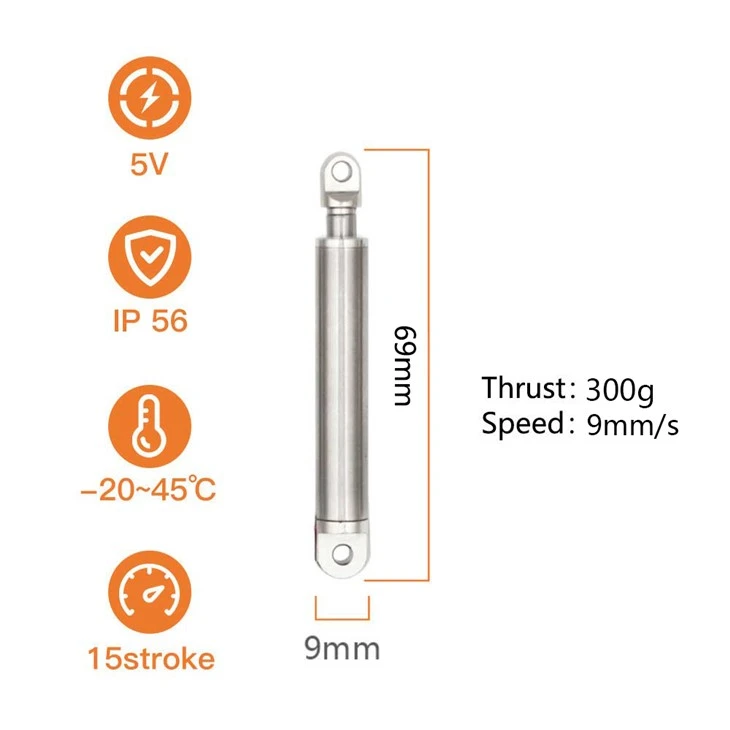
But wait—are there any scenarios where electric lift cylinders just don’t work at high altitudes? The only time we advise against using them is in extreme elevations above 5,500 meters, where the air is so thin that even our optimized cooling systems struggle, and battery performance (if the cylinder is battery-powered) drops significantly due to lower oxygen levels affecting battery chemistry. There are also specialized applications, like some high-altitude aerospace testing, that require custom-designed actuators with pressure-sealed housings, but for industrial, construction, and logistics uses up to 5,000 meters, electric lift cylinders are more reliable than their hydraulic counterparts.
Speaking of hydraulic counterparts, that’s a key comparison our clients always make. Hydraulic lift cylinders rely on fluid pressure, but at high altitudes, the fluid’s boiling point drops (since boiling occurs when vapor pressure equals atmospheric pressure). A hydraulic cylinder operating at 3,500 meters will have a boiling point about 10°C lower than at sea level, so if it’s under high load and generates heat, the fluid can boil, leading to cavitation and system failure. Electric lift cylinders, by contrast, don’t use hydraulic fluid—their motion comes from a motor driving a lead screw or ball screw, so they have zero risk of fluid boiling or leakage, which is a massive benefit for high-altitude sites where maintenance is hard to access and spills are difficult to clean up.
Another advantage of electric lift cylinders in high altitudes is precision. Clients in the wind energy industry, for example, operate at 2,000-3,000 meters to access wind turbines, and they need lift cylinders that can adjust turbine blades to exact angles. Our electric lift cylinders have positional accuracy within 0.1mm, regardless of elevation, because their control systems are digital and don’t rely on hydraulic fluid pressure (which can be inconsistent with changing atmospheric conditions). We’ve supplied dozens of these to wind farms in the Patagonian Andes, and their operators report that the actuators perform just as well as they did at sea-level test sites.
Of course, it’s not just about the cylinder itself—installation and maintenance play a role too. High-altitude sites often have less infrastructure, so clients need actuators that are easy to repair with standard parts. That’s why all our high-altitude DC Linear Actuator and electric lift cylinder parts are interchangeable with our standard lines, so if a seal or motor controller fails, they can replace it on-site without waiting for a custom shipment from the coast. We also provide a free 15-minute onboarding call for every high-altitude client, walking them through the specific adjustments needed for their elevation, whether that’s motor cooling settings or lubrication checks.
I remember a client in Bolivia’s Altiplano region, which is at 3,800 meters, who was using hydraulic lift cylinders for loading heavy mining equipment. They were dealing with monthly fluid leaks, downtime of 2-3 days each time, and rising maintenance costs. They switched to our high-altitude electric lift cylinders two years ago, and in that time, they’ve only had one minor issue— a blown fuse, which they fixed in 10 minutes. The total maintenance cost for those cylinders is now less than 10% of what they spent on hydraulics, and their production uptime has increased by 22%. That’s the kind of real-world result that makes all the engineering work worth it.
So, to circle back to the original question: Can an electric lift cylinder be used in high-altitude areas? The answer is a resounding yes—if you choose a model that’s designed and optimized for high-altitude conditions, not just a standard off-the-shelf unit. The key factors to address are motor cooling, load derating, lubrication, and control system calibration, all of which our team integrates into every high-altitude Electric Lift Cylinder we build. For applications requiring rapid movement, our Fast Actuators Linear and Fast Linear Actuator lines can be adjusted to maintain speed and reliability at elevation, while our Linear Motor Actuator models offer ultra-high precision for tasks like blade adjustment or medical equipment in mountain clinics.
If you’re operating in a high-altitude location and evaluating linear motion solutions, don’t settle for one-size-fits-all components. Our team has decades of experience working with clients across mountainous regions, and we can help you design a custom electric lift cylinder setup that fits your specific elevation, load, and cycle needs. Whether you’re a mining operator in Peru, a wind farm manager in the Swiss Alps, or a logistics provider in the Himalayas, we’re here to walk you through the options, address your questions, and make sure your motion systems work as reliably at 4,000 meters as they do at sea level. Reach out to our team today to discuss your project and get a tailored solution.
References
- Altitude Effects on Electric Motor Performance: A Technical Review of Industrial Motion Systems, 2021, Motion Control Engineering Journal
- High-Altitude Lubrication Standards for Linear Actuators, 2022, International Journal of Precision Engineering and Manufacturing
- Hydraulic vs. Electric Linear Actuators in Extreme Environments, 2023, Industrial Maintenance & Operations Magazine
- Atmospheric Pressure and Actuator Solenoid Calibration, 2020, IEEE Transactions on Industrial Electronics