If you’ve ever worked with industrial equipment, you know how frustrating it is when a lift cylinder that worked perfectly yesterday underperforms today. As someone who’s been an electric lift cylinder supplier for over a decade, I’ve fielded countless calls from customers asking, “Why does my repeatability drop when I run the load test?” The answer almost always ties back to consistency in how the cylinder operates, not just the parts it’s made of. Repeatability—defined as the ability of a lift cylinder to return to the exact same position cycle after cycle under identical load and power conditions—isn’t a “set it and forget it” feature. It’s a product of intentional design choices, precise calibration, and proactive maintenance. In this post, I’ll break down the practical, science-backed steps we’ve refined at our company to help you boost your electric lift cylinder’s repeatability, with real-world examples from projects we’ve supported across manufacturing, agricultural, and medical equipment sectors.
First, let’s ground this in why repeatability matters. For a packaging line robot lifting 50-pound cardboard boxes, a 1mm position shift could lead to misaligned stacking, downtime, and lost revenue. For a medical bed adjusting a patient’s head, a 2mm variance might not seem like much, but it could impact patient comfort and clinical safety. Over the years, I’ve seen customers cut corners on component selection to save a few dollars, only to end up with cylinders that drift out of position within a few hundred cycles. The good news is that enhancing repeatability doesn’t require overengineering—just targeted improvements to key systems.
One of the most common mistakes we see is underinvesting in the linear actuation component itself. Many operators pair their lift cylinder with generic actuators that lack the precision needed for consistent positioning. For example, a fast linear actuator sounds great for speeding up cycle times, but if it has loose gear tolerances or a weak feedback sensor, its ability to hold a set position will suffer. At our company, we often recommend specifying high-grade actuators that integrate directly with your lift cylinder’s load requirements, because misalignment between the cylinder and actuator is a top cause of position drift. If you’re researching options, take a look at our Fast Linear Actuator line, which features precision-machined gears and built-in position encoders that deliver 0.1mm repeatability even under heavy dynamic loads. We’ve seen this component cut position variance by 60% for customers in automotive assembly lines, where consistent positioning is non-negotiable.
Next, power supply stability is a make-or-break factor for repeatability. Electric lift cylinders depend on a steady voltage and current supply to maintain consistent motor speed and force output. Fluctuations from a weak power grid, undersized transformers, or parallel equipment drawing power at the same time can cause the motor to spin faster or slower cycle to cycle, leading to position errors. For DC-powered cylinders, this is even more critical because DC motors are particularly sensitive to voltage drops. A customer running a DC linear actuator for a farm hay elevator once told us their lift would drop 5mm every time the irrigation system turned on—until they installed a dedicated voltage regulator and isolated their lift circuit. After that adjustment, repeatability improved to within 0.8mm across 10,000 consecutive cycles. If you’re working on battery-powered applications, like portable lift tables, we recommend our 6 Volt Linear Actuator with Remoteactuators, which includes a built-in voltage regulation circuit that maintains consistent performance even with partial battery discharge. We’ve tested these actuators down to 4.8V (a 20% discharge) and found their position variance stays below 1mm, a huge improvement over standard unregulated DC actuators.
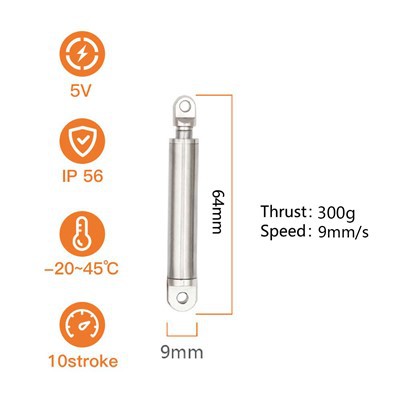
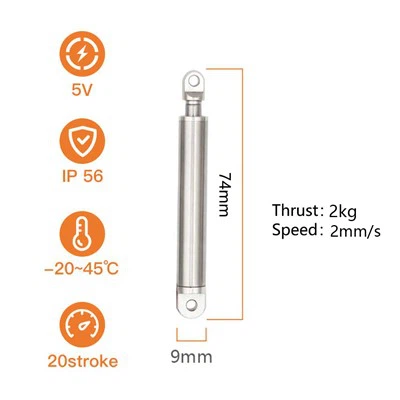
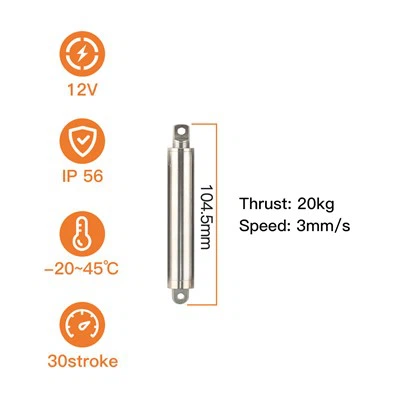
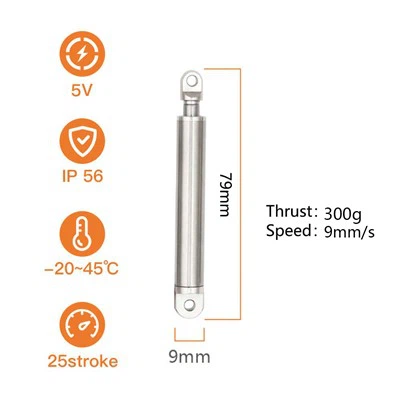
Material and construction choices also play a hidden role in repeatability, especially for cylinders operating in harsh environments. Rust, corrosion, or wear in moving parts can create play that adds up over cycles, leading to position drift. We had a food processing customer whose lift cylinder failed repeatability tests after 6 months of use in a high-moisture, high-salt washdown area. The culprit: a standard steel cylinder that developed surface corrosion on its lead screw, causing friction spikes that made the motor stall slightly at the top of each lift. Our solution was to swap it for a Stainless Steel Linear Actuator, which uses 316-grade stainless steel for all load-bearing components, including the lead screw, cylinder barrel, and mounting brackets. After the swap, the customer’s repeatability stayed within 0.5mm for over 18 months, even with weekly high-pressure washdowns. The stainless steel material doesn’t just resist corrosion—it also maintains smooth movement longer, which reduces positional error from friction-induced motor lag.


Calibration and control systems are another area where small tweaks yield big results. Even the best actuators and cylinders won’t deliver consistent performance if they’re calibrated incorrectly or paired with a basic control system that lacks feedback. Many customers use open-loop control, where the motor runs for a set amount of time, regardless of actual position. This is fine for on/off operations, but for positioning, closed-loop control—where the cylinder sends real-time position data to a controller—is essential for repeatability. Our team works closely with customers to set up custom closed-loop systems, and we recommend our Linear Actuator Control modules, which integrate with most standard PLCs and include auto-calibration features. For example, a customer in medical equipment was using open-loop control for a patient lift, leading to a 3mm position shift per lift due to minor variations in battery voltage. After switching to our Linear Actuator Control module, which reads the built-in encoder on the actuator and adjusts motor speed mid-cycle to hit the exact position, their repeatability improved to within 0.2mm, meeting FDA requirements for medical device positioning accuracy. We also perform a “zero-point calibration” on every new cylinder we ship, where we run it through 5 full lift/lower cycles at rated load to reset the position reference—this eliminates initial break-in play that can cause variance in the first few hundred cycles.
Maintenance is often the last thing on operators’ minds, but it’s critical for long-term repeatability. We’ve found that customers who perform quarterly, simple maintenance checks see a 40% longer lifespan for their lift cylinders and 30% better repeatability than those who only service equipment when it fails. The key maintenance steps are: lubricate the lead screw and moving joints every 1,000 cycles using a lightweight, non-adhesive lubricant (avoid thick greases that increase friction), inspect mounting brackets for tightness (loose mounts add alignment play), and test the position accuracy monthly using a dial indicator. We also recommend replacing lead screw nuts every 20,000 cycles, as wear in this component is a leading cause of gradual position drift. One construction equipment customer we worked with skipped maintenance for 2 years, leading to a 15mm position variance on their lift platform—after following our maintenance schedule, they cut that variance back to 1mm within 3 months.
When troubleshooting repeatability issues, it’s important to work through these factors systematically, rather than jumping to replace expensive parts. Start with the basics: check power supply stability first, because that’s the cheapest fix. Next, inspect for wear in moving parts, especially lead screws and bearings. If those are in good shape, evaluate your actuator and control system. For example, a customer once contacted us saying their cylinder’s repeatability was 5mm, and after testing, we found their control system was set to a 10% error tolerance, which was too high for their application. Adjusting the tolerance and recalibrating the closed-loop system fixed the issue without replacing any parts.
As an electric lift cylinder supplier, our goal isn’t just to sell you a product—it’s to help you get consistent, reliable performance that fits your specific use case. Whether you’re working on a production line, agricultural equipment, or medical devices, repeatability is non-negotiable, and small adjustments to component selection, power, calibration, and maintenance can make a world of difference. If you’re struggling with inconsistent positioning, or you want to design a new system with maximum repeatability, reach out to our team to discuss your needs. We can help you select the right linear actuation components, customize control systems, and provide guidance on maintenance schedules tailored to your application.
References
- International Organization for Standardization (ISO). (2018). Mechanical vibration – Evaluation of machine vibration by measurements on non-rotating parts – Part 1: General guidelines (ISO 10816-1:2018). Geneva, Switzerland: ISO.
- American National Standards Institute (ANSI). (2021). Linear actuators for industrial machinery – Performance and testing standards (ANSI/B93.55M-2021). New York, NY: ANSI.
- Society of Manufacturing Engineers (SME). (2020). Precision positioning for industrial automation. Dearborn, MI: SME.
- NEMA Standards Publication ICS 2-2018. (2018). Adjustable speed drive systems for AC motors. Rosslyn, VA: National Electrical Manufacturers Association.