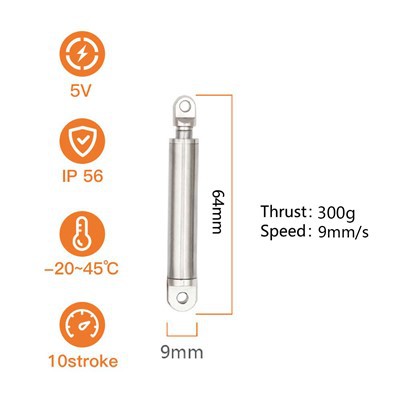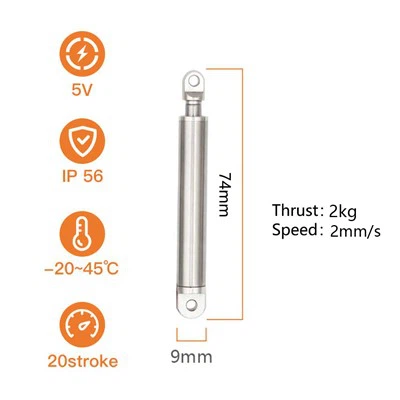
Hey everyone, let’s talk about something I get asked almost every single day as a 6V electric actuator supplier: How long actually does a 6V electric actuator last? I’ve had contractors, hobbyists, and even engineering teams hit me up with this question, and honestly, it’s not a one-word answer. It depends on so many factors—stuff most people don’t think about when they’re browsing for parts, like how you use it, what environment you stick it in, and even how often you maintain it. Today, I’m breaking this down like we’re hanging out in the warehouse (well, over a laptop, but same vibe) and spilling the real tea on actuator lifespans.
First, let’s get one thing straight: not all 6V electric actuators are created equal. If you’re grabbing a cheap off-brand one off Amazon that costs $20 and says it’s “heavy duty,” that’s a whole different story than a quality built unit. That’s why it’s worth checking out our Electric Actuator 6V page—we design these for consistent, reliable use, not just short-term gimmicks. But before I dive into specs, let’s get into the nitty gritty of what makes an actuator tick, because that’s where the lifespan lives.
The core parts of any electric actuator (whether it’s a Electric Linear Actuator, a Fast Electric Actuator, or a Electric Motor Linear Actuator 6V) are the motor, the gearbox, the drive screw, and the seals. Each of these parts has its own wear points, and how you treat each one adds up to the total lifespan. Let’s go one by one.
The motor is the heart of it. For 6V units, most are DC motors—small, powerful, but not indestructible. If you’re running it at full load 24/7, that motor’s gonna heat up, and heat is the #1 enemy of motor windings. Insulation breaks down, and suddenly you’ve got a short that kills the motor in a few months. But if you’re using it periodically—like for a RV slide-out that only runs when you set up camp—those windings stay cool. Our 6V actuators are designed with thermal cutoffs, so they shut down before overheating, which is a big reason they last longer than no-name ones.
Then there’s the gearbox. Most 6V actuators use plastic or metal gears. Plastic ones are lighter and quieter, but they chew up faster under heavy load. Metal gears (usually steel or brass) are tougher—they can handle higher forces without stripping. This is where a lot of people cut corners. I’ve seen guys put a 200lb load on a actuator rated for 100lb, and the gears strip in a week. That’s not the actuator’s fault—That’s user error. When you pick a Electric Linear Actuator 6V, you have to match the load to the rating. If you’re not sure, hit us up—we’ll help you size it right, no pressure.
The drive screw is next—this is the part that actually moves the load, like a big threaded rod. Most are either trapezoidal or ball screws. Trapezoidal are cheaper, simpler, but have more friction. Over time, that friction wears down the screw and the nut, leading to slop or no movement at all. Ball screws are more efficient, have less friction, and last way longer—great for high-cycle applications. But even ball screws get gunked up if you don’t lubricate them. Dust, dirt, rain—all that stuff gets in the actuator if the seals are bad, and it grinds on the screw. That’s why quality seals matter, which is another thing we prioritize in our units.
Now, let’s get to the actual numbers. I’m not gonna give you a vague “5-10 years” because that’s useless. Let’s split it into use cases, because that’s what really determines lifespan.
First, light-duty, intermittent use. Think: a toy that moves, a small desk adjuster that you use once a day, a garden gate that opens once a week. For this, a good quality 6V actuator (like the ones on our Electric Actuator 6V page) can last 10,000 to 15,000 cycles. Wait, what’s a cycle? One full extend and retract—so if your gate opens 5 times a week, that’s 5 cycles a week, 260 cycles a year. 15,000 cycles would be like 57 years? No, wait, maybe my math is off, but even 10,000 cycles is 38 years if you use it 5 times a week. That’s way longer than most people will keep their gate! But obviously, that’s the best case.
Medium-duty, occasional regular use. This is stuff like a RV slide-out that runs every time you travel, a workbench lift you use a few times a day, a small automated door that runs a few times a day. Here, you’re looking at 5,000 to 10,000 cycles. If you use it 10 times a day, that’s 3,650 cycles a year—so 10,000 cycles is about 2.7 years? Wait, no, wait, maybe I should clarify: cycles depend on the application, not just frequency. If you’re running a medium load (say, 50lb on a actuator rated for 100lb) and not overheating, you’re at the higher end of that range. Skip the overloading, keep it lubricated, and you’ll hit 10k cycles easy.
Heavy-duty, high-cycle use. This is where the big boys come in—like industrial equipment, automated machinery, a door that runs hundreds of times a day. For these, you need a tough unit, like our Fast Electric Actuator or heavy-duty Electric Linear Actuator variants. Here, lifespans are measured in 100,000+ cycles. Wait, that’s a huge jump, but it’s because we use metal gears, ball screws, and better motor insulation. Industrial actuators like this can run 24/7 for years, as long as you do basic maintenance—lubricate the screw every few months, check the connections for wear, don’t overload it. I’ve got a customer in the packaging industry who’s been running our 6V heavy-duty actuators on their sorting machines for 7 years, and they’re still going strong. That’s not luck—that’s good design and proper use.
But wait, there are things that kill lifespan way faster than use. Let’s talk about the mistakes people make all the time. First, overloading. I can’t stress this enough. If your actuator is rated for 100lb, don’t put 120lb on it “just this once.” The motor has to work harder, generates more heat, the gears bend, and that’s a one-way ticket to actuator death. Second, ignoring maintenance. Yeah, I know, it’s a actuator, not a car, but it needs a little TLC. Wipe off dirt from the outside, check the screw for lubrication (most actuators have a grease fitting or a port for this), make sure the wiring isn’t frayed. If you skip this, dust will get in, friction will go up, and parts will wear out in half the time. Third, environmental stuff. If you stick a 6V actuator outside in the rain without any weather sealing, the motor will get water in it, the gears will rust, and that’s game over. Our Electric Actuator 6V units have IP-rated housings, so they can handle dust and rain, but they’re not for full submersion—keep that in mind. Fourth, wrong voltage. Wait, it’s a 6V actuator, right? Don’t plug it into 12V! That’ll make the motor spin way too fast, overheat instantly, and burn out in minutes. Always match the voltage to what the actuator needs.
Another thing I get asked: What about “failure modes”? Most actuators don’t just die out of nowhere. You’ll get warning signs first. Sluggish movement, weird noises (grinding, clicking), the motor getting hot when it never used to, or it stopping mid-cycle. If you notice these, check the load, clean the screw, make sure the voltage is right. Catching it early can double the lifespan. I’ve had customers send back actuators that were “broken” because they just needed a quick lube—no charge, no hassle, because that’s the kind of service we do.
Wait, let’s circle back to quality vs. cheap. I’ve seen cheap 6V actuators that died after 100 cycles. Those are the ones with plastic gears that strip, cheap motors that overheat, and no seals. When you’re looking for a reliable 6V actuator, it’s worth paying a little more up front because you won’t have to replace it every few months. Our line, including the Electric Linear Actuator 6V, is built with commercial-grade components, so even in medium-duty use, you’re looking at years of life, not months.
Let me give you a real example. A few months back, a guy hit me up from a RV company. He said their old 6V actuators were dying on the slide-outs every 6 months, costing them a fortune in repairs and customer complaints. We swapped them out for our heavy-duty Electric Motor Linear Actuator units. A few weeks ago, he messaged me saying they’ve been running 8 months, no issues, and the customers are happy. That’s the kind of result you get when you pick a quality product and use it right.
So to wrap this up, what’s the actual lifespan of a 6V electric actuator? It’s:
- Light use: 5–15+ years (10k–15k cycles) with proper care
- Medium use: 2–7 years (5k–10k cycles) if sized right and maintained
- Heavy-duty use: 5+ years (100k+ cycles) for commercial-grade units
But that’s only if you do your part: size it for the load, use the right voltage, maintain it, and don’t skimp on quality. If you cut corners, you’ll get a cheap unit that dies fast. If you invest in a good one and take care of it, it’ll last longer than most of your other gear.


Hey, if you’re not sure which Electric Actuator 6V is right for your project—whether it’s a hobby build, a industrial setup, or something in between—hit us up. We don’t do pushy sales pitches, we just help you pick what works. No weird hidden fees, no junk parts. Just straight talk and quality actuators that last.
References:
- Actuator Lifecycle Testing Standards. International Electrotechnical Commission (IEC).
- DC Motor Performance and Thermal Management for Low-Voltage Actuators. IEEE Transactions on Industrial Electronics.
- Linear Actuator Load Sizing and Maintenance Guide. Motion Control Association.
- Environmental Protection Classifications for Industrial Actuators. National Electrical Manufacturers Association (NEMA).