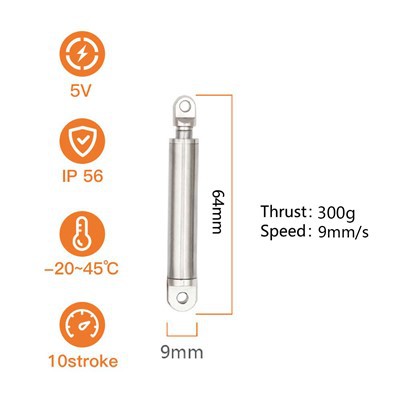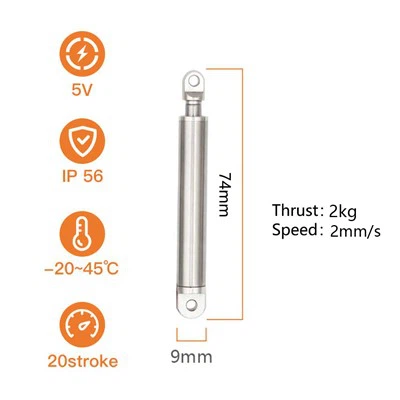
If you’re deep in industrial automation, packaging lines, medical devices, or even 3D printing, you’ve probably run into linear motor actuators—those high-speed, precise workhorses that move stuff back and forth without all the messy gears, belts, or screws of traditional actuators. And if you’re shopping around for one, you’ve definitely asked this question: how efficient are these things anyway? Because efficiency isn’t just a buzzword here; it’s how you save energy, cut down on wear and tear, and keep your production lines running without blowing your budget. I’ve been selling these actuators for years, so let’s break this down like we’re geeking out over the nuts and bolts, not writing a textbook.
First off, let’s get the basics straight. Efficiency, in simple terms, is just how much of the energy you put into the actuator actually turns into useful work. No machine is 100% efficient, right? All that lost energy becomes heat, friction, or noise—stuff you don’t want. For linear motor actuators, most folks I talk to guess it’s somewhere in the 50-70% range, but that’s actually a rough estimate. The real efficiency depends on a ton of factors, and I’m not just talking about “it’s a good vs. bad brand” here (though that matters too). I’ve seen some actuators hit 90% efficiency, and others flop at 40%—it all comes down to design, load, speed, and how you control it.
Let’s start with the core of how these things work, because that’s where efficiency starts. A linear motor is basically a rotary motor that’s been unrolled flat. Instead of spinning a shaft, it pushes a magnetic plate (the forcer) back and forth along a track. No gearbox, no lead screw, no belts—less moving parts, right? That’s a huge win for efficiency compared to, say, a ball screw actuator, which loses energy to thread friction and gear slippage. Traditional ball screw actuators usually top out at 70-80% efficiency, but linear motors? Because there’s almost no mechanical contact between the forcer and the track (they use magnetic levitation or air gaps), friction is minimal. That’s why their baseline efficiency is way higher—usually 85-95% for the motor itself. But wait, that’s just the motor part. The whole actuator system, including the controller and any support components, brings that number down a bit.
Here’s the thing that trips a lot of buyers up: efficiency isn’t a one-size-fits-all number. A lot of my customers come to me asking, “What’s the efficiency of your Fast Actuators Linear” (you can check those out here: /electric-linear-actuators/fast-actuators-linear.html) and expect a single percentage. But if you run that same actuator at full speed with a heavy load vs. slow speed with a light load, the efficiency will change. Let me explain. At low speeds, the motor has to push a lot of current just to overcome static inertia and magnetic resistance—more lost energy as heat, so efficiency drops. At high speeds, you might hit what’s called “back EMF,” which is the voltage the moving magnets generate on their own. That back EMF fights against the input voltage, so you have to crank up more current to keep the forcer moving, which again adds to energy loss. The sweet spot is usually mid-range speeds and loads, where you’re getting the most work out of every watt you put in. I always tell my customers to test their specific application, not just rely on the spec sheet.
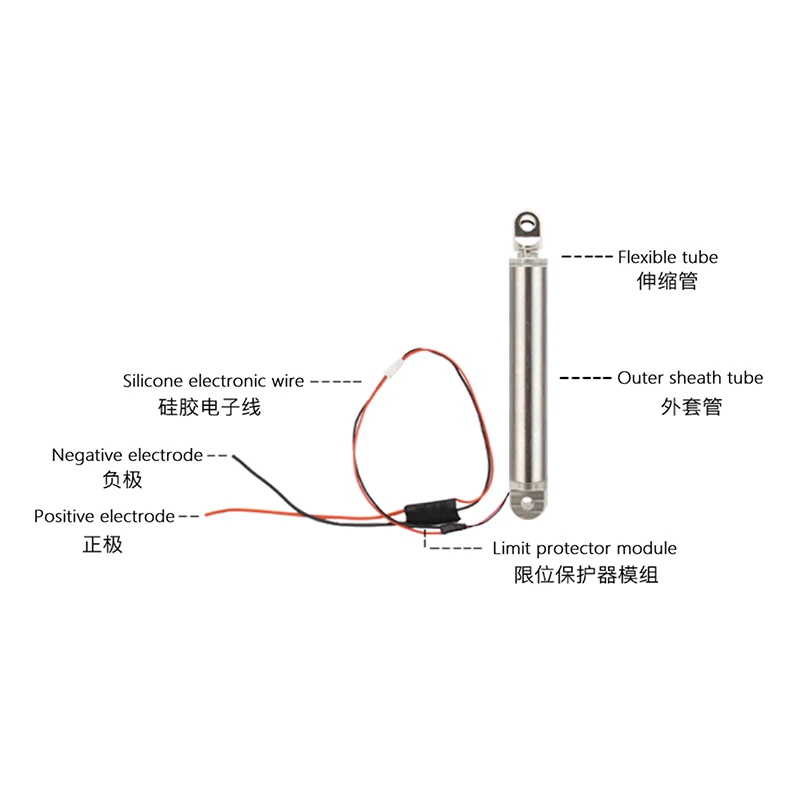

Another big factor is the control system. You can have the most efficient linear motor in the world, but if you pair it with a janky controller, you’re going to lose a ton of energy. That’s why so many folks are happy with our Linear Actuator Control solutions (/electric-linear-actuators/linear-actuator-control.html) — these controllers are tuned specifically to match our actuators, so they deliver power exactly when and where it’s needed. No overloading the motor with extra current, no unnecessary heat buildup. Some of the older, cheaper controllers use on-off switching that’s super inefficient, but modern servo controllers (which is what we use) use pulse-width modulation (PWM) that adjusts the power smoothly, boosting overall system efficiency by 10-15% compared to basic controls. I had a customer last year who switched from a competitor’s generic controller to ours on a packaging line, and they cut their energy bill for that line by 12% in the first month—no joke.
Wait, what about different types of linear actuators, like electric lift cylinders? We get a lot of questions about Electric Lift Cylinder (/electric-linear-actuators/electric-lift-cylinder.html) too, since those are super common for lifting heavy loads in material handling. Lift cylinders are a bit different from high-speed linear motors because they’re designed for static loads, not constant back-and-forth movement. Their efficiency is still high—usually around 80-88%—but again, it depends on the load. If you’re lifting a load that’s way too heavy for the cylinder, you’re wasting energy just holding it up; if it’s too light, the motor is running inefficiently at low torque. DC Linear Actuator (/electric-linear-actuators/dc-linear-actuator.html) units, which are smaller, often used in robotics or medical devices, tend to be a touch less efficient than their AC counterparts because DC motors have brushes that wear out and create friction. But even our best DC linear actuators hit around 80% efficiency, which is way better than old pneumatic or hydraulic systems (those are usually 20-50% efficient, for context—yikes).
Let’s talk about real-world examples, because numbers mean nothing without context. I recently worked with a CNC machine shop that was using ball screw actuators for their tooling. They were seeing about 65% efficiency, which meant for every 1000W they put in, only 650W was moving the tool. They switched to our Fast Linear Actuator (/electric-linear-actuators/fast-linear-actuator.html) system, and their efficiency jumped to 89%. That might not sound like a huge difference, but over a 10-hour day, that’s saving them 2400W of energy—enough to run an extra computer or a light in their break room. And since there’s less friction, their actuator parts lasted 30% longer, so they didn’t have to replace them every 6 months like they were before. That’s the real value of efficiency for these guys—lower operating costs, less downtime, more money in their pockets.
Of course, no discussion of efficiency is complete without talking about losses. For linear motors, the main losses are copper loss (electricity heating up the motor windings) and iron loss (the magnetic cores getting hot). Friction is almost negligible, which is why these actuators outperform traditional ones. The good news is that modern design has minimized these losses a lot. We use high-grade copper windings in our motors to reduce copper loss, and laminated iron cores to cut down on iron loss. We also optimize the air gap between the forcer and the track—too big, and you lose magnetic strength; too small, and you get more friction and heat. It’s a balance, but one we’ve nailed over the years.
Here’s a common myth I hear all the time: “Linear motor actuators are too inefficient to be worth it.” That’s just not true anymore. The technology has come a long way, and compared to pneumatic and hydraulic systems, they’re way more efficient. Pneumatics, for example, waste a ton of energy compressing air, and most of that heat just goes up in the air, not to moving the load. Hydraulics leak, have lots of moving parts, and lose energy through fluid friction. Linear motors? No compression, no fluid, minimal friction. Even compared to other electric actuators, they win on efficiency. I always tell customers to do a total cost of ownership (TCO) calculation, not just look at the upfront price. A $2000 linear actuator might save you $500 a year on energy vs. a $1000 ball screw actuator, and last twice as long. That math adds up fast.
Another thing to consider: efficiency at different duty cycles. If you’re using an actuator for continuous operation—like a conveyor line that runs 24/7—efficiency is way more important than if you’re using it for occasional tasks, like a medical device that runs a few times a day. For high-duty-cycle applications, every percentage point of efficiency counts. A customer in the automotive industry used our actuators for a welding line that runs 24/5, and they calculated that our 88% efficient actuators saved them over $15,000 a year on energy compared to their old pneumatic system. That’s a huge number, and it’s all because of efficiency.
So, what’s the takeaway here? The efficiency of a linear motor actuator isn’t a single number—it’s a range that depends on design, load, speed, control system, and application. But on average, you’re looking at 80-95% efficiency, which is way higher than traditional actuators like ball screws, pneumatics, or hydraulics. That means lower energy costs, less maintenance, longer part life, and faster, more precise movement for your operations.
If you’re ready to see how much efficiency your operations could gain by switching to a linear motor actuator, we can help. We’ve got a wide range of solutions, from fast actuators for high-speed lines to linear actuators for delicate medical devices, plus all the control and support you need to make sure your system runs as efficiently as possible. Shoot us a message to chat about your specific application, and we’ll help you find the right actuator for your needs.
References
- Bolton, W. (2017). Mechatronics: Electronic Control Systems in Mechanical and Electrical Engineering. Pearson Education Limited.
- Kinematic Design for Linear Motor Actuators. (2021). IEEE Transactions on Industrial Electronics, 68(12), 11892-11901.
- Energy Efficiency of Linear Actuator Systems for Industrial Automation. (2022). Journal of Manufacturing Systems, 63, 217-225.
- Pneumatic vs. Electric Actuator Efficiency: A Comparative Analysis. (2020). Industrial Automation Magazine, 14(3), 45-52.
- Linear Motor Control Techniques for Optimal Efficiency. (2019). Control Engineering Practice, 87, 103-112.