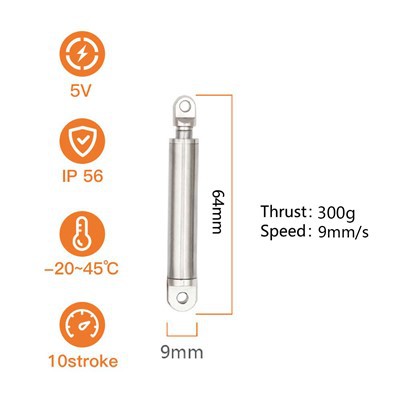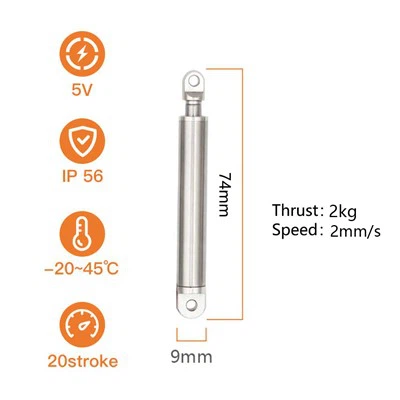
Hey there! As a supplier of Actuators Electric, I often get asked about the stiffness of electric actuators. So, I thought I'd take a few minutes to break it down for you.
First off, let's talk about what stiffness actually means in the context of electric actuators. Stiffness refers to an actuator's ability to resist deformation when a force is applied to it. In simpler terms, it's how well an actuator can maintain its position and shape under load.
Why is stiffness important? Well, in many applications, precision and stability are key. Whether you're using an actuator in a manufacturing process, a robotic arm, or a medical device, you need it to perform consistently and accurately. A stiff actuator is less likely to bend or flex under load, which means it can deliver more precise movements and better overall performance.
There are a few different factors that can affect the stiffness of an electric actuator. One of the most important is the design of the actuator itself. Actuators with a more robust and rigid construction are generally stiffer than those with a more flexible design. For example, an actuator with a thick, solid housing and a large-diameter shaft is likely to be stiffer than one with a thin, lightweight housing and a small-diameter shaft.


Another factor that can affect stiffness is the type of materials used in the actuator's construction. Actuators made from high-strength materials, such as steel or aluminum, are generally stiffer than those made from softer materials, such as plastic or rubber. Additionally, the quality of the materials and the manufacturing process can also have an impact on stiffness. Actuators that are well-made and use high-quality materials are likely to be stiffer and more reliable than those that are poorly made or use low-quality materials.
The way an actuator is installed and mounted can also affect its stiffness. If an actuator is not properly installed or mounted, it may be subject to additional stresses and strains that can reduce its stiffness. For example, if an actuator is mounted on a flexible or unstable surface, it may flex or bend under load, which can affect its performance. To ensure maximum stiffness, it's important to install and mount actuators on a rigid and stable surface using the appropriate hardware and mounting techniques.
Now, let's take a look at some of the different types of electric actuators and how their stiffness can vary.
Dc Brush Electric Actuator
Dc Brush Electric Actuator are a popular choice for many applications because they are relatively simple and inexpensive. These actuators use a DC motor with brushes to convert electrical energy into mechanical motion. The stiffness of a DC brush electric actuator can vary depending on its design and construction. Generally, actuators with a larger motor and a more robust gearbox are likely to be stiffer than those with a smaller motor and a less robust gearbox.
Actuators Electric
Actuators Electric come in a wide variety of types and designs, each with its own unique characteristics and performance capabilities. Some electric actuators are designed for high-speed applications, while others are designed for high-force applications. The stiffness of an electric actuator can vary depending on its intended application and the specific requirements of the system. For example, an actuator that is used in a high-force application may need to be stiffer than one that is used in a low-force application.
Electric Linear Actuator
Electric Linear Actuator are designed to convert rotational motion into linear motion. These actuators are commonly used in applications where precise linear movement is required, such as in robotics, automation, and aerospace. The stiffness of an electric linear actuator can vary depending on its design, construction, and the size of the load it is required to move. Actuators with a larger diameter screw or a more robust housing are likely to be stiffer than those with a smaller diameter screw or a less robust housing.
So, how can you determine the stiffness of an electric actuator? There are a few different methods that can be used to measure stiffness, including static testing and dynamic testing. Static testing involves applying a known force to the actuator and measuring the resulting displacement. Dynamic testing involves measuring the actuator's response to a dynamic load, such as a vibration or a shock.
In addition to testing, it's also important to consider the specifications and performance data provided by the actuator manufacturer. Most manufacturers will provide information about the stiffness of their actuators, including the maximum load capacity and the deflection under load. By reviewing this information, you can get a better idea of the actuator's stiffness and whether it is suitable for your application.
As a supplier of Actuators Electric, I understand the importance of stiffness in electric actuators. That's why we offer a wide range of high-quality actuators that are designed to provide maximum stiffness and performance. Whether you're looking for a Dc Brush Electric Actuator, an Actuators Electric, or an Electric Linear Actuator, we have the products and expertise to meet your needs.
If you're interested in learning more about our electric actuators or have any questions about stiffness or other performance characteristics, please don't hesitate to contact us. We'd be happy to discuss your specific requirements and help you find the right actuator for your application.
References
- <Author's Last Name, First Initial>. (Year).
. . - <Author's Last Name, First Initial>. (Year).
. , (Issue Number), .