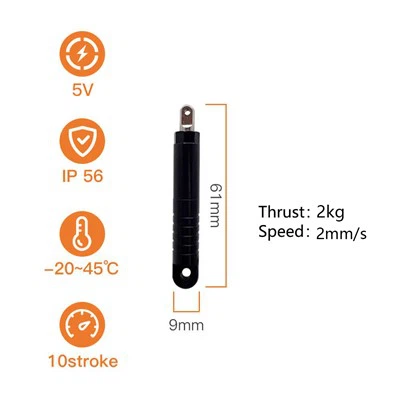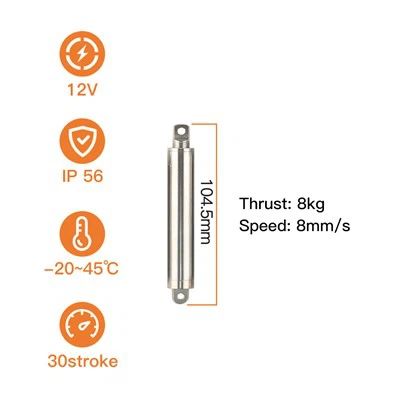
As a supplier of 12V actuator motors, I often encounter questions from customers about the magnetic field strength of these motors. Understanding the magnetic field strength is crucial because it directly impacts the performance and efficiency of the actuator motor. In this blog post, I'll delve into what the magnetic field strength of a 12V actuator motor is, how it's determined, and its significance in real - world applications.
Basics of a 12V Actuator Motor
Before we discuss the magnetic field strength, let's briefly understand what a 12V actuator motor is. A 12V actuator motor is an electromechanical device that converts electrical energy into mechanical motion. These motors are commonly used in various applications, such as automotive, robotics, and home automation. They are popular due to their relatively low voltage requirement, which makes them safe and easy to integrate into different systems.
What is Magnetic Field Strength?
Magnetic field strength, also known as magnetic field intensity or magnetic field H, is a vector quantity that describes the force exerted on a magnetic pole in a magnetic field. In the context of a 12V actuator motor, the magnetic field is generated by the flow of electric current through the motor's coils. The magnetic field interacts with the permanent magnets or other magnetic materials in the motor to produce mechanical torque.
The unit of magnetic field strength is ampere per meter (A/m) in the International System of Units (SI). In some cases, the gauss (G) or oersted (Oe) are also used, especially in older literature. One tesla (T), the SI unit of magnetic flux density, is equivalent to 10,000 gauss, and 1 A/m is approximately 0.01257 Oe.
Determining the Magnetic Field Strength of a 12V Actuator Motor
The magnetic field strength in a 12V actuator motor can be determined through theoretical calculations and experimental measurements.
Theoretical Calculation
The magnetic field strength in a solenoid (a common component in actuator motors) can be calculated using Ampere's law. For a solenoid of length (L), with (N) turns of wire carrying a current (I), the magnetic field strength (H) inside the solenoid is given by the formula:
[H=\frac{NI}{L}]
In a 12V actuator motor, the current (I) is determined by the voltage applied (12V in this case) and the resistance (R) of the motor's coils, according to Ohm's law (I = \frac{V}{R}). The number of turns (N) and the length (L) of the solenoid are design parameters of the motor.
However, this is a simplified model. In a real - world 12V actuator motor, the magnetic field is affected by many factors, such as the shape of the coils, the presence of magnetic cores, and the magnetic properties of the materials used.
Experimental Measurement
Experimental methods are often used to accurately measure the magnetic field strength of a 12V actuator motor. One common method is to use a Hall effect sensor. A Hall effect sensor is a semiconductor device that produces a voltage proportional to the magnetic field strength. By placing the Hall effect sensor at different positions around the motor, the magnetic field distribution can be mapped.
Another method is to use a magnetometer, which can measure the magnetic field strength directly. These devices are more accurate but can be more expensive.
Significance of Magnetic Field Strength in 12V Actuator Motors
The magnetic field strength has a significant impact on the performance of a 12V actuator motor.
Torque Production
The torque produced by a 12V actuator motor is directly proportional to the magnetic field strength. A stronger magnetic field will result in a greater force being exerted on the motor's rotor, leading to higher torque. This is crucial in applications where the motor needs to move heavy loads or overcome high resistance.
Efficiency
The efficiency of a 12V actuator motor is also related to the magnetic field strength. A well - designed motor with an optimal magnetic field strength can convert electrical energy into mechanical energy more efficiently. If the magnetic field is too weak, the motor may draw more current to produce the required torque, resulting in lower efficiency and increased heat generation.
Speed Control
The magnetic field strength can also affect the speed control of a 12V actuator motor. By adjusting the current flowing through the motor's coils, the magnetic field strength can be changed, which in turn affects the motor's speed. This is commonly used in variable - speed applications.
Applications of 12V Actuator Motors with Different Magnetic Field Strengths
12V actuator motors with different magnetic field strengths are used in a wide range of applications.
Automotive Applications
In automotive applications, 12V actuator motors are used for functions such as power windows, door locks, and seat adjustment. Motors with a relatively high magnetic field strength are required for these applications to ensure reliable operation and the ability to move heavy components.
Robotics
In robotics, 12V actuator motors are used to control the movement of robotic arms and joints. The magnetic field strength of the motors determines the precision and speed of the robot's movements. Miniature Linear Motor are often used in small - scale robotic applications, where a compact design and precise control are required.


Home Automation
In home automation systems, 12V actuator motors are used for tasks such as opening and closing blinds, curtains, and garage doors. Motors with different magnetic field strengths can be selected based on the size and weight of the objects to be moved. 12V Linear Actuator are commonly used in these applications due to their simplicity and ease of installation.
Choosing the Right 12V Actuator Motor Based on Magnetic Field Strength
When choosing a 12V actuator motor, it's important to consider the magnetic field strength based on the specific application requirements.
If high torque is required, a motor with a stronger magnetic field should be selected. This may involve choosing a motor with more turns of wire in the coils or a motor with a magnetic core made of a high - permeability material.
On the other hand, if energy efficiency is a priority, a motor with an optimized magnetic field strength should be chosen. This can be determined through testing and comparison of different motor models.
Conclusion
In conclusion, the magnetic field strength of a 12V actuator motor is a critical parameter that affects its performance, efficiency, and application suitability. As a supplier of 12V actuator motors, we understand the importance of providing motors with the right magnetic field strength for different customer needs.
If you are in the market for a 12V actuator motor or have any questions about magnetic field strength and motor performance, we are here to help. Our team of experts can assist you in selecting the most suitable motor for your application. Whether you need a motor for automotive, robotics, or home automation, we have a wide range of 12V Linear Actuator and other related products to meet your requirements. If you need a higher - voltage option, we also offer Actuator 24V.
Feel free to contact us to start a procurement discussion. We look forward to working with you to find the best solution for your needs.
References
- Halliday, D., Resnick, R., & Walker, J. (2014). Fundamentals of Physics. Wiley.
- Kraus, J. D., & Carver, K. R. (1988). Electromagnetics. McGraw - Hill.
- Tipler, P. A., & Mosca, G. (2007). Physics for Scientists and Engineers. W. H. Freeman and Company.