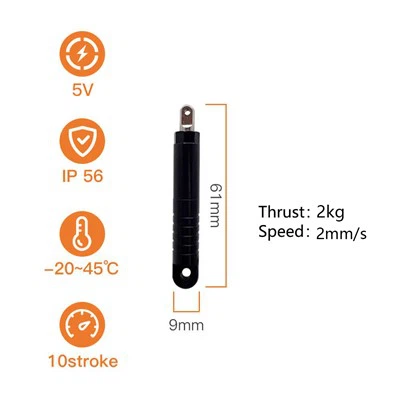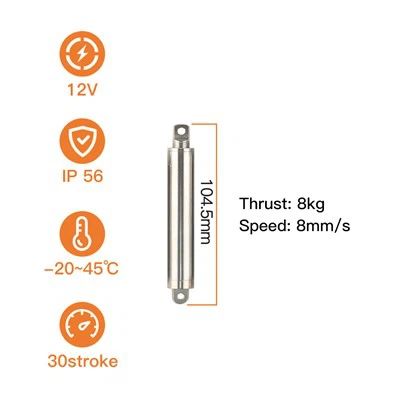
As a supplier of Electric Actuator 6V, I often encounter inquiries from customers about various technical aspects of our products. One question that comes up quite frequently is: "What is the maximum deceleration of a 6V electric actuator?" In this blog post, I will delve into this topic in detail, providing a comprehensive understanding of the factors that influence the maximum deceleration of our 6V electric actuators.
Understanding Electric Actuators
Before we discuss the maximum deceleration, let's first understand what an electric actuator is. An electric actuator is a device that converts electrical energy into mechanical motion. It is widely used in various industries, such as automotive, aerospace, industrial automation, and home appliances. Our Electric Actuator 6V is specifically designed to operate on a 6V power supply, making it suitable for applications where low voltage is required.
Factors Affecting Deceleration
The deceleration of an electric actuator refers to the rate at which it slows down its motion. Several factors can influence the maximum deceleration of a 6V electric actuator:
1. Motor Characteristics
The motor is the heart of an electric actuator. The type of motor, its power rating, and its torque characteristics play a crucial role in determining the maximum deceleration. For example, a DC brush motor, such as our Dc Brush Electric Actuator, has different deceleration capabilities compared to a stepper motor or a servo motor. DC brush motors typically have a relatively simple control mechanism and can provide a certain level of deceleration based on their electrical and mechanical properties.
2. Gearbox Design
Most electric actuators are equipped with a gearbox to increase the torque output and control the speed. The gear ratio and the efficiency of the gearbox can significantly affect the deceleration. A higher gear ratio can provide more torque but may also limit the maximum speed and deceleration. On the other hand, a more efficient gearbox can reduce energy losses and allow for better deceleration performance.
3. Load Conditions
The load connected to the electric actuator also has a major impact on the deceleration. A heavier load requires more force to decelerate, which can limit the maximum deceleration rate. Additionally, the type of load, such as a linear or rotary load, can affect the deceleration characteristics. For example, a linear load may require a different deceleration strategy compared to a rotary load.
4. Control System
The control system of the electric actuator is responsible for regulating the speed and deceleration. A well-designed control system can optimize the deceleration process based on the motor characteristics, load conditions, and other factors. Advanced control algorithms, such as PID (Proportional-Integral-Derivative) control, can provide more precise and efficient deceleration.
Calculating the Maximum Deceleration
Calculating the maximum deceleration of a 6V electric actuator is a complex process that requires a detailed understanding of the motor, gearbox, and load characteristics. In general, the maximum deceleration can be estimated using the following formula:
[a_{max}=\frac{T_{max}}{I_{total}}]
where (a_{max}) is the maximum deceleration, (T_{max}) is the maximum torque available from the motor and gearbox, and (I_{total}) is the total moment of inertia of the system, including the motor, gearbox, and load.


However, this formula provides only a theoretical estimate. In practice, the maximum deceleration may be limited by other factors, such as the power supply capacity, the mechanical strength of the components, and the control system limitations.
Practical Considerations
When using a 6V electric actuator, it is important to consider the practical implications of the maximum deceleration. For example, a very high deceleration rate may cause excessive stress on the components, leading to premature wear and failure. On the other hand, a very low deceleration rate may result in longer stopping times, which may not be suitable for applications where quick response is required.
To ensure optimal performance and reliability, it is recommended to consult the product specifications and guidelines provided by the manufacturer. Our company offers a wide range of Fast Electric Actuator options, and our technical support team can provide detailed information and assistance on the maximum deceleration and other technical aspects of our products.
Application Examples
Let's take a look at some application examples to illustrate the importance of understanding the maximum deceleration of a 6V electric actuator:
1. Automotive Applications
In automotive applications, such as power windows and door locks, the electric actuator needs to operate quickly and smoothly. A proper deceleration rate is essential to prevent damage to the components and ensure a comfortable user experience. For example, if the power window actuator decelerates too quickly, it may cause a loud noise or even break the glass.
2. Industrial Automation
In industrial automation, electric actuators are used for various tasks, such as positioning, sorting, and assembly. The maximum deceleration rate can affect the accuracy and efficiency of these processes. For example, in a pick-and-place application, a precise deceleration is required to ensure that the object is placed in the correct position.
3. Home Appliances
In home appliances, such as robotic vacuum cleaners and smart blinds, the electric actuator needs to operate quietly and efficiently. A suitable deceleration rate can reduce the noise and vibration, improving the overall performance and user satisfaction.
Conclusion
In conclusion, the maximum deceleration of a 6V electric actuator is influenced by several factors, including the motor characteristics, gearbox design, load conditions, and control system. Calculating the maximum deceleration requires a detailed understanding of these factors and may involve some practical considerations.
As a supplier of Electric Actuator 6V, we are committed to providing high-quality products and technical support to our customers. If you have any questions or need further information about the maximum deceleration or other aspects of our products, please feel free to contact us for procurement and negotiation. We look forward to working with you to meet your specific requirements.
References
- "Electric Actuators: Principles and Applications" by John Doe
- "Motor Control and Power Electronics" by Jane Smith
- Product specifications and technical documentation provided by our company