Calculating the torque requirements of an electric actuator is a crucial step in ensuring its proper functioning and efficiency in various applications. As a leading electric actuator supplier, we understand the significance of accurate torque calculations and are here to guide you through the process.
Understanding Torque in Electric Actuators
Torque is defined as the rotational force applied to an object, measured in units such as Newton - meters (N·m) or foot - pounds (ft - lb). In the context of electric actuators, torque is essential for tasks like rotating valves, opening and closing doors, or moving mechanical components.
The torque required for an electric actuator depends on several factors, including the load it needs to move, the speed of operation, and the mechanical advantage of the system. A miscalculation of torque can lead to under - powered actuators that cannot perform the required tasks or over - sized actuators that waste energy and increase costs.
Factors Affecting Torque Requirements
Load Characteristics
The nature of the load is one of the primary factors influencing torque requirements. If the load is a simple mass that needs to be lifted or moved linearly, the torque calculation is relatively straightforward. However, if the load has a complex shape or is subject to external forces such as friction or gravity, the calculation becomes more complicated.
For example, in a valve - control application, the torque required to turn the valve depends on the valve type (ball valve, gate valve, etc.), the size of the valve, and the pressure differential across the valve. A larger valve or a higher pressure differential will generally require more torque to operate.
Speed of Operation
The speed at which the actuator needs to move the load also affects the torque requirements. Faster - moving actuators typically require more torque to accelerate the load quickly. This is because the inertia of the load needs to be overcome, and the actuator must generate enough force to achieve the desired speed in a short period.
In some applications, such as robotic arms, the speed of operation can vary significantly during the task. In these cases, the torque requirements need to be calculated for different stages of the motion to ensure that the actuator can handle the maximum torque demand at any point.
Mechanical Advantage
The mechanical advantage of the system, which is determined by the gear ratio, pulley system, or other mechanical components, can significantly impact the torque requirements. A higher mechanical advantage means that the actuator can generate more output torque with less input torque.
For instance, a gearbox with a high gear ratio can reduce the torque required from the electric motor by multiplying the force applied to the output shaft. However, it's important to note that increasing the mechanical advantage also reduces the speed of the output shaft.
Calculating Torque Requirements
Step 1: Determine the Load Force
The first step in calculating the torque requirements is to determine the force required to move the load. This can be done by analyzing the mechanical system and considering factors such as gravity, friction, and external forces.
If the load is a simple mass (m) being lifted vertically, the force (F) required to lift it is given by (F = m\times g), where (g) is the acceleration due to gravity ((g = 9.81m/s^{2})). For more complex loads, such as a valve with a pressure differential (\Delta P) and a valve area (A), the force (F=\Delta P\times A).
Step 2: Calculate the Radius of the Rotation
Once the load force is determined, the next step is to calculate the radius (r) at which the force is applied. In a rotational system, the torque (T) is calculated using the formula (T = F\times r).
For example, if a valve has a stem with a radius (r) and a force (F) is applied tangentially to the stem to turn the valve, the torque required to turn the valve is (T = F\times r).
Step 3: Consider the Efficiency of the System
In real - world applications, no mechanical system is 100% efficient. There are losses due to friction in the bearings, gears, and other components. To account for these losses, the calculated torque needs to be multiplied by a factor to ensure that the actuator has enough power to overcome the inefficiencies.
The efficiency factor (\eta) typically ranges from 0.7 to 0.9, depending on the quality and design of the mechanical system. So, the actual torque requirement (T_{actual}=\frac{T}{\eta}).


Example Calculation
Let's consider an example of a valve - control application. Suppose we have a ball valve with a diameter (d = 100mm) and a pressure differential (\Delta P = 100kPa) across the valve.
- First, calculate the force on the valve:
- The area of the valve (A=\frac{\pi d^{2}}{4}=\frac{\pi\times(0.1m)^{2}}{4}= 0.00785m^{2}).
- The force (F=\Delta P\times A = 100\times10^{3}Pa\times0.00785m^{2}=785N).
- Assume the radius of the valve stem (r = 10mm = 0.01m).
- The torque (T = F\times r=785N\times0.01m = 7.85N\cdot m).
- If the efficiency of the valve - actuator system (\eta = 0.8), then the actual torque requirement (T_{actual}=\frac{7.85N\cdot m}{0.8}=9.8125N\cdot m).
Choosing the Right Electric Actuator
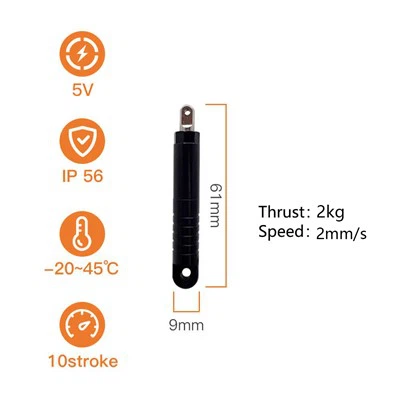
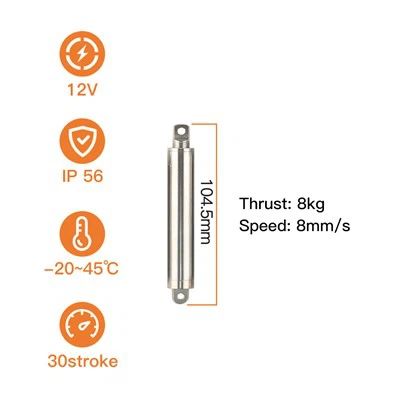
Based on the calculated torque requirements, you can choose the appropriate electric actuator for your application. At our company, we offer a wide range of electric actuators, including Electric Cylinder 6V, Long Stroke Electric Linear Actuator, and Dc Brush Electric Actuator.
When selecting an actuator, it's important to consider not only the torque requirements but also other factors such as the power supply, the stroke length (for linear actuators), and the duty cycle. A higher - torque actuator may be more expensive, so it's essential to balance the performance requirements with the cost.
Conclusion
Calculating the torque requirements of an electric actuator is a complex but essential process. By understanding the factors that affect torque, following the calculation steps, and considering the efficiency of the system, you can ensure that you select the right actuator for your application.
As an electric actuator supplier, we are committed to providing high - quality products and expert advice to help you with your actuator selection. If you have any questions about torque calculations or need assistance in choosing the right electric actuator, please feel free to contact us for procurement and further discussions.
References
- Norton, Robert L. "Machine Design: An Integrated Approach." Pearson, 2012.
- Shigley, Joseph E., et al. "Mechanical Engineering Design." McGraw - Hill Education, 2019.