

Hey there! As a supplier of tiny linear actuators, I'm super stoked to take you on a journey into how these little wonders work. Tiny linear actuators might be small in size, but they pack a punch when it comes to functionality.
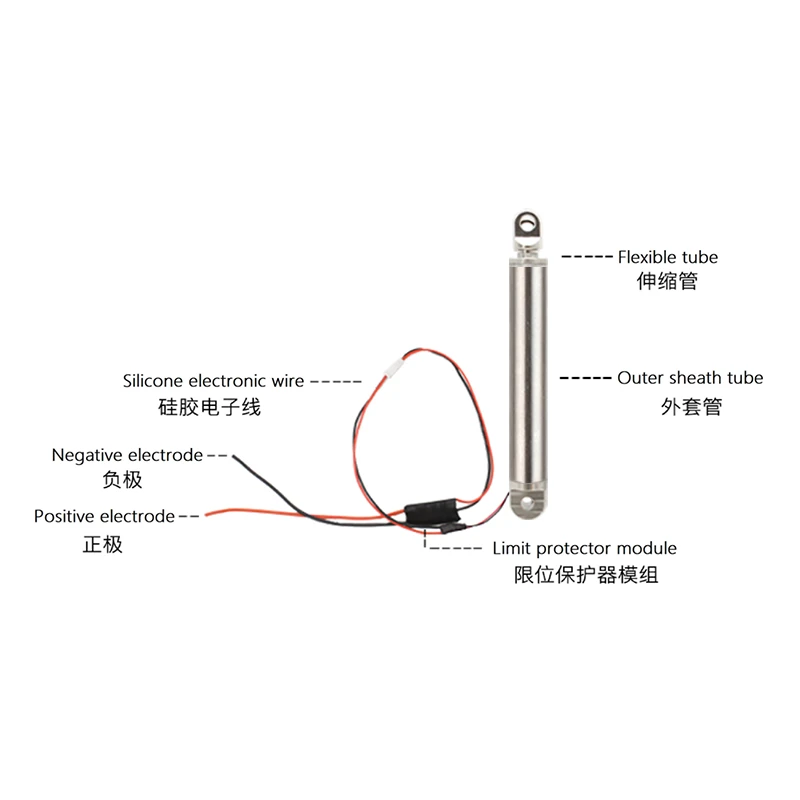
Let's start with the basics. A linear actuator is a device that creates motion in a straight line. Unlike a traditional motor that spins in a circular motion, a linear actuator moves forward and backward, or up and down. This linear motion is super useful in a whole bunch of applications, from robotics to medical devices.
So, how does a tiny linear actuator actually work? Well, there are a few different types, but the most common ones use either a DC motor or a linear motor.
DC Linear Actuators
Let's talk about DC linear actuators first. These are the ones you'll often find in smaller, battery - powered devices. The heart of a DC linear actuator is, of course, the DC motor. When you apply an electric current to the DC motor, it starts to spin. But we want linear motion, not circular, right? That's where the magic of a gearbox and a lead screw comes in.
The gearbox is used to reduce the speed of the motor and increase its torque. Torque is basically the force that makes the actuator move. As the motor spins, it turns the input shaft of the gearbox. The gearbox then transfers this rotational motion to the lead screw.
A lead screw is a threaded rod. As the lead screw rotates, a nut that's threaded onto it moves along the length of the screw. This nut is connected to the actuator's rod or piston. So, as the nut moves along the lead screw, the rod of the actuator moves in a straight line. It's like a simple mechanical conversion from rotational to linear motion.
One of the great things about DC linear actuators is their simplicity and cost - effectiveness. They're easy to control, too. You can control the speed of the actuator by adjusting the voltage applied to the DC motor. A higher voltage will make the motor spin faster, which in turn makes the actuator move faster. You can also control the direction of the actuator by reversing the polarity of the voltage applied to the motor. If you want to learn more about DC linear actuators, check out Dc Linear Actuator.
Linear Motor Actuators
Now, let's move on to linear motor actuators. These are a bit more high - tech. Instead of using a traditional DC motor and a lead screw, a linear motor actuator uses a magnetic field to create linear motion directly.
A linear motor consists of two main parts: a stator and a slider. The stator is a stationary part that contains a series of coils. When an electric current is passed through these coils, a magnetic field is created. The slider, on the other hand, contains permanent magnets.
The interaction between the magnetic field created by the stator and the permanent magnets in the slider causes the slider to move in a straight line. It's a bit like how a regular electric motor works, but instead of creating a rotating magnetic field to make a rotor spin, a linear motor creates a linear magnetic field to make the slider move.
Linear motor actuators are known for their high speed and precision. They can move very quickly and stop exactly where you want them to. This makes them ideal for applications where speed and accuracy are crucial, like in high - speed manufacturing or semiconductor testing. If you're interested in learning more about linear motor actuators, head over to Linear Motor Actuator.
Fast Actuators Linear
There are also fast actuators linear, which are designed to move at high speeds. These can be either DC linear actuators or linear motor actuators, but they're optimized for speed.
For fast DC linear actuators, manufacturers use high - speed motors and low - friction components. The gearbox is designed to transfer power efficiently, and the lead screw is made with a high - pitch thread to allow for faster movement of the nut.
Fast linear motor actuators, on the other hand, use advanced magnetic materials and sophisticated control systems. The coils in the stator are designed to create a strong and rapidly changing magnetic field, which allows the slider to move at high speeds. If you want to know more about fast actuators linear, check out Fast Actuators Linear.

Applications of Tiny Linear Actuators
Tiny linear actuators are used in a wide range of applications. In the medical field, they're used in devices like syringe pumps. These pumps need to move a small amount of fluid at a very precise rate, and a tiny linear actuator can do that job perfectly.
In the automotive industry, they're used in things like power seats and window regulators. They provide the smooth and controlled movement that you expect from these features.
In robotics, tiny linear actuators are used to control the movement of robot arms and joints. They allow robots to perform precise and complex tasks.
Why Choose Our Tiny Linear Actuators
As a supplier of tiny linear actuators, we take pride in offering high - quality products. Our actuators are designed with the latest technology to ensure maximum performance and reliability.
We understand that different applications have different requirements. That's why we offer a wide range of tiny linear actuators with different stroke lengths, speeds, and load capacities. Whether you need a slow - moving actuator for a delicate medical device or a fast - moving one for a high - speed manufacturing process, we've got you covered.
Our actuators are also easy to install and maintain. We provide detailed installation guides and technical support to make sure you get the most out of our products.
If you're in the market for tiny linear actuators, we'd love to have a chat with you. Whether you're a small - scale hobbyist or a large - scale manufacturer, we can work with you to find the perfect actuator for your needs. Just reach out to us, and let's start a conversation about how our tiny linear actuators can fit into your project.
References
- "Motion Control Handbook" by Peter Nachtwey
- "Electromechanical Motion Devices" by Umans, Stephen D.






