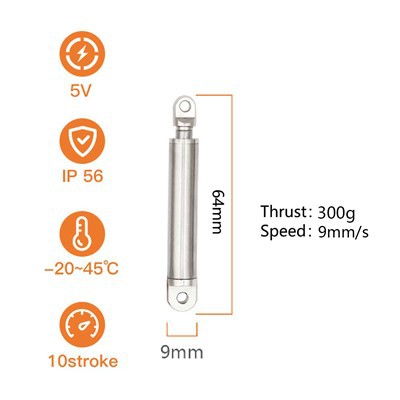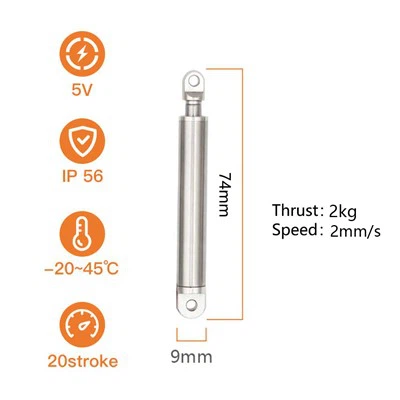
Can a 12V actuator motor be used in a robot? This is a question that many robotics enthusiasts, engineers, and hobbyists often ponder. As a supplier of 12V actuator motors, I am well - versed in the capabilities and limitations of these motors when it comes to robotic applications. In this blog post, I will explore the feasibility of using a 12V actuator motor in a robot, considering various aspects such as power requirements, torque, speed, and control.
Power Requirements
One of the primary considerations when using a motor in a robot is the power source. A 12V actuator motor is designed to operate on a 12 - volt direct current (DC) power supply. This makes it highly compatible with many common power sources used in robotics, such as 12V batteries. Batteries are a popular choice for powering robots because they provide a portable and self - contained power solution.
For small to medium - sized robots, a 12V power supply is often sufficient to meet the energy demands of the actuator motor. For example, in a tabletop robotic arm used for light - duty tasks like picking and placing small objects, a 12V actuator motor can operate effectively. The relatively low voltage also means that the power consumption is manageable, which is crucial for extending the battery life of the robot.
However, for larger and more complex robots that require a significant amount of power to perform heavy - duty tasks, a 12V actuator motor may not be sufficient. In such cases, higher - voltage motors or multiple 12V motors working in tandem might be needed. For instance, industrial robots used in manufacturing plants often require motors with higher power ratings to handle large payloads and perform high - speed operations.
Torque and Speed
Torque is the rotational force that a motor can generate, and speed refers to how fast the motor can rotate. In a robotic application, both torque and speed are critical factors. A 12V actuator motor can offer a range of torque and speed capabilities depending on its design and specifications.
For robots that need to move slowly and with high precision, such as a robotic camera mount for smooth panning and tilting, a 12V actuator motor with a high - torque, low - speed characteristic can be an ideal choice. These motors can provide the necessary force to hold the camera steady and make precise movements without overshooting.
On the other hand, if the robot requires rapid movement, like a small - scale racing robot, a 12V actuator motor with a high - speed, lower - torque profile might be more suitable. It can quickly accelerate the robot and allow it to reach high speeds.
It's important to note that the torque and speed of a 12V actuator motor can be adjusted through the use of gears and other mechanical components. Gearboxes can be used to increase the torque at the expense of speed or vice versa, depending on the specific requirements of the robot.


Control
Controlling the movement of a robot is essential for its proper functioning. A 12V actuator motor can be easily integrated into a robot's control system. Most 12V actuator motors can be controlled using pulse - width modulation (PWM), which is a common technique in robotics for adjusting the speed and direction of the motor.
PWM works by varying the width of the electrical pulses sent to the motor. By changing the duty cycle of the pulses, the average voltage applied to the motor can be adjusted, thereby controlling its speed. Additionally, by reversing the polarity of the voltage, the direction of the motor's rotation can be changed.
Many microcontrollers, such as the Arduino and Raspberry Pi, support PWM output, making it straightforward to interface a 12V actuator motor with these popular development platforms. This ease of control allows hobbyists and engineers to quickly prototype and develop robotic systems using 12V actuator motors.
Advantages of Using a 12V Actuator Motor in a Robot
- Cost - effective: 12V actuator motors are generally more affordable compared to higher - voltage motors. This makes them an attractive option for hobbyists and small - scale robotics projects with limited budgets.
- Safety: The lower voltage of 12V reduces the risk of electrical shock, making it safer to work with, especially for those new to robotics.
- Compatibility: As mentioned earlier, 12V motors are compatible with a wide range of power sources and control systems, which simplifies the design and construction of the robot.
Disadvantages of Using a 12V Actuator Motor in a Robot
- Limited power: As discussed, 12V actuator motors may not be powerful enough for large - scale or heavy - duty robotic applications.
- Heat dissipation: Since these motors operate at a relatively low voltage, they may need to draw more current to generate the required torque. This can lead to increased heat generation, which needs to be managed properly to prevent damage to the motor.
Other Considerations
When considering using a 12V actuator motor in a robot, it's also important to think about the environment in which the robot will operate. For example, in a dusty or humid environment, the motor may need to be properly sealed to prevent damage. Additionally, the mechanical design of the robot should be optimized to ensure that the motor is mounted securely and that the load is evenly distributed.
If you are interested in exploring other actuator options, we also offer Linear Actuator 24V for applications that require higher power. Our 12 Volt Dc Actuator and 12V Actuator Linear are also popular choices among our customers.
In conclusion, a 12V actuator motor can be a viable option for many robotic applications, especially those that are small - scale, require moderate power, and need precise control. However, it's essential to carefully evaluate the specific requirements of your robot, including power, torque, speed, and control, before making a decision. If you have any questions or need further assistance in selecting the right actuator motor for your robot, please feel free to contact us for a detailed discussion and procurement opportunities.
References
- "Robotics: Modelling, Planning and Control" by Bruno Siciliano, Lorenzo Sciavicco, Luigi Villani, and Giuseppe Oriolo.
- "Practical Robotics in C and C++" by Lloyd Brombach.
- Manufacturer's datasheets for 12V actuator motors.