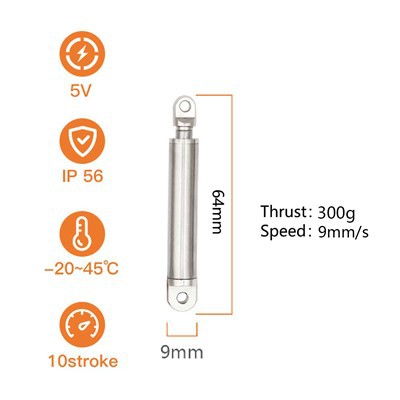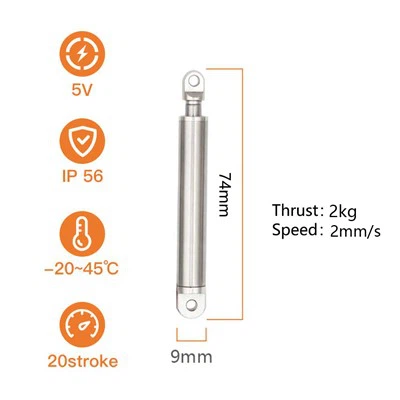
A DC linear actuator is a device that converts the rotational motion of a DC motor into linear motion. This type of actuator is widely used in various industries due to its simplicity, efficiency, and controllability. As a DC linear actuator supplier, I am often asked about how these actuators work. In this blog post, I will explain the working principle of a DC linear actuator in detail.
Basic Components of a DC Linear Actuator
Before delving into the working mechanism, it's essential to understand the key components of a DC linear actuator. The main parts include a DC motor, a gearbox, a lead screw or a ball screw, and a nut.


- DC Motor: The heart of the actuator, the DC motor, provides the initial rotational force. It operates on direct current, and its speed and torque can be controlled by adjusting the voltage applied to it.
- Gearbox: Connected to the DC motor, the gearbox is used to reduce the speed of the motor and increase its torque. Different gear ratios can be selected according to the specific requirements of the application.
- Lead Screw or Ball Screw: This is a threaded rod that converts the rotational motion from the motor (through the gearbox) into linear motion. A lead screw is a simple and cost - effective option, while a ball screw offers higher efficiency and precision due to the use of ball bearings.
- Nut: The nut is threaded onto the lead screw or ball screw. As the screw rotates, the nut moves linearly along the screw, which is the output motion of the actuator.
Working Principle
The working process of a DC linear actuator can be divided into several steps:
-
Power Supply and Motor Activation
When an appropriate DC voltage is applied to the terminals of the DC motor, an electric current flows through the motor's coils. According to the principle of electromagnetism, this current creates a magnetic field that interacts with the permanent magnets in the motor. This interaction generates a rotational force, causing the motor shaft to start rotating. The speed of the motor's rotation is proportional to the applied voltage, following the basic relationship (n=\frac{V - IR}{K\Phi}), where (n) is the speed, (V) is the applied voltage, (I) is the current, (R) is the resistance of the motor coils, (K) is a constant, and (\Phi) is the magnetic flux. -
Speed Reduction and Torque Increase by the Gearbox
The high - speed rotation of the motor shaft is then transmitted to the gearbox. The gearbox consists of multiple gears with different numbers of teeth. By using gears with different gear ratios, the speed of the input shaft (connected to the motor) is reduced, while the torque is increased. For example, if the gear ratio is 10:1, the output shaft of the gearbox will rotate at one - tenth of the speed of the input shaft, but the torque will be approximately ten times greater. This is crucial because many applications require high torque at relatively low speeds, which the motor alone may not be able to provide. -
Conversion of Rotational to Linear Motion
The output shaft of the gearbox is connected to the lead screw or ball screw. As the screw rotates, the nut, which is in threaded engagement with the screw, moves linearly along the screw. The direction of the nut's movement depends on the direction of the screw's rotation. If the screw rotates clockwise, the nut may move forward, and if it rotates counter - clockwise, the nut will move backward. The pitch of the screw determines the linear displacement per revolution. For example, if the pitch of the screw is 5 mm, for each full revolution of the screw, the nut will move 5 mm linearly. -
Controlling the Actuator's Movement
The movement of the DC linear actuator can be controlled in several ways. By adjusting the voltage applied to the DC motor, the speed of the actuator can be regulated. A higher voltage will result in a faster - moving actuator, while a lower voltage will slow it down. Additionally, the direction of the actuator's movement can be changed by reversing the polarity of the DC voltage applied to the motor. Most DC linear actuators also come with limit switches, which are used to define the end - points of the actuator's travel. When the nut reaches a limit switch, the electrical circuit is interrupted, and the motor stops rotating, preventing the actuator from over - extending or over - retracting.
Applications of DC Linear Actuators
DC linear actuators have a wide range of applications across different industries:
- Automotive Industry: They are used in automotive seats for adjusting the position of the seat, including height, tilt, and fore - aft movement. They are also used in the opening and closing of sunroofs and in some active suspension systems.
- Home Appliances: In home appliances such as electric beds, the actuator is used to adjust the angle of the bed frame, providing users with a comfortable sleeping or sitting position. They are also used in the opening and closing of cabinet doors and in some adjustable desks.
- Industrial Automation: In industrial settings, DC linear actuators are used for tasks such as material handling, positioning of workpieces on conveyor belts, and in robotic arms for precise movement.
Our Product Range
As a DC linear actuator supplier, we offer a diverse range of products to meet different customer needs. We have Electric Lift Cylinder, which is suitable for applications requiring high - force lifting. Our Tiny Linear Actuator is perfect for small - scale applications where space is limited. And for applications that demand rapid movement, our Fast Linear Actuator is an ideal choice.
Contact for Purchase and Consultation
If you are interested in our DC linear actuators or have any questions about their applications, working principles, or specifications, please feel free to contact us. We have a team of experienced professionals who can provide you with detailed information and help you select the most suitable actuator for your project. Whether you need a single actuator for a small - scale experiment or a large number of actuators for an industrial application, we are here to serve you.
References
- "Electric Motors and Drives: Fundamentals, Types, and Applications" by Austin Hughes and Bill Drury.
- "Mechatronics: An Integrated Approach" by David Crolla.