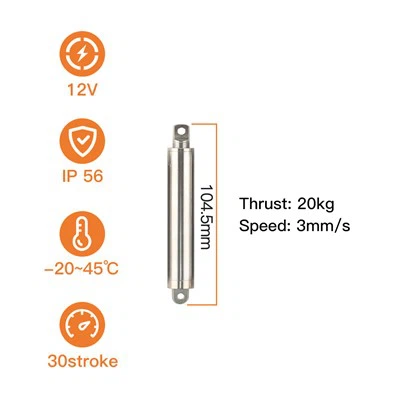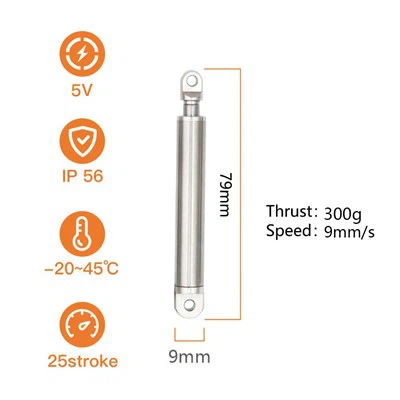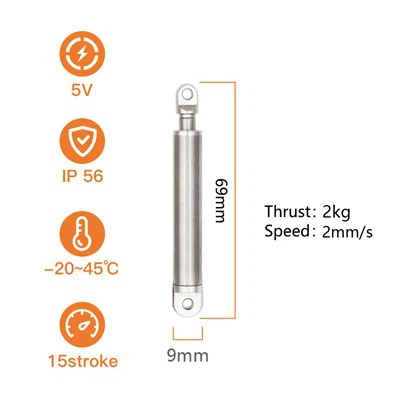
A 12 Volt DC actuator is a versatile and widely used device in various industries and applications. As a supplier of 12 Volt DC actuators, I am often asked about how these actuators work. In this blog post, I will provide a detailed explanation of the working principle of a 12 Volt DC actuator, its components, and its applications.


Basic Working Principle
At its core, a 12 Volt DC actuator is an electromechanical device that converts electrical energy into mechanical motion. It operates on the principle of electromagnetic induction, which was discovered by Michael Faraday in the 19th century. When an electric current flows through a coil of wire placed in a magnetic field, a force is generated that causes the coil to move. This movement can be harnessed to perform useful work, such as pushing, pulling, or rotating an object.
In a 12 Volt DC actuator, the electrical energy is supplied by a 12 Volt direct current (DC) power source, such as a battery or a power supply. The actuator typically consists of a DC motor, a gearbox, and a linear or rotary output mechanism. The DC motor is the heart of the actuator, as it converts the electrical energy into mechanical rotation. The gearbox is used to reduce the speed of the motor and increase the torque, allowing the actuator to generate more force. The output mechanism is responsible for converting the rotary motion of the motor into linear or rotary motion, depending on the application.
Components of a 12 Volt DC Actuator
Let's take a closer look at the main components of a 12 Volt DC actuator:
DC Motor
The DC motor is the primary component of the actuator, and it is responsible for converting electrical energy into mechanical rotation. DC motors are available in various types and sizes, but the most common type used in 12 Volt DC actuators is the brushed DC motor. Brushed DC motors have a simple design and are relatively inexpensive, making them a popular choice for many applications.
The basic structure of a brushed DC motor consists of a stator, a rotor, and a commutator. The stator is the stationary part of the motor, and it contains the permanent magnets or electromagnets that create the magnetic field. The rotor is the rotating part of the motor, and it contains the armature, which is a coil of wire. The commutator is a split ring that is attached to the rotor, and it is used to reverse the direction of the current flow in the armature as the rotor rotates. This causes the magnetic field of the armature to interact with the magnetic field of the stator, resulting in the rotation of the rotor.
Gearbox
The gearbox is used to reduce the speed of the motor and increase the torque. This is necessary because most DC motors operate at high speeds but produce relatively low torque. By using a gearbox, the actuator can generate more force and move heavier loads.
There are several types of gearboxes used in 12 Volt DC actuators, including spur gears, planetary gears, and worm gears. Spur gears are the simplest and most common type of gearbox, and they consist of two or more gears with teeth that mesh together. Planetary gears are more complex and efficient than spur gears, and they consist of a central sun gear, several planet gears, and an outer ring gear. Worm gears are used when a high reduction ratio is required, and they consist of a worm screw and a worm wheel.
Output Mechanism
The output mechanism is responsible for converting the rotary motion of the motor into linear or rotary motion, depending on the application. There are two main types of output mechanisms used in 12 Volt DC actuators: linear and rotary.
Linear actuators are used to produce linear motion, such as pushing or pulling an object. They typically consist of a screw or a rack and pinion mechanism that converts the rotary motion of the motor into linear motion. Rotary actuators are used to produce rotary motion, such as rotating an object. They typically consist of a shaft or a gear that is directly connected to the output of the motor.
Working Process of a 12 Volt DC Actuator
Now that we have a basic understanding of the components of a 12 Volt DC actuator, let's take a look at the working process of the actuator:
- Power Supply: The actuator is connected to a 12 Volt DC power source, such as a battery or a power supply. When the power is turned on, the electric current flows through the motor, causing the rotor to rotate.
- Gearbox: The rotation of the motor is transmitted to the gearbox, which reduces the speed of the motor and increases the torque. The output of the gearbox is then transmitted to the output mechanism.
- Output Mechanism: The output mechanism converts the rotary motion of the gearbox into linear or rotary motion, depending on the type of actuator. For example, in a linear actuator, the output mechanism may consist of a screw or a rack and pinion mechanism that converts the rotary motion of the gearbox into linear motion. In a rotary actuator, the output mechanism may consist of a shaft or a gear that is directly connected to the output of the gearbox.
- Load: The actuator is connected to a load, such as a door, a window, or a machine part. The force generated by the actuator is used to move the load, either linearly or rotationally.
Applications of 12 Volt DC Actuators
12 Volt DC actuators are used in a wide range of applications, including:
- Automotive Industry: 12 Volt DC actuators are used in various automotive applications, such as power windows, power seats, and convertible tops. They are also used in engine management systems, such as throttle control and valve actuation.
- Home Automation: 12 Volt DC actuators are used in home automation systems, such as smart blinds, smart curtains, and smart doors. They can be controlled remotely using a smartphone or a smart home hub, allowing users to automate the opening and closing of their windows, doors, and curtains.
- Industrial Automation: 12 Volt DC actuators are used in industrial automation systems, such as conveyor belts, robotic arms, and packaging machines. They are used to control the movement of various components and equipment, allowing for more efficient and precise operation.
- Medical Equipment: 12 Volt DC actuators are used in medical equipment, such as hospital beds, wheelchairs, and surgical robots. They are used to control the movement of various components and equipment, allowing for more comfortable and precise operation.
Advantages of 12 Volt DC Actuators
12 Volt DC actuators offer several advantages over other types of actuators, including:
- Low Voltage Operation: 12 Volt DC actuators operate on a low voltage, which makes them safe and easy to use. They can be powered by a battery or a low voltage power supply, making them suitable for portable and mobile applications.
- High Efficiency: 12 Volt DC actuators are highly efficient, as they convert most of the electrical energy into mechanical motion. This results in lower power consumption and longer battery life.
- Compact Size: 12 Volt DC actuators are available in a compact size, which makes them suitable for applications where space is limited. They can be easily integrated into various systems and equipment, without taking up too much space.
- Easy to Control: 12 Volt DC actuators are easy to control, as they can be operated using a simple on/off switch or a more sophisticated control system. They can also be controlled remotely using a smartphone or a smart home hub, allowing for more convenient and flexible operation.
Conclusion
In conclusion, a 12 Volt DC actuator is a versatile and widely used device that converts electrical energy into mechanical motion. It consists of a DC motor, a gearbox, and a linear or rotary output mechanism, and it operates on the principle of electromagnetic induction. 12 Volt DC actuators are used in a wide range of applications, including automotive, home automation, industrial automation, and medical equipment. They offer several advantages over other types of actuators, including low voltage operation, high efficiency, compact size, and easy to control.
If you are interested in purchasing 12 Volt DC actuators for your application, please feel free to contact us for more information. We are a leading supplier of 12 Volt DC actuators, and we offer a wide range of products to meet your needs. You can also visit our website to learn more about our products and services: 12V Actuator Linear, 12V Actuator Motor, and 24Vdc Linear Actuator.
References
- Electric Motors and Drives: Fundamentals, Types, and Applications by Austin Hughes and Bill Drury
- Mechatronics: An Integrated Approach by David G. Alciatore and Michael B. Histand
- Industrial Automation: Fundamentals and Applications by John R. Vacca