Can a 12V Actuator Linear be used in a 3D printer?
In the ever - evolving world of 3D printing, the choice of components plays a crucial role in determining the quality, precision, and overall performance of the printer. One such component that often comes under consideration is the linear actuator. In this blog, as a 12V Actuator Linear supplier, I will explore whether a 12V linear actuator can be used in a 3D printer, delving into its advantages, limitations, and the technical aspects involved.
Understanding 12V Linear Actuators
A 12V linear actuator is a device that converts electrical energy into linear motion. It typically consists of a motor, a gearbox, and a lead screw or a belt drive system. The 12V power supply makes it relatively easy to integrate with common electronic systems, and it is widely used in various applications such as robotics, automation, and home appliances.
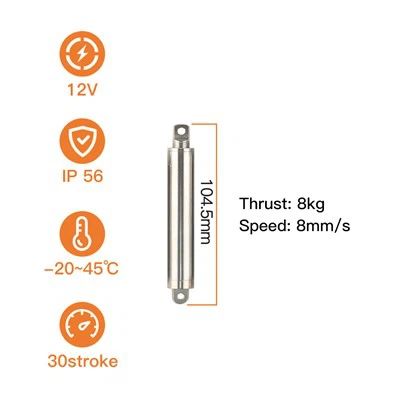
The 12V Dc Linear Actuator we supply is designed with high - quality materials and advanced manufacturing techniques. It offers a balance between power and energy consumption, making it an attractive option for many projects.
Advantages of Using a 12V Linear Actuator in a 3D Printer
1. Power and Compatibility
One of the primary advantages of a 12V linear actuator is its power supply compatibility. Most 3D printers already have a 12V power source available, either from the main power supply unit or from a dedicated power rail. This means that integrating a 12V linear actuator does not require additional power conversion equipment, simplifying the overall electrical design of the printer.
2. Cost - Effectiveness
Compared to some high - end actuators, 12V linear actuators are generally more cost - effective. For hobbyists and small - scale 3D printing enthusiasts, cost is often a significant factor. By using a 12V linear actuator, they can build a functional 3D printer without breaking the bank.
3. Compact Size
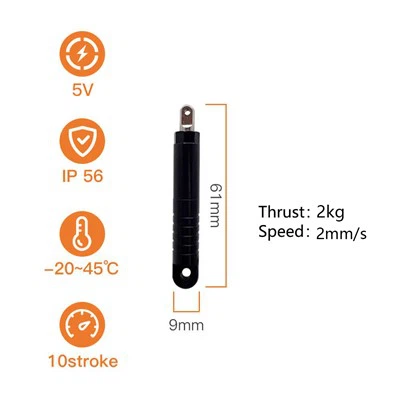
Many 12V linear actuators are designed to be compact, which is beneficial for 3D printers, especially those with limited space. The compact size allows for more flexibility in the printer's mechanical design, enabling the creation of smaller and more portable 3D printers. Our Miniature Linear Motor is a great example of a compact 12V actuator that can be easily integrated into a 3D printer.
4. Precision Control
With the right control system, a 12V linear actuator can provide precise linear motion. This is essential for 3D printing, where accurate movement of the print head and the build platform is required to create high - quality prints. The actuator can be controlled using pulse - width modulation (PWM) techniques, allowing for fine - tuned adjustments of the speed and position.
Limitations of Using a 12V Linear Actuator in a 3D Printer
1. Limited Force Output
One of the main limitations of a 12V linear actuator is its relatively limited force output compared to higher - voltage actuators. In some cases, especially when dealing with large - scale 3D printers or heavy build platforms, the 12V actuator may not be able to provide enough force to move the components smoothly. This can result in issues such as inconsistent layer deposition and reduced print quality.
2. Speed Constraints
The speed of a 12V linear actuator is also limited by its power supply. While it can provide sufficient speed for most basic 3D printing tasks, for high - speed printing applications, a 12V actuator may not be able to keep up. Faster printing requires a higher power input to drive the actuator at a higher speed, which a 12V system may not be able to provide.
3. Heat Generation
Like any electrical device, a 12V linear actuator generates heat during operation. If the actuator is used continuously for long periods, the heat can build up and affect its performance. In a 3D printer, overheating can lead to mechanical failures and inaccurate movement, which can ruin the print.
Technical Considerations for Using a 12V Linear Actuator in a 3D Printer
1. Load Calculation
Before integrating a 12V linear actuator into a 3D printer, it is crucial to calculate the load that the actuator will need to move. This includes the weight of the print head, the build platform, and any additional components. Based on the load calculation, the appropriate actuator with sufficient force output can be selected.


2. Control System
A proper control system is essential for the accurate operation of a 12V linear actuator in a 3D printer. The control system should be able to provide precise signals to the actuator to control its speed and position. This can be achieved using a microcontroller or a dedicated motion control board.
3. Cooling
To prevent overheating, a cooling system may be required for the 12V linear actuator. This can be as simple as adding a heatsink or a small fan to dissipate the heat. Proper ventilation around the actuator is also important to ensure efficient cooling.
Comparison with Other Actuators
When considering using a 12V linear actuator in a 3D printer, it is also important to compare it with other types of actuators, such as Actuator 24V. A 24V actuator generally offers higher force output and faster speed compared to a 12V actuator. However, it also requires a higher - voltage power supply, which may complicate the electrical design of the printer.
For small - scale and low - cost 3D printing projects, a 12V linear actuator may be the better choice due to its simplicity and cost - effectiveness. On the other hand, for large - scale and high - performance 3D printers, a 24V actuator may be more suitable.
Conclusion
In conclusion, a 12V linear actuator can be used in a 3D printer, especially for small - scale and hobbyist projects. It offers several advantages such as power compatibility, cost - effectiveness, compact size, and precision control. However, it also has some limitations, including limited force output, speed constraints, and heat generation.
By carefully considering the technical aspects and the specific requirements of the 3D printer, a 12V linear actuator can be a viable option. If you are interested in exploring the use of a 12V linear actuator in your 3D printer project, I encourage you to reach out to us for more information and to discuss your specific needs. We are here to help you make the right choice for your 3D printing endeavors.
References
- "Linear Actuators: A Comprehensive Guide" by Industrial Press
- "3D Printing Technology: Principles and Applications" by John Wiley & Sons