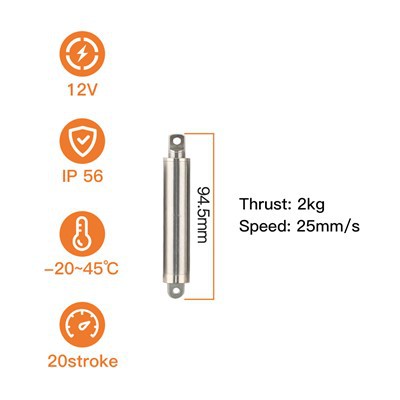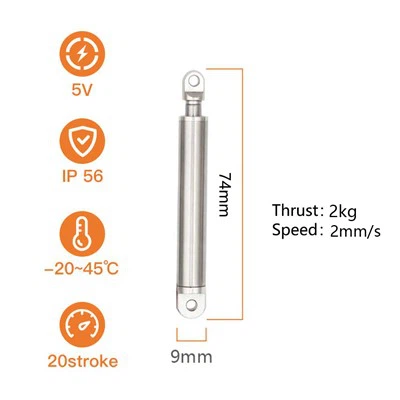
Hey there! As a supplier of micro actuators, I've seen firsthand the challenges that come with developing these tiny yet powerful devices. Micro actuators are used in a wide range of applications, from medical devices and consumer electronics to automotive and aerospace industries. They play a crucial role in enabling precise motion control in small spaces. But let me tell you, developing them isn't a walk in the park. In this blog, I'll share some of the key challenges we face in the development of micro actuators.
Miniaturization and Power Density
One of the most significant challenges in developing micro actuators is miniaturization. The demand for smaller and more compact devices is constantly increasing, especially in industries like wearables and implantable medical devices. However, as we shrink the size of the actuator, we also need to maintain or even increase its performance. This means packing more power into a smaller space, which is no easy feat.
Power density is a critical factor in micro actuator design. We need to find ways to generate enough force and torque while keeping the size and weight of the actuator to a minimum. This often involves using advanced materials and innovative manufacturing techniques. For example, some micro actuators use piezoelectric materials, which can generate a large amount of force when an electric field is applied. These materials are highly efficient and can be made very small, making them ideal for micro actuator applications.
Another approach is to use microfabrication techniques, such as photolithography and etching, to create complex structures on a microscopic scale. This allows us to integrate multiple components into a single chip, reducing the overall size of the actuator. However, these techniques require specialized equipment and expertise, and they can be expensive and time-consuming.
Precision and Accuracy
Micro actuators are often used in applications where precision and accuracy are of the utmost importance. For example, in medical devices, a micro actuator may be used to control the movement of a surgical instrument with sub-millimeter precision. In consumer electronics, a micro actuator may be used to adjust the focus of a camera lens or to provide haptic feedback in a touchscreen device.
Achieving high levels of precision and accuracy in micro actuators is challenging for several reasons. First, the small size of the actuator makes it more susceptible to external factors, such as vibrations and temperature changes. These factors can affect the performance of the actuator and cause it to deviate from its intended motion.
Second, the manufacturing process for micro actuators can introduce variations in the dimensions and properties of the components. These variations can accumulate over time and lead to errors in the actuator's motion. To overcome these challenges, we need to use advanced control algorithms and feedback systems to monitor and adjust the actuator's motion in real-time.
For example, some micro actuators use position sensors to measure the actual position of the actuator and compare it to the desired position. If there is a difference between the two, the control system can adjust the input signal to the actuator to correct the error. This feedback loop helps to ensure that the actuator operates with high precision and accuracy.
Durability and Reliability
Micro actuators are often used in harsh environments and under demanding conditions. For example, in automotive applications, a micro actuator may be exposed to high temperatures, vibrations, and moisture. In aerospace applications, a micro actuator may be subjected to extreme pressures and temperatures.
To ensure that micro actuators can withstand these conditions and provide reliable performance over a long period of time, we need to design them with durability in mind. This involves using high-quality materials and robust manufacturing processes. For example, some micro actuators use corrosion-resistant materials, such as stainless steel and titanium, to protect them from the effects of moisture and chemicals.
In addition, we need to test the micro actuators thoroughly to ensure that they meet the required standards for durability and reliability. This may involve subjecting the actuators to accelerated life tests, where they are operated under extreme conditions for an extended period of time. By doing so, we can identify any potential issues and make the necessary improvements to the design and manufacturing process.


Cost and Scalability
Cost is always a major consideration in the development of any product, and micro actuators are no exception. The cost of developing and manufacturing micro actuators can be high, especially when using advanced materials and manufacturing techniques. This can make it difficult to compete in the market, especially for small and medium-sized enterprises.
To reduce the cost of micro actuators, we need to find ways to optimize the design and manufacturing process. This may involve using more cost-effective materials, simplifying the design, and increasing the production volume. For example, some micro actuators use plastic materials instead of metal, which can significantly reduce the cost of production.
In addition, we need to ensure that the manufacturing process is scalable, so that we can produce large quantities of micro actuators at a reasonable cost. This may involve using automated manufacturing equipment and assembly lines to increase the efficiency of the production process.
Integration with Other Systems
Micro actuators are often used as part of a larger system, such as a medical device or a consumer electronics product. To ensure that the micro actuator works seamlessly with the other components of the system, we need to design it with integration in mind.
This involves understanding the requirements and specifications of the other components and ensuring that the micro actuator can communicate and interact with them effectively. For example, in a medical device, the micro actuator may need to be able to receive signals from a control unit and transmit feedback signals back to the unit.
In addition, we need to ensure that the micro actuator is compatible with the power supply and other electrical components of the system. This may involve designing the actuator to operate at a specific voltage and current level and ensuring that it has the appropriate electrical connections.
Conclusion
Developing micro actuators is a challenging but rewarding task. These tiny devices have the potential to revolutionize a wide range of industries by enabling precise motion control in small spaces. However, to overcome the challenges associated with their development, we need to use advanced materials, innovative manufacturing techniques, and sophisticated control algorithms.
At our company, we are constantly working to develop new and improved micro actuators that meet the needs of our customers. We offer a wide range of micro actuators, including Micro Linear Motor, Micro Linear Actuator 6V, and Micro Electric Actuator. Our products are designed to be reliable, efficient, and cost-effective, and we are committed to providing our customers with the highest level of service and support.
If you are interested in learning more about our micro actuators or if you have any questions or requirements, please don't hesitate to contact us. We would be happy to discuss your needs and provide you with a customized solution.
References
- Smith, J. (2018). Micro Actuators: Principles, Design, and Applications. Springer.
- Jones, A. (2019). Advances in Micro Actuator Technology. Journal of Microelectromechanical Systems, 28(3), 456-467.
- Brown, C. (2020). Challenges and Opportunities in the Development of Micro Actuators. Proceedings of the IEEE International Conference on Micro Electro Mechanical Systems, 567-572.