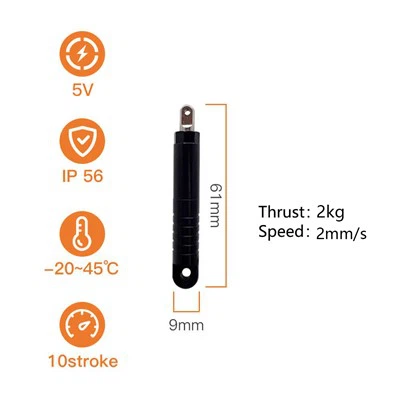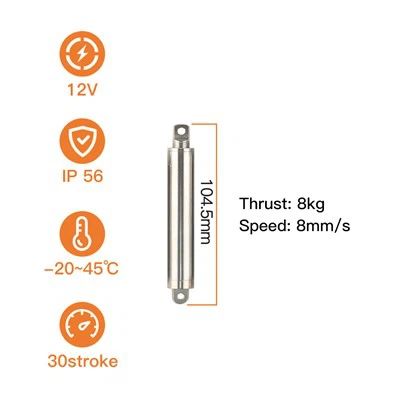
In the realm of industrial automation and mechanical control, the question of whether a 6V electric actuator can be used for load - following applications is a significant one. As a supplier of 6V electric actuators, I have encountered numerous inquiries regarding the suitability of our products for such demanding tasks. In this blog post, I will delve into the technical aspects, advantages, limitations, and practical considerations of using a 6V electric actuator for load - following applications.
Understanding Load - Following Applications
Load - following applications refer to scenarios where a system needs to adjust its output in response to changes in the load. This is commonly seen in various industries, such as manufacturing, robotics, and energy management. For example, in a manufacturing process, a machine may need to adjust the force or position of a component based on the weight or resistance of the material being processed. In a robotic arm, the actuator must adapt to different loads as it picks up and moves objects of varying masses. In energy management, a generator may need to adjust its power output according to the fluctuating electricity demand.
Technical Specifications of 6V Electric Actuators
A 6V electric actuator is a device that converts electrical energy into mechanical motion. It typically consists of a motor, a gearbox, and a linear or rotary output mechanism. The 6V power supply is relatively low, which makes it suitable for applications where safety and energy efficiency are crucial.
The motor in a 6V electric actuator is usually a DC motor, which provides smooth and controllable motion. The gearbox is designed to increase the torque output of the motor while reducing the speed. This allows the actuator to generate sufficient force to move the load. The output mechanism can be either linear or rotary, depending on the specific application requirements. A linear actuator converts the rotary motion of the motor into linear motion, while a rotary actuator provides rotational movement.
Advantages of Using 6V Electric Actuators for Load - Following Applications
Energy Efficiency
One of the primary advantages of using a 6V electric actuator is its energy efficiency. The low - voltage power supply consumes less energy compared to higher - voltage actuators. This is particularly beneficial in applications where continuous operation is required, as it can significantly reduce the overall energy costs. For example, in a battery - powered device, a 6V electric actuator can extend the battery life, making it more suitable for portable or remote applications.
Safety
The 6V power supply is also safer than higher - voltage alternatives. It reduces the risk of electrical shock, which is a major concern in industrial environments. This makes 6V electric actuators a preferred choice for applications where human - machine interaction is common, such as in medical devices or consumer electronics.
Compact Size
6V electric actuators are often more compact than their higher - voltage counterparts. This makes them easier to install in tight spaces, which is a common requirement in many load - following applications. For example, in a small robotic arm or a precision manufacturing machine, the compact size of a 6V electric actuator allows for more flexible design and integration.
Precise Control
With the right control system, a 6V electric actuator can provide precise control over the motion and force output. This is essential for load - following applications, where accurate adjustment of the load is required. Electric Actuator Control systems can be used to monitor the load and adjust the actuator's operation accordingly. For example, a feedback sensor can be used to measure the position or force of the load, and the control system can then adjust the motor speed and direction to maintain the desired load - following performance.


Limitations of Using 6V Electric Actuators for Load - Following Applications
Limited Torque and Force Output
The main limitation of a 6V electric actuator is its relatively limited torque and force output. Due to the low - voltage power supply, the motor in a 6V actuator may not be able to generate as much power as a higher - voltage actuator. This restricts its use in applications where large loads need to be moved or high forces need to be generated. For example, in heavy - duty industrial machinery or large - scale construction equipment, a 6V electric actuator may not be sufficient to handle the load.
Response Time
In some cases, the response time of a 6V electric actuator may be slower compared to higher - voltage actuators. This is because the low - voltage motor may take longer to accelerate and decelerate. In load - following applications where rapid changes in the load are required, this slower response time may affect the overall performance of the system.
Practical Considerations for Using 6V Electric Actuators in Load - Following Applications
Load Analysis
Before using a 6V electric actuator for a load - following application, it is essential to conduct a thorough load analysis. This includes determining the maximum load that the actuator needs to move, the required speed and acceleration, and the range of motion. Based on this analysis, the appropriate actuator can be selected. For example, if the load is relatively small and the required speed is low, a 6V electric actuator may be a suitable choice. However, if the load is large or the speed requirements are high, a higher - voltage actuator may be necessary.
Control System Design
The control system design is also crucial for load - following applications. A well - designed control system can compensate for the limitations of the 6V electric actuator and ensure accurate load - following performance. As mentioned earlier, Electric Actuator Control systems can be used to monitor the load and adjust the actuator's operation in real - time. The control system should also be able to handle any disturbances or changes in the load quickly and effectively.
Compatibility with Other Components
When using a 6V electric actuator in a load - following application, it is important to ensure its compatibility with other components in the system. This includes the power supply, the control system, and the load itself. For example, the power supply should be able to provide a stable 6V output, and the control system should be able to communicate effectively with the actuator. Additionally, the load should be properly connected and supported to ensure smooth and reliable operation.
Conclusion
In conclusion, a 6V electric actuator can be used for load - following applications under certain conditions. Its energy efficiency, safety, compact size, and precise control capabilities make it a viable option for many small - to - medium - sized load - following tasks. However, its limited torque and force output and slower response time may restrict its use in more demanding applications.
As a supplier of Electric Linear Actuator 6V, we offer a wide range of products that are designed to meet the diverse needs of load - following applications. Our actuators are carefully engineered to provide high - quality performance and reliability. If you are considering using a 6V electric actuator for your load - following application, we encourage you to contact us for more information and to discuss your specific requirements. We are committed to providing you with the best solutions and support to ensure the success of your project.
References
- Johnson, R. A. (2018). Electric Actuators: Principles and Applications. McGraw - Hill.
- Smith, J. B. (2020). Energy - Efficient Actuator Design for Industrial Automation. IEEE Transactions on Industrial Electronics.
- Brown, C. D. (2019). Load - Following Control Strategies for Actuators in Robotic Systems. Journal of Robotics Research.