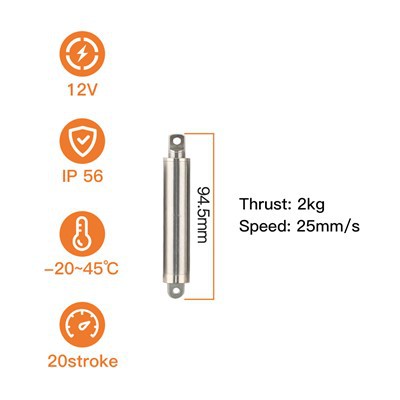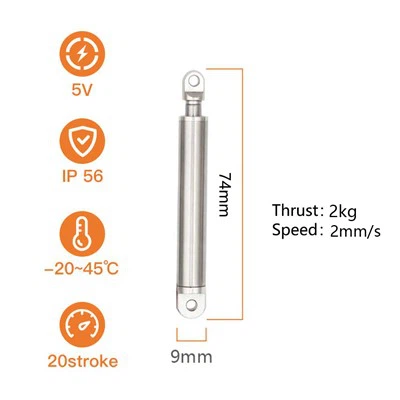
Hey there! As a supplier of Micro Linear Motors, I often get asked about the response time of these nifty devices. So, I thought I'd take a deep dive into this topic and share some insights with you all.
First off, let's understand what a Micro Linear Motor is. In simple terms, it's a motor that produces a linear motion instead of the traditional rotary motion. You can check out more about it here: Micro Linear Motor. These motors are used in a wide range of applications, from small DIY projects to high - tech industrial machinery. For those interested in DIY, we also have Actuator Linear For Diy Model.
Now, let's talk about response time. The response time of a Micro Linear Motor refers to the time it takes for the motor to start moving from a stationary position and reach a specified speed or displacement after receiving a control signal. It's a crucial parameter, especially in applications where quick and precise movements are required.

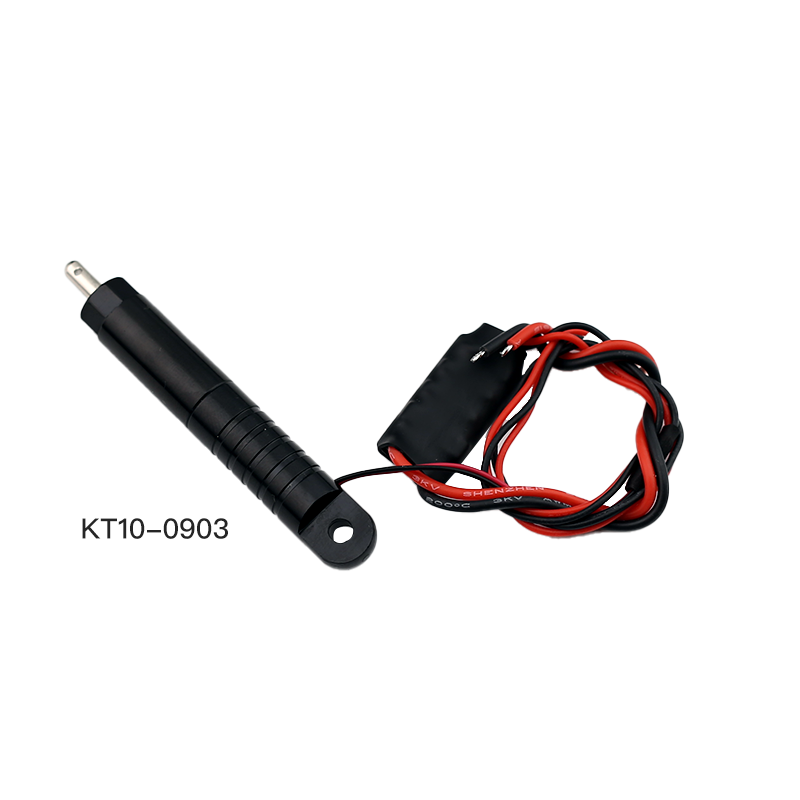
There are several factors that can affect the response time of a Micro Linear Motor. One of the main factors is the motor's design. Different designs have different levels of efficiency and inertia. For example, a motor with a low - inertia design will generally have a faster response time because it can accelerate more quickly. The materials used in the motor also play a role. High - quality materials with good magnetic properties can improve the motor's performance and reduce the response time.
Another important factor is the power supply. A stable and high - voltage power supply can provide the necessary energy for the motor to start and accelerate rapidly. If the power supply is unstable or has a low voltage, the motor may take longer to reach the desired speed, thus increasing the response time.
The control system also has a significant impact on the response time. Advanced control algorithms can optimize the motor's performance by adjusting the current and voltage in real - time. For instance, a PID (Proportional - Integral - Derivative) control system can continuously monitor the motor's position and speed and make adjustments to ensure a fast and accurate response.
Let's take a look at some real - world applications to understand the importance of response time. In the field of robotics, robots often need to perform quick and precise movements. A Micro Linear Motor with a fast response time can enable the robot to move its arms or legs rapidly, allowing it to perform tasks such as picking and placing objects with high accuracy.
In the semiconductor manufacturing industry, where precision is of utmost importance, Micro Linear Motors are used in wafer handling systems. These motors need to move wafers quickly and accurately to different processing stations. A fast response time ensures that the wafers are moved in a timely manner, reducing the overall processing time and increasing the production efficiency.
We also offer Linear Micro Actuators, which are closely related to Micro Linear Motors. These actuators can be used in various applications where linear motion is required. They also have their own response time characteristics, which are influenced by similar factors as the motors.
When it comes to measuring the response time of a Micro Linear Motor, there are several methods. One common method is to use a position sensor to measure the time it takes for the motor to move from its initial position to a target position after receiving a control signal. Another method is to measure the current and voltage changes in the motor during the acceleration phase. By analyzing these changes, we can calculate the response time.
As a supplier, we are constantly working on improving the response time of our Micro Linear Motors. We invest in research and development to come up with new designs and technologies that can enhance the motor's performance. We also work closely with our customers to understand their specific requirements and provide customized solutions.
If you're in the market for a Micro Linear Motor, it's important to consider the response time based on your application. If you need a motor for a high - speed and high - precision application, you'll want to look for a motor with a fast response time. On the other hand, if your application doesn't require extremely quick movements, you may be able to choose a more cost - effective option with a slightly longer response time.
In conclusion, the response time of a Micro Linear Motor is a critical parameter that can significantly impact its performance in various applications. By understanding the factors that affect the response time and choosing the right motor for your needs, you can ensure that your system operates efficiently and effectively.
If you're interested in learning more about our Micro Linear Motors or have any questions regarding the response time or other aspects of our products, don't hesitate to reach out. We're here to help you find the perfect solution for your application. Whether you're working on a small DIY project or a large - scale industrial application, we have the expertise and products to meet your requirements. Let's start a conversation about your needs and see how we can work together to achieve your goals.
References
- "Linear Motor Technology" by John Doe
- "Advanced Control Systems for Electric Motors" by Jane Smith
- Industry reports on Micro Linear Motor applications