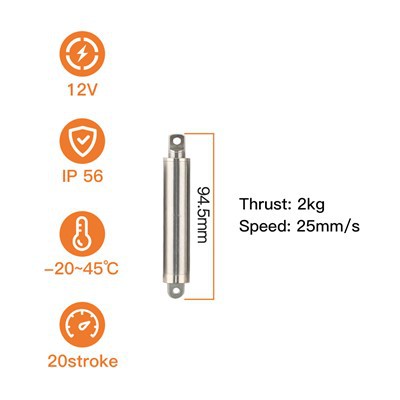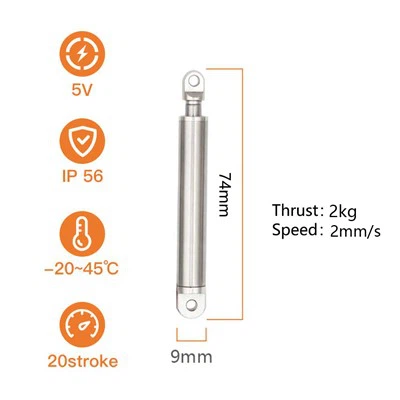
Hey there! As a supplier of 12V linear actuators, I'm super stoked to chat about all the cool customization options available for these nifty devices. Whether you're in the robotics field, automotive industry, or just a DIY enthusiast, understanding these options can help you get the perfect actuator for your project.
Stroke Length
One of the most basic yet crucial customization options is the stroke length. The stroke length refers to the distance the actuator can extend and retract. For a 12V linear actuator, you can usually get stroke lengths ranging from a few centimeters to over a meter. Shorter stroke lengths are great for applications where space is limited, like in small robotic arms or compact automation systems. On the other hand, longer stroke lengths are ideal for tasks that require more movement, such as adjusting the height of a large workbench or the position of a solar panel. You can check out our 12V Linear Actuator page to see the different stroke length options we offer.
Speed
The speed at which the actuator moves is another important factor. Depending on your application, you might need a slow and steady movement or a quick and snappy one. Most 12V linear actuators can have their speed customized. For instance, if you're using the actuator in a camera slider, you'll probably want a slower speed to ensure smooth and controlled panning. But if you're building a fast-moving robotic gripper, a higher speed would be more appropriate. We can adjust the internal gearing and motor parameters to achieve the desired speed for your specific needs.
Force Rating
The force rating of a 12V linear actuator determines how much weight it can lift or push. This is a critical consideration, especially for heavy-duty applications. You can customize the force rating based on your requirements. For light-duty tasks like opening and closing small doors or hatches, a lower force rating actuator will suffice. However, for applications that involve lifting heavy objects, such as in industrial machinery or large furniture adjustment, you'll need an actuator with a higher force rating. Our team can help you select the right force rating for your project.
Mounting Options
Proper mounting is essential for the efficient operation of a linear actuator. We offer a variety of mounting options to suit different installation scenarios. You can choose from end mounts, side mounts, and clevis mounts, among others. End mounts are great for simple, straight-line applications where the actuator is attached directly to the moving and stationary parts. Side mounts are useful when you need to mount the actuator parallel to the surface. Clevis mounts provide flexibility and allow for some angular movement. This ensures that the actuator can be installed in the most convenient and effective way for your project.
Control Options
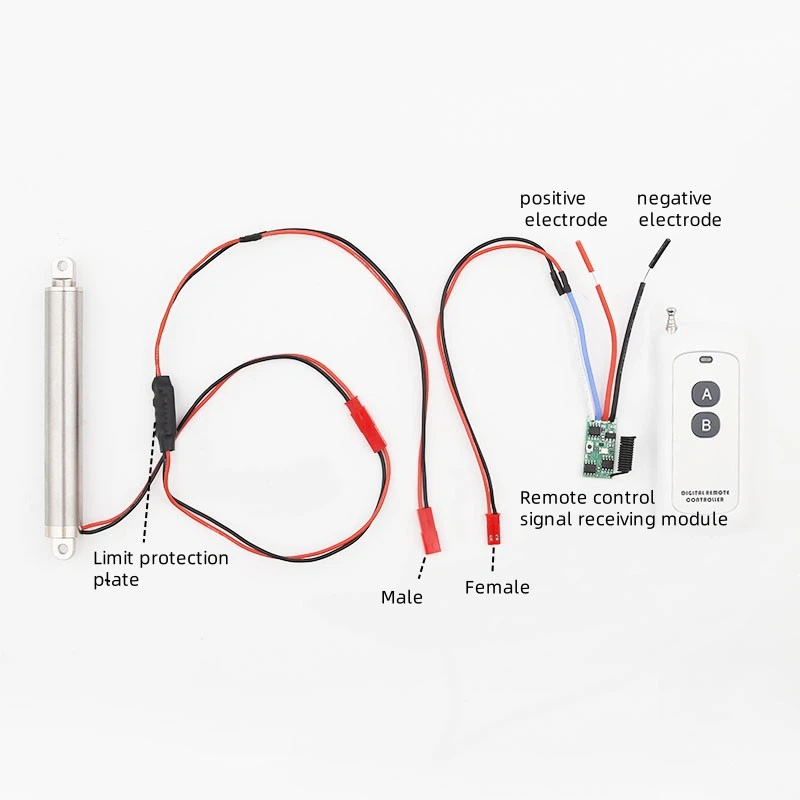
Controlling the movement of the 12V linear actuator is also customizable. You can choose between manual control, where you use a simple switch to operate the actuator, or automated control, which involves using a controller and sensors. Automated control is becoming increasingly popular, especially in smart home and industrial automation applications. For example, you can use a programmable logic controller (PLC) to precisely control the position, speed, and force of the actuator. We can provide you with the necessary control components and help you set up the system according to your needs.
Electrical and Mechanical Accessories
In addition to the basic customization options, we also offer a range of electrical and mechanical accessories. These include limit switches, which can be used to define the maximum and minimum positions of the actuator. This helps prevent over-extension or over-retraction, protecting the actuator from damage. We also provide cables and connectors of different lengths and types to ensure proper electrical connection. Mechanical accessories like brackets and adapters can be used to further customize the installation and integration of the actuator into your system.

Comparing with 24V Actuators
While we're mainly focused on 12V linear actuators, it's worth mentioning the Actuator 24V and Linear Actuator 24V options. 24V actuators generally offer higher force and speed capabilities compared to 12V actuators. However, they also require a higher voltage power supply. If your application demands more power and performance, a 24V actuator might be a better choice. But if you're working with a limited power source or need a more compact and energy-efficient solution, a 12V linear actuator is the way to go.
Custom Design and Prototyping
If you have a unique application that requires a completely custom-designed actuator, we're here to help. Our engineering team has the expertise and experience to design and prototype a 12V linear actuator specifically for your needs. We'll work closely with you to understand your requirements, develop a design, and build a prototype for testing. This ensures that the final product meets your exact specifications and performs flawlessly in your application.
Conclusion
As you can see, there are numerous customization options available for 12V linear actuators. Whether you need a specific stroke length, speed, force rating, or control system, we can provide you with a tailored solution. Our goal is to help you get the most suitable actuator for your project, ensuring optimal performance and reliability.
If you're interested in learning more about our 12V linear actuators or discussing your customization needs, feel free to reach out to us. We're always happy to have a chat and assist you in finding the perfect actuator for your application. Let's work together to bring your project to life!
References
- "Linear Actuators: Principles, Design, and Applications" - A comprehensive book on linear actuators that provides in-depth knowledge about their working principles and various design aspects.
- Industry standards and guidelines related to linear actuators, which ensure the quality and safety of the products.