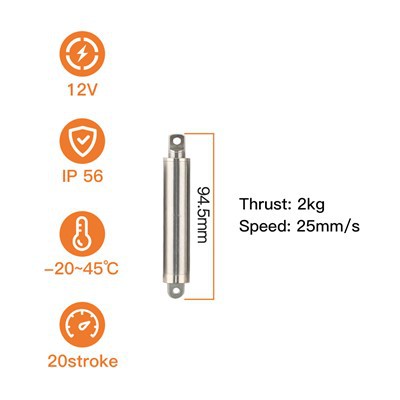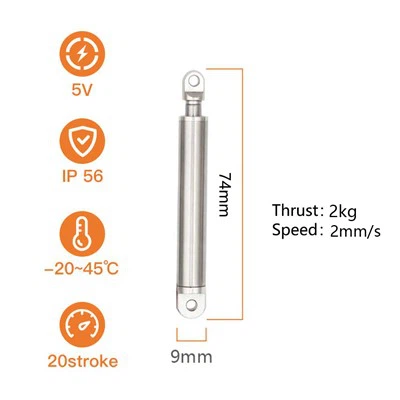
Hey there, 3D printing enthusiasts! I'm a supplier of 12V linear actuators, and I'm stoked to share with you all the ins and outs of using a 12V linear actuator in a 3D printer. These little powerhouses can really take your 3D printing game to the next level, but there are some key requirements you gotta know about. So, let's dive right in!
Power Supply Compatibility
First things first, the power supply is crucial. A 12V linear actuator, as the name suggests, needs a 12V power source. You can't just hook it up to any old power supply. Using the wrong voltage can fry your actuator faster than you can say "3D print." Make sure your 3D printer's power supply can deliver a stable 12V output. If it can't, you might need to get a separate 12V power adapter.
Now, when we're talking about power, we also need to consider the current draw. Different 12V linear actuators have different current requirements. You gotta check the datasheet of the actuator you're using to see how much current it needs. If your power supply can't provide enough current, the actuator might not work properly, or it could even overheat. It's all about finding that sweet spot between voltage and current to keep your actuator running smoothly.
Mechanical Mounting
Once you've got the power sorted, it's time to think about how you're gonna mount the 12V linear actuator in your 3D printer. The actuator needs to be securely attached to the printer's frame or other components. You don't want it wiggling around while it's moving, or it could mess up your prints.
Most 12V linear actuators come with mounting holes or brackets. You'll need to make sure these match up with the mounting points on your 3D printer. Sometimes, you might need to do a bit of custom fabrication to get the actuator to fit just right. It's a good idea to use high-quality screws or bolts to secure the actuator, so it doesn't come loose over time.
Another thing to consider is the orientation of the actuator. You need to make sure it's installed in the right direction so that it can move the printer's components in the way you want. This might seem obvious, but it's easy to make a mistake, especially if you're in a hurry to get your printer up and running.
Control System Integration
Now, let's talk about how you're gonna control the 12V linear actuator. In a 3D printer, the actuator needs to be integrated with the printer's control system. This usually means connecting it to the printer's motherboard.
Most 3D printer motherboards have control ports for motors and actuators. You'll need to find the right port for your 12V linear actuator and connect it using the appropriate cables. The control signals sent from the motherboard tell the actuator when to move, how fast to move, and how far to move.
There are different types of control signals that can be used to operate a 12V linear actuator. Some actuators use pulse-width modulation (PWM) signals, while others use analog signals. You need to make sure your printer's motherboard can send the right type of signal to the actuator. If not, you might need to use a driver or a controller to convert the signals.
Load Capacity
One of the most important things to consider when using a 12V linear actuator in a 3D printer is its load capacity. The actuator needs to be able to handle the weight of the components it's moving. In a 3D printer, this could include the print head, the build platform, or other moving parts.
You need to calculate the total weight of the load that the actuator will be responsible for and compare it to the actuator's rated load capacity. If the load is too heavy for the actuator, it might not be able to move the components smoothly, or it could even break down. It's always better to choose an actuator with a higher load capacity than you think you'll need, just to be on the safe side.
Speed and Precision
In 3D printing, speed and precision are key. You want your 12V linear actuator to be able to move quickly enough to keep up with the printing process, but also precisely enough to ensure accurate prints.
The speed of a 12V linear actuator is usually measured in millimeters per second (mm/s). You need to choose an actuator with a speed that's appropriate for your 3D printer. If the actuator is too slow, it could slow down the entire printing process. On the other hand, if it's too fast, it might not be able to move precisely enough.
Precision is also important. The actuator needs to be able to move to the exact position required by the printer's software. This is usually measured in terms of repeatability, which is how accurately the actuator can return to the same position over and over again. Look for an actuator with a high level of repeatability to ensure consistent and accurate prints.
Environmental Conditions
Finally, you need to consider the environmental conditions in which your 3D printer will be operating. 12V linear actuators can be affected by factors such as temperature, humidity, and dust.
Most actuators are designed to operate within a certain temperature range. If the temperature is too high or too low, it could affect the performance of the actuator. You might need to take steps to regulate the temperature in the printer's environment, such as using a heater or a cooler.
Humidity can also be a problem. Moisture can cause corrosion and damage to the actuator's components. If you're operating your 3D printer in a humid environment, you might need to use a dehumidifier or a moisture-resistant enclosure.
Dust and debris can also get into the actuator and cause problems. Make sure your 3D printer is located in a clean environment, and consider using a dust cover or a filter to keep the actuator protected.
Conclusion
So, there you have it, folks! These are the main requirements for using a 12V linear actuator in a 3D printer. By paying attention to power supply compatibility, mechanical mounting, control system integration, load capacity, speed and precision, and environmental conditions, you can ensure that your actuator works smoothly and helps you create amazing 3D prints.
If you're in the market for a high-quality 12V linear actuator, be sure to check out our 12V Actuator Linear and Linear Motor 12V options. We also have 24 Volt Actuator models available if you need a different voltage.


If you have any questions or want to discuss your specific needs, don't hesitate to reach out. We're here to help you find the perfect actuator for your 3D printer. Let's take your 3D printing to new heights together!
References
- Manufacturer datasheets for 12V linear actuators
- 3D printer user manuals
- Online forums and communities for 3D printing enthusiasts