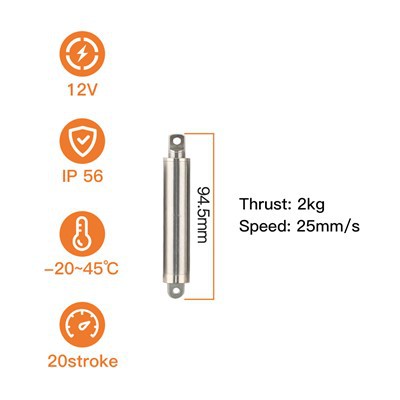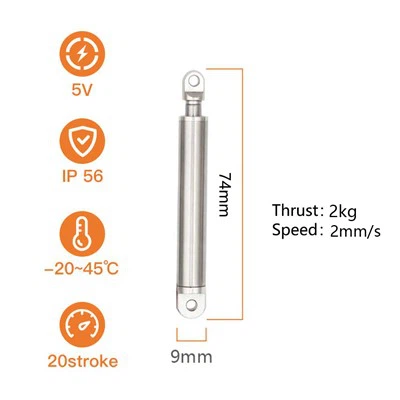
Measuring the displacement of a 6V electric actuator is a crucial task, especially for those in applications where precise movement control is required. As a reliable supplier of 6V electric actuators, I understand the significance of accurate displacement measurement. In this blog, I'll share some effective methods and considerations for measuring the displacement of a 6V electric actuator.
Why Measure Displacement?
Before delving into the measurement methods, it's essential to understand why displacement measurement is important. In various industries such as automation, robotics, and automotive, 6V electric actuators are used to perform specific tasks that rely on precise movement. Measuring the displacement allows us to:
- Ensure accuracy: By knowing the exact displacement, we can ensure that the actuator is moving to the desired position, which is crucial for the proper functioning of the overall system.
- Detect malfunctions: Any deviation from the expected displacement can indicate a problem with the actuator or the system. Early detection of such issues can prevent costly breakdowns and downtime.
- Optimize performance: Measuring displacement helps in fine - tuning the actuator's operation, leading to improved efficiency and performance.
Types of 6V Electric Actuators
As a 6V electric actuator supplier, we offer a variety of products, including Actuators Electric, Electric Cylinder 6V, and Fast Electric Actuator. Each type may require different measurement approaches based on its design and application.
- Linear Actuators: These actuators provide linear motion. They are commonly used in applications such as opening and closing valves, adjusting the position of a platform, etc.
- Rotary Actuators: Rotary actuators generate rotational motion. They are often used in robotics for joint movement and in industrial machinery for rotating components.
Methods of Measuring Displacement
Potentiometric Method
One of the simplest and most common methods for measuring the displacement of a 6V electric actuator is the potentiometric method. A potentiometer is a variable resistor whose resistance changes with the position of the actuator.
- How it works: The potentiometer is mechanically linked to the actuator's moving part. As the actuator moves, the wiper of the potentiometer slides along the resistive element, changing the resistance. By measuring the voltage across the potentiometer using a voltage divider circuit, we can determine the position of the actuator.
- Advantages: This method is relatively inexpensive and easy to implement. It provides a continuous output signal that is proportional to the displacement.
- Disadvantages: Potentiometers have a limited lifespan due to the mechanical wear of the wiper on the resistive element. They are also susceptible to electrical noise.
Encoder - Based Method
Encoders are widely used for measuring the displacement of both linear and rotary actuators. There are two main types of encoders: incremental and absolute.
- Incremental Encoders: These encoders generate a series of pulses as the actuator moves. By counting the number of pulses, we can determine the relative displacement of the actuator. However, incremental encoders do not provide information about the absolute position, so a reference point needs to be established.
- Absolute Encoders: Absolute encoders provide a unique digital code for each position of the actuator. This allows us to directly read the absolute position without the need for a reference point.
- Advantages: Encoders offer high accuracy and resolution. They are non - contact devices, which means they have a longer lifespan compared to potentiometers.
- Disadvantages: Encoders are more expensive than potentiometers, and the electronics required to read the encoder signals can be complex.
Ultrasonic Sensor Method
Ultrasonic sensors can be used to measure the displacement of linear actuators.


- How it works: The ultrasonic sensor emits ultrasonic waves and measures the time it takes for the waves to bounce back from a target. By knowing the speed of sound in the medium, we can calculate the distance between the sensor and the target, which is related to the displacement of the actuator.
- Advantages: Ultrasonic sensors are non - contact and can measure displacement over a relatively long range. They are also not affected by the material or surface finish of the target.
- Disadvantages: The accuracy of ultrasonic sensors can be affected by factors such as temperature, humidity, and the presence of obstacles in the path of the ultrasonic waves.
Laser Distance Sensor Method
Laser distance sensors are another option for measuring the displacement of actuators.
- How it works: Similar to ultrasonic sensors, laser distance sensors emit a laser beam and measure the time it takes for the beam to return. However, laser sensors offer much higher accuracy and resolution.
- Advantages: Laser distance sensors provide extremely high accuracy and can measure displacement with a high degree of precision. They are also less affected by environmental factors compared to ultrasonic sensors.
- Disadvantages: Laser distance sensors are very expensive, and they require careful alignment and calibration.
Considerations for Displacement Measurement
When measuring the displacement of a 6V electric actuator, several factors need to be considered:
- Accuracy Requirements: The accuracy required for the application will determine the choice of measurement method. For applications that require high precision, such as in medical devices or aerospace, methods like encoder - based or laser distance sensor methods may be more suitable.
- Environment: The operating environment of the actuator can affect the performance of the measurement method. For example, in a dusty or humid environment, potentiometers may not be the best choice due to the potential for electrical short - circuits or mechanical wear.
- Cost: The cost of the measurement system is also an important factor. For applications with a limited budget, simpler methods like potentiometric methods may be preferred.
Calibration of Measurement Systems
Regardless of the measurement method used, it is essential to calibrate the measurement system regularly. Calibration ensures that the measured displacement values are accurate and reliable.
- Calibration Process: The calibration process involves comparing the output of the measurement system with a known reference standard. Any errors or offsets are then adjusted to ensure that the measurement system provides accurate readings.
- Frequency of Calibration: The frequency of calibration depends on the application and the stability of the measurement system. In general, more critical applications may require more frequent calibration.
Conclusion
Measuring the displacement of a 6V electric actuator is a complex but essential task. As a 6V electric actuator supplier, we understand the importance of providing accurate measurement solutions to our customers. By choosing the right measurement method based on the application requirements, considering environmental factors, and performing regular calibration, we can ensure that the actuators operate with high accuracy and reliability.
If you are in need of 6V electric actuators or have questions about displacement measurement, feel free to contact us for a detailed discussion. We are committed to providing high - quality products and professional technical support to meet your specific needs.
References
- Doebelin, E. O. (2003). Measurement Systems: Application and Design. McGraw - Hill.
- Groover, M. P. (2010). Automation, Production Systems, and Computer - Integrated Manufacturing. Prentice Hall.