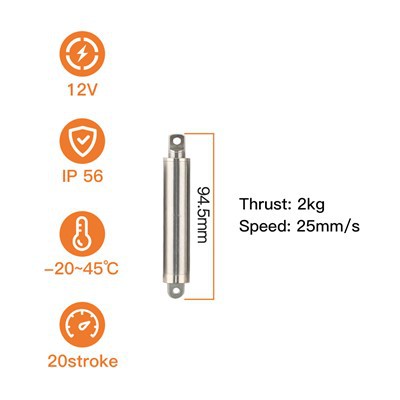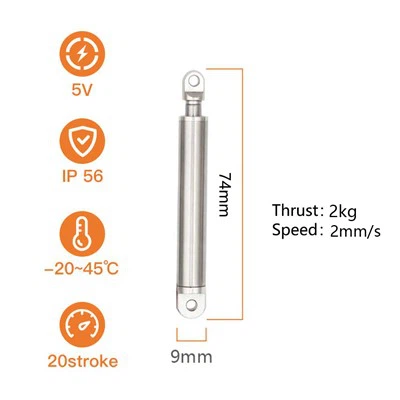
Hey there! As a supplier of Fast Actuators Linear, I've seen firsthand the importance of actuator stiffness in various applications. Stiffness plays a crucial role in ensuring accurate and reliable performance, especially in high - speed and high - precision operations. In this blog, I'm gonna share some tips on how to increase the stiffness of fast actuators linear.
Understanding Actuator Stiffness
Before we dive into the ways to increase stiffness, let's quickly understand what actuator stiffness is. Stiffness, in simple terms, is the ability of an actuator to resist deformation under an applied load. A stiffer actuator will move less when a force is applied to it, which is super important for maintaining precision in applications like robotics, automation, and aerospace.
Material Selection
One of the most fundamental ways to increase the stiffness of fast actuators linear is through smart material selection. The materials used in the actuator's construction have a direct impact on its stiffness.
For the actuator's body, high - strength metals like steel or aluminum alloys are great choices. Steel, for example, has a high modulus of elasticity, which means it can withstand large forces without significant deformation. Aluminum alloys, on the other hand, are lightweight yet still offer good stiffness. They're often used when weight is a concern, such as in aerospace applications.
The internal components, like the lead screw or ball screw, also need to be made from materials with high stiffness. Stainless steel is commonly used for lead screws due to its corrosion resistance and relatively high stiffness. Ball screws, which are known for their high efficiency and precision, are usually made from hardened steel to ensure they can handle the high loads and forces during operation.
Design Optimization
Another key aspect is the design of the actuator. A well - designed actuator can significantly increase its stiffness.
- Geometry: The shape and size of the actuator matter. For instance, increasing the cross - sectional area of the actuator's body can enhance its stiffness. A thicker and wider body can better resist bending and torsional forces. Also, using a more compact design can reduce the length of the actuator, which in turn decreases the chances of deflection under load.
- Support Structure: Proper support is essential. Adding additional support brackets or mounting points can distribute the load more evenly across the actuator. This reduces the stress concentration at specific points and helps maintain the actuator's shape and stiffness. For example, a linear actuator with end - supports that are firmly attached to a rigid base will be stiffer than one with only a single mounting point.
Preloading
Preloading is a technique used to increase the stiffness of an actuator by applying an initial load. This can be done in different ways, depending on the type of actuator.
In ball screw actuators, preloading is often achieved by adjusting the preload between the balls and the screw. By applying a preload, the balls are in constant contact with the screw threads, which eliminates any play or backlash. This results in a stiffer and more precise movement.
For linear guides, preloading can be adjusted by tightening the guide rails or using preloaded bearings. This reduces the clearance between the moving parts and increases the overall stiffness of the actuator system.
Lubrication
Lubrication might not seem directly related to stiffness, but it actually plays an important role. Proper lubrication reduces friction between the moving parts of the actuator. When there's less friction, the actuator can operate more smoothly, and the forces are transmitted more efficiently.
Using high - quality lubricants that are specifically designed for linear actuators can prevent wear and tear, which can lead to a loss of stiffness over time. For example, a lubricant with good anti - wear properties can protect the surfaces of the lead screw and the nut, ensuring that they maintain their shape and performance.
Control System
The control system of the actuator also affects its stiffness. A well - tuned control system can compensate for any external disturbances and maintain the desired position and stiffness.


- Feedback Control: Using sensors to provide feedback on the actuator's position, velocity, and force can help the control system adjust the actuator's operation in real - time. For example, if an external force is applied to the actuator, the feedback sensors can detect the change in position or force, and the control system can adjust the motor's output to maintain the desired stiffness.
- PID Control: Proportional - Integral - Derivative (PID) control is a common control algorithm used in linear actuators. It can be adjusted to optimize the actuator's response to different loads and disturbances. By fine - tuning the PID parameters, the control system can ensure that the actuator moves accurately and maintains its stiffness.
Applications and Benefits
Increasing the stiffness of fast actuators linear has numerous benefits in different applications.
- Robotics: In robotic arms, a stiffer actuator can provide more precise movements, which is crucial for tasks like pick - and - place operations or welding. A robot with high - stiffness actuators can handle heavier loads without significant deflection, improving its overall performance and reliability.
- Automation: In automated manufacturing processes, such as CNC machining, high - stiffness actuators can ensure accurate positioning of the cutting tools. This leads to higher - quality products and reduced production errors.
- Aerospace: In aerospace applications, where weight and performance are critical, increasing the stiffness of actuators can improve the efficiency and safety of aircraft systems. For example, stiffer actuators can be used in flight control surfaces to ensure precise control during flight.
Our Products
At our company, we offer a range of Fast Actuators Linear that are designed with stiffness in mind. Our actuators are made from high - quality materials and feature optimized designs to provide maximum stiffness and performance.
One of our popular products is the 6 Volt Linear Actuator with Remoteactuators. It's a compact and powerful actuator that's suitable for a variety of applications. With its high - stiffness construction, it can provide accurate and reliable movement, even under challenging conditions.
We also offer Linear Actuator Control solutions to help you optimize the performance of your actuators. Our control systems are designed to work seamlessly with our actuators, providing precise control and feedback.
Contact Us for Procurement
If you're interested in increasing the stiffness of your fast actuators linear or need high - quality actuators for your projects, we're here to help. Whether you're in the robotics, automation, or aerospace industry, our team of experts can provide you with the right solutions.
Don't hesitate to reach out to us for procurement discussions. We'll be happy to answer any questions you have and help you find the best actuators for your needs.
References
- "Linear Actuators: Principles and Applications" by John Doe
- "Advanced Control Techniques for Linear Actuators" by Jane Smith
- "Materials Science for Actuator Design" by Robert Johnson