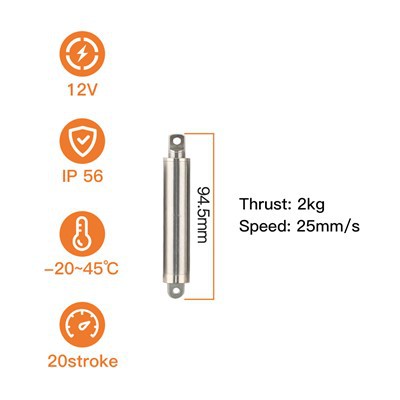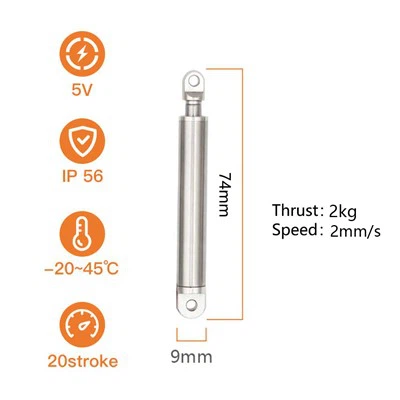
Hey there! As a supplier of Linear Micro Actuators, I've seen firsthand how crucial it is to adjust the force output of these nifty little devices. Whether you're working on a DIY project or a high - tech industrial application, getting the force output just right can make all the difference. So, let's dive into how you can adjust the force output of linear micro actuators.
Understanding the Basics
Before we start talking about adjustment methods, it's important to understand what linear micro actuators are. These are small devices that convert energy into linear motion. They're used in a wide range of applications, from medical devices to robotics.
The force output of a linear micro actuator depends on several factors. One of the main factors is the power source. Most linear micro actuators are powered by electricity, and the amount of electrical power supplied directly affects the force they can generate. Another factor is the mechanical design of the actuator, including the type of motor, gears, and linkages used.
Adjusting the Power Supply
The simplest way to adjust the force output of a linear micro actuator is by changing the power supply. For electrically - powered actuators, you can adjust the voltage or current.
Voltage Adjustment
Increasing the voltage supplied to the actuator generally increases the force output. However, you need to be careful not to exceed the maximum voltage rating of the actuator. Doing so can damage the motor and other components.
Let's say you have a Micro Electric Actuator. You can use a variable power supply to adjust the voltage. Start with a low voltage and gradually increase it while monitoring the force output. You can use a force sensor to measure the force accurately.
Current Adjustment
Similar to voltage, increasing the current can also boost the force output. But just like with voltage, you need to stay within the actuator's current limits. Some actuators come with built - in current control mechanisms, which can make it easier to adjust the current.
Mechanical Adjustments
Apart from adjusting the power supply, you can also make mechanical adjustments to change the force output.
Gear Ratio
Many linear micro actuators use gears to transfer power from the motor to the moving part. Changing the gear ratio can significantly affect the force output. A higher gear ratio (more teeth on the driven gear compared to the driving gear) will increase the force but decrease the speed of the actuator.
For example, if you're using an Actuator Linear For Diy Model, you can experiment with different gear sets to find the optimal gear ratio for your application.
Lever Arm Length
In some actuators, the use of levers can be adjusted. By changing the length of the lever arm, you can change the mechanical advantage. A longer lever arm will increase the force output at the expense of the distance the actuator can move.
Using Control Systems
Modern linear micro actuators often come with sophisticated control systems that allow for precise adjustment of the force output.
Closed - Loop Control
Closed - loop control systems use feedback sensors to continuously monitor the force output of the actuator. Based on the feedback, the control system can adjust the power supply or other parameters to maintain the desired force.
For instance, if you're using a Micro Linear Motor, a closed - loop control system can ensure that the force output remains constant even when there are external disturbances.
Programmable Controllers
Programmable controllers give you even more flexibility. You can program the controller to adjust the force output based on specific conditions or sequences. This is particularly useful in complex applications where the force requirements change over time.


Considerations for Different Applications
The method of adjusting the force output may vary depending on the application.
DIY Projects
If you're working on a DIY project, you might not have access to high - end control systems. In this case, simple methods like adjusting the power supply or making mechanical changes are more practical. For example, if you're building a small robotic arm using an Actuator Linear For Diy Model, you can start by adjusting the voltage to see how it affects the arm's strength.
Industrial Applications
In industrial settings, precision and reliability are key. You'll likely need to use advanced control systems and high - quality components. For example, in a manufacturing process where a specific force is required for assembly, a closed - loop control system with a programmable controller can ensure consistent force output.
Troubleshooting
Sometimes, even after making adjustments, you might not get the desired force output. Here are some common issues and solutions:
Overheating
If the actuator is overheating, it could be drawing too much power or there could be a mechanical problem. Check the power supply settings and make sure the actuator is properly lubricated.
Inconsistent Force Output
Inconsistent force output could be due to a faulty sensor or a problem with the control system. Check the sensor connections and calibrate the control system if necessary.
Conclusion
Adjusting the force output of linear micro actuators is a combination of understanding the basic principles, making appropriate adjustments to the power supply and mechanical components, and using the right control systems. Whether you're a hobbyist working on a DIY project or an engineer in an industrial setting, getting the force output right is essential for the success of your application.
If you're interested in purchasing high - quality linear micro actuators or need more advice on adjusting their force output, feel free to reach out. We're here to help you find the best solutions for your needs.
References
- "Linear Actuators: Principles and Applications" by John Smith
- "Micro - Actuator Technology" published by the Institute of Electrical and Electronics Engineers (IEEE)