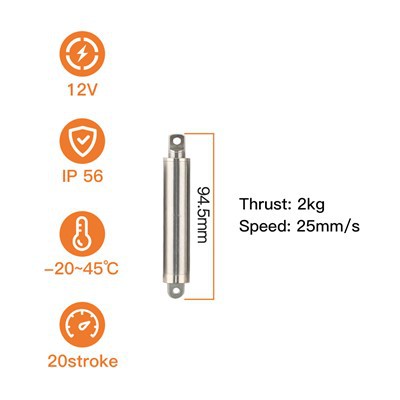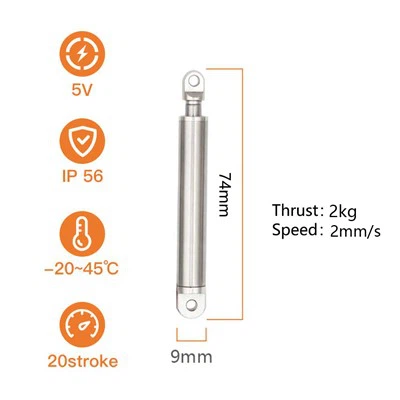
Hey there! As a supplier of Miniature Linear Motors, I've seen firsthand how temperature can have a big impact on these little powerhouses. In this blog, I'm gonna break down how temperature affects the performance of Miniature Linear Motors, and why it's something you need to keep in mind when using or buying them.
How Temperature Affects Resistance
Let's start with the basics. One of the key ways temperature affects a Miniature Linear Motor is through its impact on electrical resistance. You see, most materials, including the conductors in a motor, have a property called temperature coefficient of resistance. This means that as the temperature goes up, the resistance of the material also increases.
In a Miniature Linear Motor, this increase in resistance can have several effects. First off, it means that for a given voltage, the current flowing through the motor will decrease. Since the force produced by a linear motor is proportional to the current, a decrease in current leads to a decrease in the motor's force output. So, if you're relying on your motor to move a certain load, higher temperatures could mean it struggles to do the job.


For example, let's say you have a Linear Actuator 24V that's working great at room temperature. But if the temperature in the environment where it's operating rises significantly, the increased resistance in the motor's windings will cause the current to drop. As a result, the actuator might not be able to extend or retract with the same force as before, and it could even slow down.
Impact on Magnetic Properties
Another important aspect is the effect of temperature on the magnetic properties of the materials used in the motor. Many Miniature Linear Motors use permanent magnets to generate the magnetic field necessary for operation. These magnets have a characteristic called the Curie temperature, which is the temperature at which they lose their magnetic properties.
Even below the Curie temperature, the magnetic strength of the magnets can decrease as the temperature rises. This reduction in magnetic field strength directly affects the motor's performance. Just like with the decrease in current due to increased resistance, a weaker magnetic field means less force is produced by the motor.
Imagine you're using a 12V Actuator Linear in a system where precise positioning is crucial. If the temperature goes up and the magnetic strength of the motor's magnets decreases, the actuator might not be able to move to the exact position you need it to. This can lead to inaccuracies in your application, whether it's in a robotic arm or a medical device.
Thermal Expansion and Mechanical Issues
Temperature also causes thermal expansion, which can create mechanical problems for Miniature Linear Motors. Different parts of the motor are made of different materials, each with its own coefficient of thermal expansion. This means that as the temperature changes, these parts will expand or contract at different rates.
For instance, the housing of the motor and the internal components like the shaft or the bearings might expand at different speeds when heated. This can lead to misalignments, increased friction, and even binding in some cases. If the motor is tightly assembled, thermal expansion can cause parts to rub against each other, which not only reduces the motor's efficiency but can also lead to premature wear and tear.
Let's take a 12V Actuator Motor as an example. If the motor is operating in a hot environment, the housing might expand slightly, while the internal components expand at a different rate. This can cause the bearings to become misaligned, increasing the friction and making the motor work harder. Over time, this can lead to a shorter lifespan for the motor.
Cooling and Temperature Management
So, what can you do to mitigate the effects of temperature on Miniature Linear Motors? One of the most important things is proper cooling and temperature management. There are several ways to achieve this.
One common method is using heat sinks. Heat sinks are devices that are designed to dissipate heat away from the motor. They work by increasing the surface area available for heat transfer, allowing the heat to radiate into the surrounding environment more efficiently. Some motors come with built - in heat sinks, while others might require an external one to be added.
Another option is forced air cooling. This involves using a fan to blow air over the motor, which helps to carry away the heat. Forced air cooling can be very effective, especially in applications where the motor is generating a lot of heat or operating in a high - temperature environment.
Liquid cooling is also an option for more demanding applications. This method uses a liquid, such as water or a coolant, to absorb the heat from the motor and carry it away. Liquid cooling systems can be more complex and expensive, but they offer very efficient heat removal.
Considerations for Design and Selection
When designing a system that uses Miniature Linear Motors or selecting a motor for a specific application, temperature should be a major consideration. You need to know the operating temperature range of the motor and make sure it can handle the temperatures in the environment where it will be used.
If you're working in a high - temperature environment, you might need to choose a motor that's specifically designed for such conditions. Some motors are built with materials that have better thermal stability, such as high - temperature - resistant magnets and insulation.
It's also important to factor in the duty cycle of the motor. If the motor is going to be running continuously, it will generate more heat than if it's only operating intermittently. So, you need to make sure the cooling system you choose can handle the heat load based on the motor's duty cycle.
Conclusion
In conclusion, temperature can have a significant impact on the performance of Miniature Linear Motors. From affecting electrical resistance and magnetic properties to causing mechanical issues due to thermal expansion, it's a factor that can't be ignored.
As a supplier, I understand the importance of providing motors that can perform well in different temperature conditions. Whether you're looking for a Linear Actuator 24V, a 12V Actuator Linear, or a 12V Actuator Motor, I can help you find the right solution for your application.
If you're interested in learning more about how our Miniature Linear Motors can meet your needs, or if you have any questions about temperature management and motor performance, don't hesitate to reach out. We're here to assist you in making the best choice for your project.
References
- "Electric Motors and Drives: Fundamentals, Types and Applications" by Austin Hughes and Bill Drury
- "Thermal Management of Electronic Systems" by Avram Bar-Cohen and Ali Boroushaki