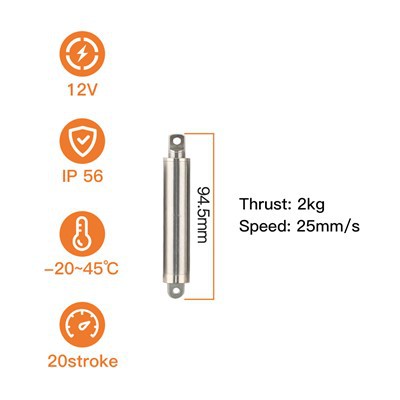
Hey there! As a supplier of fast electric actuators, I get asked a ton of questions. One of the most common ones is, "What is the maximum speed at which a fast electric actuator can change direction?" It's a super interesting topic, and I'm stoked to dive into it with you today.
Let's start by understanding what a fast electric actuator is. In simple terms, an Electric Linear Actuator is a device that converts electrical energy into linear motion. It's like a little workhorse that can move things back and forth in a straight line. These actuators are used in all sorts of applications, from industrial machinery to home automation.
The ability of an electric actuator to change direction quickly is crucial in many scenarios. For example, in robotics, a fast - changing direction can make a robot more agile and responsive. In manufacturing, it can speed up production processes by allowing for rapid adjustments. So, what factors affect the maximum speed at which a fast electric actuator can change direction?
1. Motor Type
The type of motor used in the actuator plays a huge role. We have different kinds, like the Electric Motor Linear Actuator. Brushless DC motors are often a great choice when it comes to fast direction changes. They have less friction compared to brushed motors, and they can respond to electrical signals much faster. This means they can switch their rotation direction pretty quickly, which in turn allows the actuator to change direction rapidly.
On the other hand, brushed DC motors, like in a Dc Brush Electric Actuator, have brushes that make contact with the commutator. This mechanical contact can introduce some lag when changing the direction of rotation. So, if you're after lightning - fast direction changes, brushless motors are usually the way to go.
2. Controller Design
The controller is the brain of the electric actuator. It's responsible for sending the right signals to the motor to make it move and change direction. A well - designed controller can significantly improve the speed at which the actuator changes direction.
Modern controllers use advanced algorithms to optimize the motor's performance. They can quickly calculate the required electrical signals based on the desired direction change. Some controllers even have feedback systems that can sense the motor's actual position and adjust the signals accordingly. This kind of precision control allows for very fast and accurate direction changes.
3. Mechanical Load
The load that the actuator has to move also affects its ability to change direction quickly. If the load is heavy, the actuator has to work harder to overcome the inertia. Imagine trying to turn a heavy cart around quickly; it takes more effort compared to a light one.
So, when the load is high, the maximum speed of direction change will be lower. However, if the load is light, the actuator can change direction much faster. That's why it's important to match the actuator's capabilities with the specific load requirements of your application.
4. Power Supply
The power supply provides the energy that the actuator needs to operate. If the power supply can't deliver enough power quickly, the actuator won't be able to change direction at its maximum potential.
Higher - voltage power supplies can sometimes allow for faster direction changes because they can provide more energy to the motor in a shorter period. For example, an Electric Cylinder 6V might have different performance characteristics compared to an actuator with a higher voltage supply. A bigger voltage can give the motor a bigger "kick" to change its rotation direction.
How to Measure the Maximum Speed of Direction Change
Now that we know the factors that affect it, how do we actually measure the maximum speed at which a fast electric actuator can change direction? One common way is to use sensors to measure the time it takes for the actuator to go from one direction to the opposite direction.
You can set up a test where the actuator starts moving in one direction, and then you send a signal to change its direction. Using sensors like encoders or Hall - effect sensors, you can record the exact time of the direction change command and the time when the actuator actually starts moving in the new direction. The difference between these two times gives you an idea of how fast the actuator can change direction.

Real - World Applications
Let's look at some real - world applications to see why the maximum speed of direction change matters. In automated conveyor systems, actuators are used to divert products from one conveyor to another. If the actuator can change direction quickly, it can handle a higher volume of products in a shorter time, increasing the overall efficiency of the system.
In the medical field, for example, in some surgical robots, fast - direction - changing actuators are essential. These robots need to make precise and rapid movements during surgeries. A slow direction change could lead to inaccurate movements, which is a big no - no in a surgical setting.
Our Offer as a Supplier
As a supplier of fast electric actuators, we've spent a lot of time researching and developing products that offer excellent performance when it comes to direction changes. We offer a wide range of Electric Linear Actuator 6V and other models that are designed to meet different application requirements.
Our actuators are built with high - quality components, including brushless motors and advanced controllers. This combination allows for fast and reliable direction changes. We also provide customization services, so if you have specific load or speed requirements, we can work with you to create an actuator that's just right for your project.
If you're in the market for a fast electric actuator and you're interested in learning more about our products, or if you have a specific application in mind, don't hesitate to reach out. We're always happy to have a chat, discuss your needs, and see how we can help you get the best - performing actuator for your project. Whether it's for a small - scale home automation project or a large - scale industrial application, we're here to support you.
References
- Johnson, M. (2020). "Principles of Electric Actuators." Tech Publishing.
- Smith, A. (2021). "Advanced Actuator Control Systems." Engineering Press.