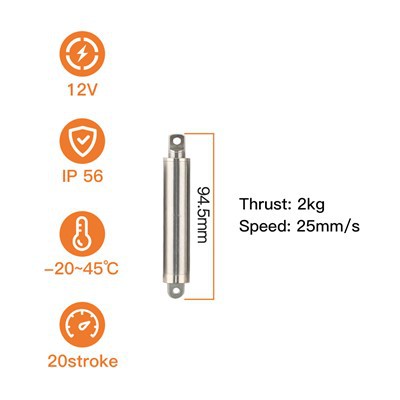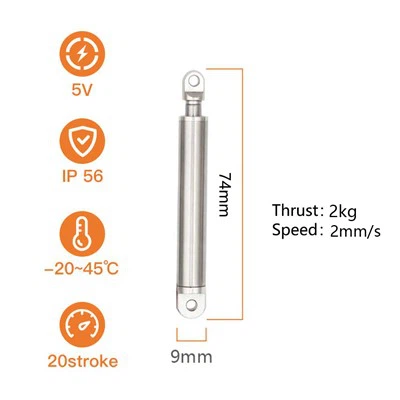
As a supplier of 12V linear motors, I often encounter inquiries from customers regarding the maximum load capacity of these motors. Understanding the maximum load capacity is crucial for various applications, from small-scale automation projects to more complex industrial machinery. In this blog post, I'll delve into the factors that determine the maximum load capacity of a 12V linear motor, provide some real - world examples, and offer insights for choosing the right motor for your specific needs.
Factors Affecting the Maximum Load Capacity
Motor Design and Construction
The design and construction of a 12V linear motor play a significant role in determining its load - carrying capacity. Motors with a larger cross - sectional area of the coil and a stronger magnetic field tend to have a higher load capacity. For instance, a motor with a well - designed stator and rotor structure can efficiently convert electrical energy into mechanical force, enabling it to handle heavier loads. The quality of materials used in the motor, such as the type of magnets and the gauge of the wire in the coil, also affects performance. High - quality neodymium magnets, for example, can provide a more intense magnetic field, resulting in greater force output.
Power Supply
The 12V power supply is a defining characteristic of these linear motors. However, the actual power available to the motor can vary depending on the power source's quality and stability. A stable 12V power supply with low ripple and sufficient current capacity is essential for the motor to operate at its maximum load capacity. If the power supply cannot provide enough current, the motor may not be able to generate the necessary force to move the load, leading to reduced performance or even motor failure. For example, a power supply with a high internal resistance may cause a voltage drop when the motor draws a large current, resulting in a decrease in the motor's output force.
Friction and Resistance
Friction and resistance within the motor and the connected mechanical system can significantly impact the maximum load capacity. In the motor itself, friction between the moving parts, such as the shaft and the bearings, can reduce the efficiency of the motor. Additionally, external factors like the type of load and the surface it moves on can introduce additional resistance. For example, if the load is moving on a rough surface, the frictional force will be higher, requiring the motor to generate more force to move the load. To minimize these effects, proper lubrication of the motor's moving parts and the use of low - friction materials in the mechanical system are crucial.
Duty Cycle
The duty cycle of the motor, which refers to the ratio of the time the motor is in operation to the total time, also affects its maximum load capacity. A motor that operates continuously at a high load may overheat, which can reduce its performance and lifespan. Motors are typically rated for a specific duty cycle, and exceeding this rating can lead to premature failure. For example, a motor with a 50% duty cycle can operate at its maximum load for half of the total time and must rest for the other half to prevent overheating.
Calculating the Maximum Load Capacity
Calculating the exact maximum load capacity of a 12V linear motor is a complex process that requires considering multiple factors. However, manufacturers usually provide load - capacity ratings based on standardized testing conditions. These ratings are a good starting point for determining if a particular motor is suitable for your application.
One common way to estimate the load capacity is by using the motor's force - output rating. This rating is typically given in newtons (N) or pounds - force (lbf). To convert between the two, 1 lbf is approximately equal to 4.448 N. For example, if a motor has a force - output rating of 200 N, it can theoretically lift or move a load that weighs approximately 20.4 kg (using the formula F = m * g, where F is the force, m is the mass, and g is the acceleration due to gravity, approximately 9.81 m/s²).
It's important to note that the actual load capacity in a real - world application may be lower than the rated value due to the factors mentioned above, such as friction and power - supply limitations. Therefore, it's advisable to add a safety margin when selecting a motor for your project.
Real - World Applications and Load Requirements
Home Automation
In home - automation applications, 12V linear motors are often used for tasks such as opening and closing curtains, operating small doors, or adjusting the position of furniture. For curtain - opening systems, the load capacity required is relatively low, usually in the range of a few newtons to tens of newtons, depending on the weight and size of the curtains. A Miniature Linear Motor is often a suitable choice for these applications due to its compact size and relatively low load - handling requirements.
Industrial Automation
In industrial settings, 12V linear motors can be used for small - scale assembly lines, testing equipment, and robotics. For example, in a small - part assembly line, the motor may need to move components with a load capacity of several hundred newtons. In such cases, a more robust 12V Actuator Linear may be required to handle the higher loads and ensure reliable operation.
Automotive Accessories
In the automotive industry, 12V linear motors are used for various accessories, such as adjusting the position of seats, mirrors, or sunroofs. The load capacity requirements vary depending on the specific application. For seat - adjustment systems, the motor may need to handle loads in the range of tens to hundreds of newtons, depending on the weight of the seat and the adjustment mechanism. A 12 Volt Linear Actuator with Remote can provide convenient control for these types of applications.
Choosing the Right 12V Linear Motor for Your Application
When selecting a 12V linear motor for your application, consider the following steps:
- Determine the Load Requirements: Calculate the maximum load that the motor will need to move, taking into account factors such as friction and acceleration. Add a safety margin to ensure reliable operation.
- Evaluate the Duty Cycle: Determine how often the motor will be in operation and for how long. Choose a motor with a duty cycle that can handle your application's requirements.
- Consider the Power Supply: Ensure that your power supply can provide a stable 12V voltage with sufficient current capacity.
- Check the Motor's Dimensions and Mounting Options: Make sure the motor's physical dimensions and mounting options are compatible with your mechanical system.
Contact Us for Your 12V Linear Motor Needs
If you're in the market for a 12V linear motor and need assistance in choosing the right one for your application, we're here to help. Our team of experts has extensive knowledge and experience in the field of linear motors and can provide you with personalized advice based on your specific requirements. Whether you're working on a small - scale home - automation project or a large - scale industrial application, we have a wide range of 12V linear motors to meet your needs. Contact us today to start the procurement process and discuss how we can provide the best solution for your project.


References
- "Linear Motor Handbook", published by a leading industry press
- Technical specifications and application notes from various 12V linear motor manufacturers