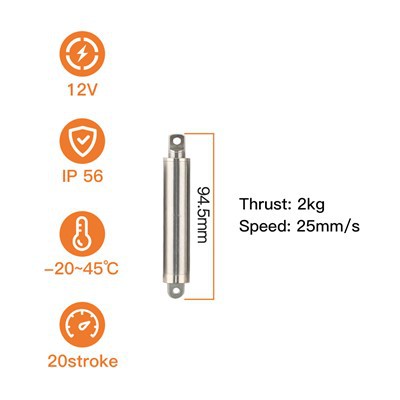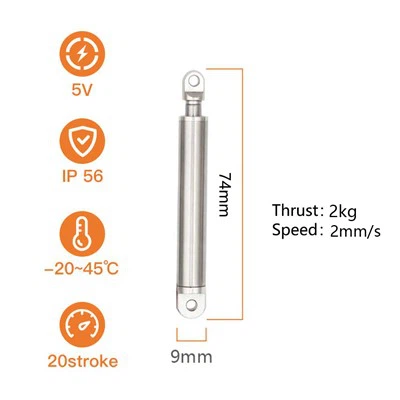
Hey there! As an electric actuator supplier, I'm super excited to chat with you about the control methods of electric actuators. These nifty devices are used in a wide range of applications, from industrial automation to home appliances. So, let's dive right in and explore the different ways we can control them.
Manual Control
Let's start with the simplest method: manual control. This is basically when you operate the electric actuator by hand. It's like turning a switch or using a lever to make the actuator move. Manual control is great for small-scale applications where you don't need a lot of precision or automation. For example, you might use manual control to adjust the position of a small electric cylinder in a DIY project.
The advantage of manual control is its simplicity. You don't need any fancy equipment or programming skills. Just a good old-fashioned switch or lever, and you're good to go. However, it's not very efficient for large-scale or complex operations. You have to be there all the time to operate the actuator, and it's hard to achieve consistent results.
Remote Control
Next up is remote control. With remote control, you can operate the electric actuator from a distance. This is really useful in situations where you can't be right next to the actuator, like in a large industrial plant or a hazardous environment. You can use a wireless remote control device to send signals to the actuator and make it move.
There are different types of remote control systems. Some use infrared signals, like the remote control for your TV. Others use radio frequency (RF) signals, which can travel longer distances and through obstacles. Remote control gives you more flexibility and convenience, but it also requires a reliable communication link between the remote control and the actuator.


Programmable Logic Controller (PLC)
Now, let's talk about Programmable Logic Controllers, or PLCs. These are powerful devices that can be programmed to control electric actuators in a very precise and automated way. A PLC can receive input signals from sensors, process them according to a pre-programmed logic, and then send output signals to the actuator to make it move.
PLCs are widely used in industrial automation because they can handle complex control tasks. For example, in a manufacturing line, a PLC can control multiple electric actuators to perform different operations in a specific sequence. You can program the PLC to adjust the speed, position, and force of the actuator based on the requirements of the process.
The great thing about PLCs is their flexibility. You can easily change the programming to adapt to different production requirements. However, programming a PLC requires some technical skills and knowledge. You need to understand ladder logic or other programming languages used in PLCs.
Microcontroller
Another option for controlling electric actuators is a microcontroller. A microcontroller is a small computer on a single chip that can be programmed to control various devices, including electric actuators. It's similar to a PLC, but it's usually smaller and less expensive.
Microcontrollers are often used in embedded systems, where you need a compact and cost-effective control solution. For example, in a smart home application, a microcontroller can be used to control the electric actuators of window blinds or curtains. You can program the microcontroller to open and close the blinds at specific times or based on the amount of sunlight.
One of the advantages of microcontrollers is their low power consumption. They can run on battery power for a long time, which makes them suitable for portable or remote applications. However, like PLCs, programming a microcontroller requires some technical know-how.
Sensor Feedback Control
Sensor feedback control is a very important method for controlling electric actuators. With sensor feedback, you can measure the position, speed, or force of the actuator and use this information to adjust its operation. For example, if you want the actuator to move to a specific position, you can use a position sensor to measure the actual position of the actuator and compare it with the desired position. If there's a difference, the control system can adjust the actuator's movement to correct it.
There are different types of sensors that can be used for feedback control, such as potentiometers, encoders, and load cells. Potentiometers are used to measure the position of the actuator, encoders can measure the speed and position, and load cells can measure the force applied by the actuator.
Sensor feedback control improves the accuracy and reliability of the actuator's operation. It can also help to prevent overloading and damage to the actuator. However, adding sensors to the system increases the cost and complexity.
Pulse Width Modulation (PWM)
Pulse Width Modulation, or PWM, is a technique used to control the speed and power of electric actuators. With PWM, you can vary the width of the electrical pulses sent to the actuator to control its speed. By adjusting the duty cycle (the ratio of the pulse width to the total period), you can change the average voltage applied to the actuator and thus control its speed.
PWM is widely used in DC motors, which are commonly used in electric actuators. It's a very efficient way to control the speed of the motor because it reduces the power consumption. You can also use PWM to control the force or torque of the actuator by adjusting the current flowing through the motor.
Network Control
In modern industrial and smart home applications, network control is becoming more and more popular. With network control, you can connect the electric actuators to a network, such as Ethernet or Wi-Fi, and control them from a central location or through the internet.
Network control allows for remote monitoring and management of the actuators. You can access the actuator's status, adjust its settings, and receive alerts if there's a problem. For example, in a large building automation system, you can use a network to control all the electric actuators of the HVAC system from a central control room.
However, network control also raises some security concerns. You need to ensure that the network is secure to prevent unauthorized access to the actuators.
Conclusion
So, there you have it! These are some of the main control methods of electric actuators. Each method has its own advantages and disadvantages, and the choice of control method depends on the specific requirements of your application.
If you're looking for high precision and automation, PLCs or microcontrollers might be the best choice. For simple and cost-effective applications, manual or remote control could be sufficient. And if you need to improve the accuracy and reliability of the actuator's operation, sensor feedback control is a must.
At our company, we offer a wide range of electric actuators, including the Electric Cylinder 6V and Fast Electric Actuator. We also provide comprehensive support for Electric Actuator Control. Whether you need help with choosing the right control method or programming the control system, our team of experts is here to assist you.
If you're interested in purchasing our electric actuators or have any questions about their control methods, don't hesitate to get in touch with us. We'd love to have a chat with you and discuss how we can meet your needs.
References
- "Industrial Automation Handbook"
- "Electric Actuator Design and Application"
- "Microcontroller Programming for Beginners"