Can a linear motor actuator be used in a cleanroom environment? That's a question I get asked a lot as a supplier of Linear Motor Actuator. Cleanrooms are super important in industries like semiconductor manufacturing, pharmaceuticals, and biotechnology. They need to maintain extremely low levels of pollutants, including dust, airborne microbes, aerosol particles, and chemical vapors. So, let's dig into whether linear motor actuators can fit the bill in these super - clean spaces.
First off, let's understand what a linear motor actuator is. It's a device that converts electrical energy into linear motion. Unlike traditional rotary motors that use belts, gears, or screws to convert rotary motion to linear motion, linear motor actuators do it directly. This direct conversion has some big advantages when it comes to cleanroom applications.
One of the main concerns in a cleanroom is particle generation. Traditional mechanical systems with moving parts like gears and belts can generate a significant amount of particles due to friction and wear. Every time these parts rub against each other, tiny bits of material can break off and become airborne. That's a no - no in a cleanroom.


Linear motor actuators, on the other hand, have fewer moving parts in contact. Since they don't rely on mechanical transmissions like gears and belts, there's less friction and wear. This means they generate far fewer particles. For example, in a semiconductor manufacturing cleanroom where even a single particle can ruin a chip, the low particle generation of linear motor actuators is a huge plus.
Another important aspect is the ability to operate in a sealed environment. Cleanrooms often require equipment to be sealed to prevent contaminants from entering or escaping. Linear motor actuators can be designed with sealed enclosures. This not only protects the internal components of the actuator from the cleanroom environment but also prevents any potential contaminants from the actuator from getting into the cleanroom.
Let's talk about maintenance. In a cleanroom, maintenance can be a real headache. Any time you open up a piece of equipment for maintenance, there's a risk of introducing contaminants. Linear motor actuators generally require less maintenance compared to traditional actuators. With fewer moving parts, there are fewer things that can wear out or break. This reduces the need for frequent maintenance and the associated risk of contaminating the cleanroom.
However, it's not all sunshine and rainbows. There are some challenges to using linear motor actuators in a cleanroom. One of the main issues is heat generation. Linear motor actuators can generate heat during operation. In a cleanroom, maintaining a stable temperature is crucial. Excess heat can affect the performance of other sensitive equipment and even cause thermal expansion, which can lead to alignment issues.
To address the heat problem, special cooling systems can be used. For example, liquid - cooled linear motor actuators can be a great solution. The liquid coolant absorbs the heat and dissipates it outside the cleanroom, keeping the temperature inside the cleanroom stable.
Another consideration is electromagnetic interference (EMI). Linear motor actuators use electrical currents to generate motion, which can create electromagnetic fields. In a cleanroom, especially in industries like electronics manufacturing, EMI can interfere with the operation of other sensitive equipment. To mitigate this, proper shielding can be used. Shielding materials can block the electromagnetic fields and prevent them from affecting other equipment in the cleanroom.
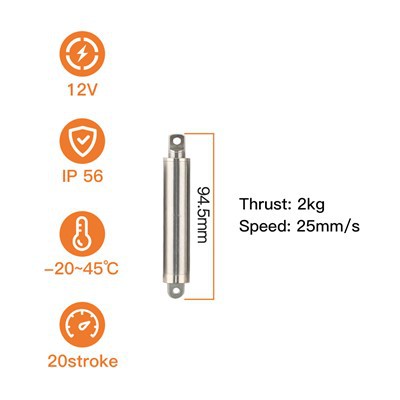
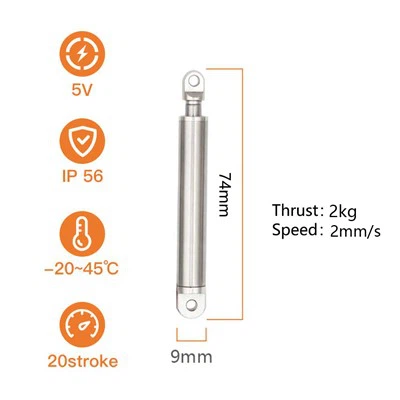
Now, let's look at some specific types of linear motor actuators that are well - suited for cleanroom applications. The Stainless Steel Linear Actuator is a great option. Stainless steel is resistant to corrosion and easy to clean, which are important properties in a cleanroom. It can withstand the harsh cleaning agents used in cleanrooms without deteriorating.
The Tiny Linear Actuator is also a good choice for cleanroom applications where space is limited. Its small size makes it easy to integrate into compact cleanroom equipment. And since it's small, it generally generates less heat and has a lower power consumption, which is beneficial in a cleanroom environment.
In conclusion, linear motor actuators can definitely be used in a cleanroom environment. They offer many advantages such as low particle generation, low maintenance, and the ability to be sealed. However, there are also some challenges like heat generation and EMI that need to be addressed. With the right design and proper mitigation strategies, linear motor actuators can be a reliable and efficient choice for cleanroom applications.
If you're in the market for a linear motor actuator for your cleanroom application, I'd love to talk to you. We have a wide range of high - quality linear motor actuators that can meet your specific needs. Whether you need a stainless steel actuator for its corrosion resistance or a tiny actuator for a compact space, we've got you covered. Reach out to us to start a discussion about your requirements and how we can help you find the perfect solution.
References
- "Cleanroom Technology Handbook" by William H. Kester
- "Linear Motion Control Handbook" by John J. Carr III