The Soul of Simulation: How Micro Linear Actuators Solve Precision Drive Challenges in Confined Spaces
In the world of high-end dynamic models and smart sandboxes, every precision movement is a battle for space utilization. As market demand for "what you see is what you get" simulation increases, how can a stable power system be integrated within extremely limited proportional spaces? Kabasi micro linear actuators, with their ultra-compact tubular structure and industrial-grade materials, are becoming the core choice for B2B integrators to achieve true physical simulation.
1. Extreme Compactness: Providing "Invisible Power" for 1:10 Models
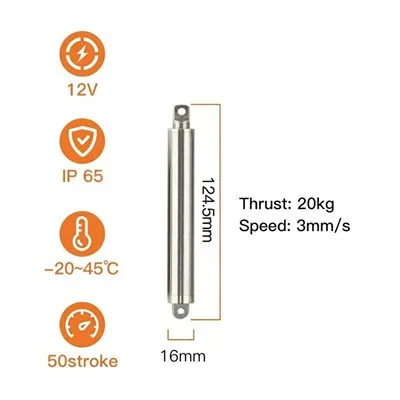
Dynamic model developers often face a conflict between the volume of power components and the scale of the simulation. Kabasi KT1610 series actuators encapsulate the DC motor and precision lead screw within a micro housing no thicker than a standard marker. This minimal physical footprint allows for hidden installation inside mechanical arms, lifting platforms, or ship models, recreating smooth linear reciprocating motion without compromising the external proportions.
2. Industrial-Grade Materials: Ensuring Long-Term Delivery Stability
Unlike consumer-grade plastic actuators, this series utilizes "304 stainless steel housings" and "copper alloy" core transmission parts. This material combination not only provides excellent oxidation resistance but also delivers a superior "mechanical self-locking force. This ensures that even when the model is powered off, heavy simulation loads (such as aircraft wings or simulated hydraulic rods) remain firmly in place, effectively solving the common "mechanism creep" or "automatic sagging" issues in long-term displays.
3. Performance Grading under E-E-A-T Principles: Objective Transparency
Graded Noise Standards: To meet the needs of quiet indoor showrooms, low-thrust models have been optimized to around 50dB, while high-thrust units, which require more torque, operate at around 60dB. This parameter grading allows procurement teams to make accurate predictions based on the ambient noise level of the exhibition area.
Waterproofing Transparency: For standard indoor sandbox applications, the standard model is recommended. However, for projects involving water features or outdoor interactive installations, it is essential to specify the IP65-rated fully sealed version to prevent moisture penetration.
4. Technical Adaptation: Minimalist Integration via Open-Loop Control
In large-scale B2B deployments of sandbox arrays, system complexity is directly linked to maintenance costs. These actuators utilize brushed DC motor drives without integrated position feedback, achieving extension and retraction simply through polarity reversal. This design significantly optimizes the overall BOM budget and allows R&D teams to implement limit protection through simple logic like current monitoring, greatly enhancing system anti-interference performance.
FAQ: B2B Procurement and Engineering Q&A
Q1: Do the actuators support 5V power?
A: Yes. For DIY models and portable sandboxes, we have developed specific 5V versions. Their extremely low startup current makes them directly compatible with common microcontroller boards or 5V battery, simplifying the power design for mobile displays.
Q2: Without position feedback, how do we prevent the mechanism from crashing or sustaining damage during operation?
A:A mature industry practice is to implement "current surge monitoring". When the actuator reaches a mechanical end or encounters an obstruction causing the motor to stall, the current rises rapidly. The control system captures this signal and can instantly cut power, achieving efficient limit protection without the need for feedback wires.
Q3: Will the mechanism jam or the motor fail after long-term static storage?
A: Kabasi micro actuators feature precision lead screws paired with 304 stainless steel housings, providing excellent physical stability. The fully enclosed structure prevents environmental dust from entering the transmission chamber, ensuring smooth operation after long-term dormancy.
Q4: If two actuators are needed to lift a large model hatch simultaneously, what is the stroke synchronization error?
A: Standard Kabasi micro actuators typically have a physical stroke error of approximately ±3 millimeters during dual-unit operation. Synchronization is not a standard specification but a specialized service provided upon request. For B2B projects with specific requirements for synchronization, we provide "manual screening and testing", selecting actuators with the most closely matched speed and power curves for pairing to minimize error.
Q5: Is the motor brushed or brushless? How is the lifespan under high-frequency demonstration?
A:This series utilizes "brushed DC motors". They are designed specifically for intermittent duty cycles. Note: Due to the limited heat dissipation space in the micro structure, this product is not suitable for high-frequency pulse operations involving multiple reciprocations per second. Reasonable intervals between actions are key to ensuring the long-term service life of the dynamic model system.