Smart Home Precision Drive: How Micro Actuators Balance the Diverse Needs of Sweeping Robots and Automatic Window Systems?
The integration of smart home hardware has entered a "centimeter-level" competition. Whether it is a sweeping robot pursuing silence and lightness or an automatic window system emphasizing power and wind resistance, the selection of the core drive directly determines the reliability of the finished product. Kabasi provides precise transmission solutions for B2B manufacturers through modular grading of thrust, noise, and IP ratings.
1. Sweeping Robots: Balancing Low Decibels and High Integration
A top-tier sweeping robot brand had stringent noise requirements when designing its automatic mop-lifting mechanism.
Application Logic: Selected 5V low-thrust micro actuators. The operational noise of this series is controlled at around 50dB, allowing it to blend perfectly into the background sound of the robot's operation without affecting the home experience.
Protection Design: For the humid conditions at the bottom of the robot, the low-thrust models come standard with an IP56 protection rating, effectively preventing moisture and dust from entering the motor, ensuring stability during frequent lifting cycles.
2. Automatic Window Systems: Combining High Power and Industrial Protection
In a curtain wall window project for a smart apartment in South China, the equipment required sufficient thrust to overcome its own weight and resist pressure differences during typhoon seasons.
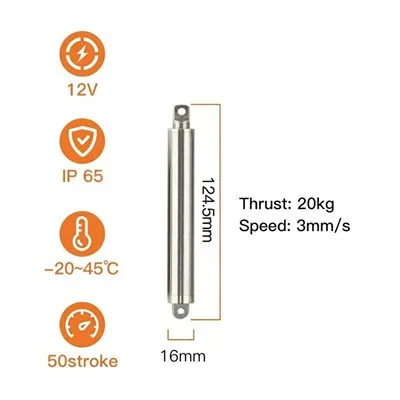
Application Logic: The project utilized high-thrust linear actuators with an "IP65 protection rating". Their structural sealing is sufficient to withstand direct outdoor heavy rain, making them the core power source for high-reliability window openers.
Performance Trade-off: Due to the stronger motor torque required for high thrust, the operational noise is around 60dB. When installed outdoors or at heights, this sound pressure level has minimal impact on the indoor environment and provides a higher system self-locking force (measured at over 30kg).
3. B2B Procurement Logic: Seeking the Cost-Optimal "Just Enough" Solution
Kabasi micro actuators utilize brushed DC motors without position feedback. This "open-loop" design offers significant advantages for smart home B2B manufacturers:
Purchasing Efficiency: Lower unit costs by eliminating expensive encoders.
Collaboration: The control logic is extremely simple (polarity reversal for direction change), allowing R&D personnel to skip complex closed-loop algorithm development, shortening the collaboration cycle from prototype to mass production by over 30%.
4. Reliability Analysis under E-E-A-T Principles:
Expertise: Precise matching of noise and IP ratings according to thrust requirements: Low thrust = 50dB / IP56; High thrust = 60dB / IP65.
Boundary Transparency: This series of products is suitable only for "intermittent duty cycles" (e.g., opening windows 2–4 times a day or lifting mop modules a few times per cleaning cycle). They are not suitable for laboratory fatigue testers or high-frequency production lines requiring constant reciprocation. Clear application boundaries must be defined to prevent motor overheating.
FAQ: B2B Procurement Technical Q&A
Q1: Why is the noise of high-thrust actuators louder than that of low-thrust actuators?
A: This is determined by physical characteristics. To output stronger power, high-thrust actuators require higher motor wattage and greater gear meshing force, resulting in an operational noise of around 60dB. Low-thrust actuators, optimized for lightness and silence, can reduce noise to around 50dB.
Q2: Can low-thrust actuators with IP56 be directly exposed to rain?
A: Not recommended. IP56 can resist strong water jets and dust entry, but for long-term unshielded outdoor exposure or high-pressure water washing, a large actuator with an IP65 rating should be selected. IP56 is better suited for internal sweeping robot modules, door openers, and semi-indoor environments with only minor splashing.
Q3: How do the products prevent crushing injuries without position feedback?
A: This is a key technical point for B2B integration. We recommend that B2B engineers integrate a current sensor on the control board. When the actuator encounters an obstruction (such as a human limb), the current will rise rapidly. Once the system senses this fluctuation, it can execute an automatic reversal or power-off protection.
Q4: Can the mounting methods be customized?
A: We provide various standardized mounting options, including clevis and threads. For large-scale B2B orders, front and rear connectors can be customized based on the device's cavity structure. Note: The specific MOQ and development cycle for customization must be further evaluated by the technical team based on CAD drawings.