The Core of Lightweight Drive: Research on the Application of Micro Linear Actuators in UAV Payload Angle Adjustment
As industrial drones transition from "aerial cameras" to "aerial work platforms," the adjustment mechanisms for gimbals, radars, and specialized payloads impose strict requirements on power components. Providing reliable angle adjustment power within extremely limited structural space without significantly increasing the aircraft's weight has become key to enhancing drone mission efficiency.
1. Balancing Extreme Weight Reduction and Space Efficiency
Drone design is extremely sensitive to every gram. By highly integrating a brushed DC motor and a precision lead screw within a micro-tubular shell, micro linear actuators achieve a leap-forward reduction in volume and weight compared to traditional hydraulic or large servo mechanisms. Their excellent "thrust-to-weight ratio" provides robust power support for gimbal tilting, antenna pitching, and landing gear retraction, serving as a fundamental guarantee for hardware stability.
2. Technical Adaptation Logic for Auxiliary Actions
Based on the physical characteristic that Kabasi actuators currently lack precision position feedback, their application in the UAV sector should avoid flight control surfaces that require real-time, high-frequency corrections. Instead, they should target intermittent, low-frequency auxiliary adjustment scenarios. Achieving angle switching through mechanical hard limits or current detection simplifies control logic, significantly reduces the computational load of the flight control system, and lowers the overall procurement and development barriers for B2B customers.
3. Environmental Durability under E-E-A-T Principles:
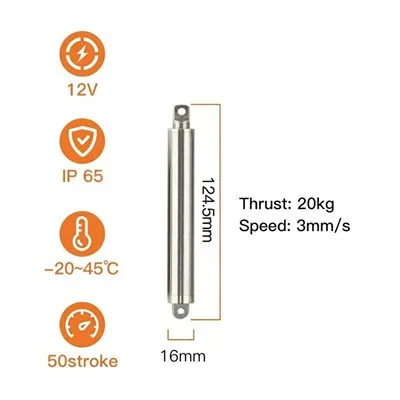
Professional Performance: To address humid or dusty environments faced by drones, specific models within this series offer IP65-grade protection.Buyers should note that protection ratings vary by model and specification and are not standard across the entire range. When selecting a product, the IP rating requirements should be clarified based on the actual mission environment (such as high-altitude mist or desert dust) to ensure the long-term reliability of the drive components.
Safety Assurance: Superior mechanical self-locking force ensures that the payload angle remains in place during flight vibrations or power failures, effectively preventing displacement caused by gravity or wind resistance.
4. Rapid Integration and Collaboration Value
To meet the rapid iteration of the drone industry, these products offer multiple voltage specifications (5V/12V/24V), allowing for direct connection to onboard power systems. During the collaboration process, manufacturers can flexibly customize the stroke (10mm–100mm) according to different aerodynamic layouts. This efficient technical alignment helps the payload system move quickly from design to field testing.
Industry Outlook
In the future, with the large-scale deployment of logistics drones and inspection robots, micro-linear transmission components-characterized by extreme cost-effectiveness and high integration-will become an indispensable hardware cornerstone in the drone automation ecosystem.
FAQ: B2B Procurement and Engineering Q&A
Q1: What is the weight of the actuator? Will it significantly shorten the drone's flight time?
A: Note: Since different strokes (10mm–100mm) result in variations in self-weight, the specific unit weight (g) must be determined based on the detailed selection table; there is currently no unified average weight data. However, this series is specifically designed for miniaturization with extremely low power consumption. Since it is primarily used for intermittent adjustment actions (non-continuous power consumption), its impact on drone battery endurance is negligible.
Q2: Without position feedback, how do we ensure the landing gear or payload angle has been adjusted to the correct position?
A: In B2B application solutions, a "current monitoring method" is typically used: when the actuator reaches the mechanical end, the current will show a significant fluctuation. The flight control system captures this signal to determine that the action is complete. This solution eliminates the need for additional feedback cables, reducing wiring weight and enhancing system anti-interference capabilities.
Q3: Why is it not recommended for flight control surface (rudder) control with multiple reciprocations per second?
A: This is to protect the brushed DC motor. Micro actuators have limited internal heat dissipation and are best suited for "move once, rest for a while" payload adjustment tasks. High-frequency jitter in flight control would lead to motor overheating and shortened lifespan. For low-frequency scenarios like payload angle adjustment, its reliability is excellent.
Q4: How does the actuator perform in high-altitude (low pressure, extreme cold) environments?
A: Note: Performance verification data for this product in high-altitude low-pressure and below -40°C environments is currently uncertain. Standard models are primarily aimed at ground and low-to-medium altitude industrial environments. If your drone needs to perform missions in extreme cold or at ten-thousand-meter altitudes, we recommend contacting technical engineers for specialized environmental chamber simulation testing before bulk procurement to verify the performance of the lubricant and motor in high-altitude conditions.