Precision Power for Automation: Analysis of Self-locking Performance and Graded Protection in Micro Linear Actuators
In the development of precision automation equipment, the trade-off between the spatial footprint of end-effectors and operational reliability is a central challenge. As the trend toward equipment miniaturization intensifies, integrating power sources with "power-off locking" capabilities within centimeter-scale cavities has become a priority. Micro linear actuators, characterized by their extreme physical dimensions and specific performance grading, are emerging as standard components for B2B manufacturers addressing vertical displacement and safety interlocking requirements.
Double Self-locking Force: Enhancing System Safety Margins
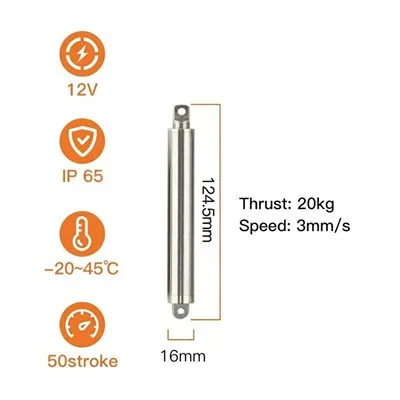
For vertical adjustment or tilting mechanisms in automated equipment, self-locking force is a critical metric for ensuring payload safety. Taking the KT1610 20KG (200N) thrust specification as an example, its core physical advantage lies in a static self-locking force that reaches twice the maximum dynamic thrust (approximately 400N).
This signifies that during a sudden power failure or emergency braking, the internal precision lead screw mechanism can firmly lock the position even when subjected to external loads exceeding the rated thrust. This feature effectively prevents mechanical damage caused by unintended mechanism descent, eliminating the need for costly electromagnetic braking systems and simplifying the overall architecture.
Performance Grading Matrix: Scientific Alignment of Thrust, Noise, and IP Ratings
To assist engineers in achieving precise selection based on specific operating conditions, we have categorized the execution mechanisms into distinct performance tiers:
Small Thrust Actuator Series: Focused on miniaturization and acoustic discretion. Operating noise is controlled at approximately 50dB, making them ideal for laboratory and office-grade automation. These units feature an IP56 protection rating, providing effective defense against industrial dust and daily moisture ingress.
Large Thrust Actuator Series: Focused on power output and environmental durability. Due to higher power demands, the operating noise is approximately 60dB. For harsh industrial environments, this series offers IP65-grade fully sealed protection, capable of resisting direct water jets and coolant splashes, thereby ensuring the longevity of the core motor under complex conditions.
Industrial-Grade Material Integrity: TCO Value via 304 Stainless Steel
B2B procurement prioritizes the Total Cost of Ownership (TCO) across the equipment's lifecycle. The core components of the KT1610 utilize 304 stainless steel housings and copper alloy transmission parts instead of fragile plastic components. This material combination ensures that the mechanism remains free from oxidation and physical deformation over extended periods. Furthermore, the maintenance-free sealed design eliminates the need for manual lubricant replenishment, meeting the rigorous "low-maintenance" requirements of automated production lines.
System Integration: Simplified Control Logic for Open-loop DC Systems
This series of actuators utilizes brushed DC motor drives without integrated feedback. While this bypasses millimeter-level closed-loop feedback, this open-loop logic significantly reduces system complexity for 80% of "two-point" switching tasks (such as material ejection or cover plate actuation). By monitoring circuit current (setting a 0.32A threshold), R&D personnel can achieve reliable limit protection without additional sensing wires, shortening the cycle from initial design to field integration.
FAQ: Technical Q&A for B2B Procurement and Engineering
Q1: Will the 2x self-locking force loosen under frequent vibration?
A: Self-locking is achieved via the physical friction angle of the internal lead screw, providing extreme stability under static conditions. Note: Under continuous high-frequency, high-amplitude vibration, mechanical clearances may result in minor physical displacement. In such specialized conditions, it is recommended to implement a periodic position reset function within the control logic.
Q2: If synchronized operation is required for two actuators (e.g., lifting a wide bracket), how is the error controlled?
A: The physical stroke error for Kabasi micro actuators during dual-unit operation is typically approximately ±3±3mm. Please note that synchronization is not a standard factory specification. For B2B projects requiring synchronization, we offer a specialized manual screening process to select actuators with the most closely matched power curves and speeds from the same batch.
Q3: Does the product support continuous 24-hour high-frequency reciprocating operation?
A: Not recommended. Due to their micro-scale volume, the heat dissipation capacity of the motors is limited. These units must adhere to an intermittent duty cycle (move once, dwell once). While performance is exceptionally stable in typical trigger-based tasks, heat accumulation from ultra-high-frequency reciprocation (e.g., several cycles per second) will rapidly diminish motor life.
Q4: Is there empirical data for the lubrication performance of actuators at high altitudes or in extreme cold?
A: Note: Information is uncertain. There is currently no quantitative empirical data regarding motor cold-start performance at altitudes exceeding 10,000 meters (low pressure) or in environments below −40∘C−40∘C. For applications in extreme cold or specialized atmospheric pressures, we recommend contacting our technical team for simulated environmental chamber testing prior to bulk integration.
Q5: Can the mounting methods be customized for our specific mechanism?
A: Standard models utilize top and bottom clevis (pin) mounting. For large-scale B2B orders, we support stroke customization (10mm–100mm) and can customize mounting hole diameters based on the specific cavity structure of your equipment to ensure installation efficiency.