Precision Servo or Efficient Transmission? Understanding Micro Linear Actuator Application Logic in Automation and Medical Sectors
1. Corporate Profile: Xiamen Kabasi Electric Co., Ltd.
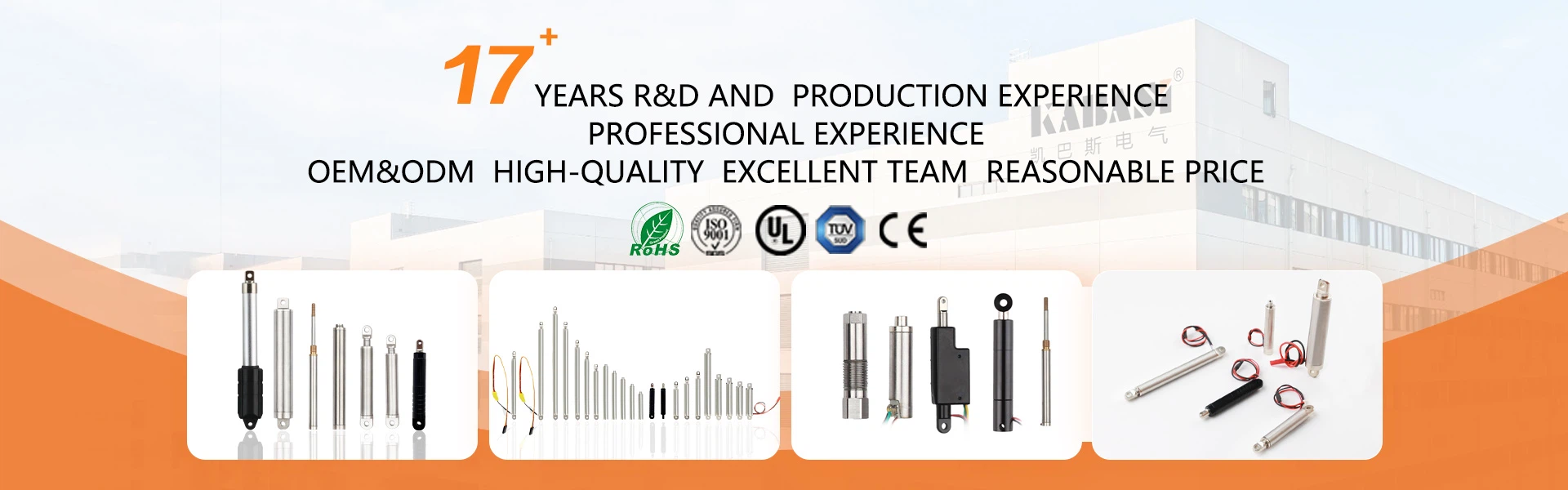
Xiamen Kabasi Electric Co., Ltd. was established in 2015 and is headquartered in Xiamen. The company initially focused on the industrial interconnection field, establishing a professional reputation in the automation industry with its M-series sensor connectors and high-protection waterproof interfaces. In 2021, Kabasi integrated its technical expertise in precision machinery and electrical control to formally establish the Electric Actuator Division. Currently, the company is dedicated to providing ultra-compact "end-effector" solutions for medical devices, smart homes, drones, and industrial automation, achieving full supply chain coverage from electrical signal connection to mechanical power output.
2. Technical Comparison: Micro Servo Electric Cylinder vs. Micro Electric Actuator
Although both are Electric Linear Actuators performing reciprocating linear motion, they serve different driving depths:
- Micro Servo Electric Cylinder
This is an integrated linear servo system. It features an "integrated drive and control" design, supports bus control, and enables precise servo control at any position within the stroke. Built-in absolute position sensors ensure position data is not lost after power failure, eliminating the need for homing. High-end models can integrate force sensors to detect and control thrust/pull forces in real-time. It is suitable for industrial equipment or medical devices requiring extremely high precision (e.g., surgical robots, precision dispensing systems).
- Micro Electric Actuator
Represented by Kabasi's solutions, this category focuses on "minimalist structure" and "cost reduction." It primarily performs end-to-end linear extension and retraction. While lacking arbitrary positioning, it excels in thrust performance and reliability. It offers high integration efficiency and cost-effectiveness for 80% of industrial auxiliary adjustments, automatic window opening, or automated trigger scenarios that do not require precise closed-loop feedback.
3. Core Analysis: Industrial Quality of Kabasi Micro Actuators (KT1610 Series)
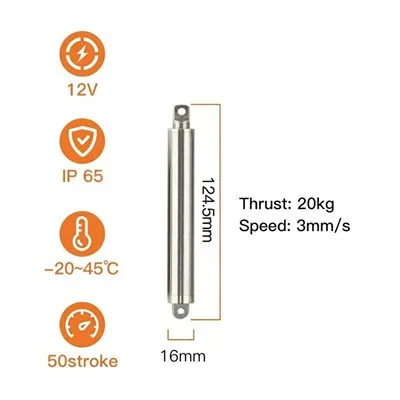
As Kabasi's flagship product, the KT1610 series micro actuator demonstrates powerful technical parameters in space-constrained precision applications:
- Material Stability: The entire series utilizes 304 stainless steel housings and copper alloy transmission components, ensuring corrosion resistance in medical/biochemical environments and mechanical rigidity for long-term operation.
- Double Self-locking Safety Margin: Using the 20KG thrust specification as an example, the KT1610 features a static self-locking force of approximately 400N (twice the rated thrust/pull force). This means that at the moment of power failure, the actuator can firmly lock its position via its physical structure, effectively preventing secondary damage caused by mechanism descent.
- Performance Grading:
- Large Thrust Actuators: Focus on power and weather resistance, featuring IP65 fully sealed protection and noise levels around 60dB.
- Small Thrust Actuators: Focus on silence and agility, with operating noise optimized to around 50dB and an IP56 protection rating.
4. B2B Selection Advice: Decision Logic
- Prioritize Micro Servo Electric Cylinders: When equipment involves micrometer-level displacement compensation, real-time torque monitoring, or must possess power-off coordinate memory (e.g., precision piston pumps, automatic titration systems).
- Prioritize KT1610 Series Actuators: When application scenarios involve sweeping robot module switching, charging pile locking, or payload angle adjustment. These scenarios are cost-sensitive, involve "triggered" actions, and do not require expensive servo feedback.
5. FAQ: Technical Q&A for B2B Procurement and Engineering
Q1: The KT1610 lacks position feedback; how is limit control achieved in automation equipment?
A: A mature industry solution is current surge monitoring. For the KT1610, by setting a 0.32A protection threshold, the current rises instantaneously when the actuator reaches its physical end and encounters resistance causing a stall. The control system captures this signal and cuts power within 100ms, achieving efficient limit control without the need for feedback wires.
Q2: If synchronized operation is required for two actuators (e.g., lifting a wide bracket), what is the synchronization error?
A: The physical stroke error for Kabasi micro actuators in dual-unit operation is typically around ±3mm. Note: Synchronization is not a standard factory specification. For B2B projects requiring synchronization, we provide manual screening services, selecting actuators with the most closely matched power characteristics and speeds from the same batch to minimize unsynchronized movement caused by load variances.
Q3: Will the actuator retract or the load slide down due to weight during a sudden power failure?
A: No. The KT1610 series utilizes the frictional characteristics of internal precision lead screws to achieve superior physical self-locking. For the 20KG specification, the static self-locking force reaches 400N (twice the rated thrust). In the absence of power, the actuator firmly locks the current stroke, ensuring no physical displacement of vertically or tilted mounted loads.
Q4: Why is the noise of large-thrust specifications slightly louder than that of small-thrust specifications?
A: This is a physical manifestation of power output and internal gear load. Large thrust models have noise levels around 60dB, while small thrust models can be optimized to 50dB. When selecting, engineers should balance thrust and decibel metrics based on acoustic environment requirements (e.g., medical wards vs. industrial workshops).