Technical Architecture, Transmission Design, and Load Performance Analysis of Linear Actuators
1. What is a Linear Actuator?
The term "linear actuator" encompasses a broad array of products. It is a mechanical device that converts energy-derived from pneumatic, electric, or hydraulic power-into straight-line motion, contrasting with the circular motion of conventional motors. It is also utilized to apply force. Functional movements include blocking, clamping, ejecting, lifting, lowering, pushing, or pulling.
2. Basic Design of Linear Actuators
As noted, the category includes diverse designs, each with distinct aesthetics and operational modes. Most linear actuators operate on the principle of the inclined plane. Essentially, the screw thread functions as a continuous ramp, allowing a relatively small rotational force applied over a distance to achieve the movement of heavy loads across a shorter linear distance.
3. How do Linear Actuators Work?
All linear actuators rely on an external non-linear force to drive a sliding component, or "piston," back and forth. In this context, a "piston" refers to a sliding element that moves through or against fluid, air pressure, or electric current. It typically consists of a short cylinder fitted within a cylindrical container. For example, in steam engines, motion is generated by steam, while pumps transfer motion to fluids.
Hydraulic actuators rely on pumps to pressurize and depressurize sides of the piston to drive the shaft. Conversely, wax motor actuators utilize electric current to melt and expand wax blocks; the resulting expansion and contraction drive a plunger in a linear motion.
4. Power and Operation Options
There are numerous drive options for linear actuators:
Manual Methods: Includes lead screw systems in vices and clamps, or levers in manual juicers and crushers.
Pneumatic: Compressed air drives cylinders for moving machine components.
Hydraulic: Hydraulic cylinders provide high force and stroke for heavy equipment like forklifts and jacks, while short-stroke cylinders are used in braking systems.
Solenoid: Short-stroke electromagnetic actuators for door locks, switches, and valve operations.
Electromagnetic: Linear stages are utilized in trams, automated walkways, and material conveyors.
5. What are Linear Actuators Used For?
Linear actuators are deployed in industrial automation, machinery, machine tools, computer peripherals (such as disk drives and printers), home automation, packaging, assembly, electronics manufacturing, data storage, laser processing, and testing/inspection. They are frequently used alongside motors, valves, and pumps. Further applications include medical imaging, solar tracking, agriculture, construction, automotive, and robotics. Nearly all electrical equipment requiring linear movement utilizes these devices; industrial tools like drills and pumps rely on them to move secondary objects. In robotics, they are essential for providing motor skills and locomotion.
6. Basic Variants of Linear Actuators
Engineering evolution has produced various designs focused on optimizing mechanical efficiency, response speed, and rated braking loads. The current industry trend favors miniaturization to increase power density and reduce the overall size and weight of motion control systems.
Rotary-to-linear conversion paths include using the linear sections of timing belts or roller chains (e.g., garage door openers) and electric motors (stepper, brushed/brushless DC, AC) driving mechanical converters like crankshafts for steering systems or sewing machines.
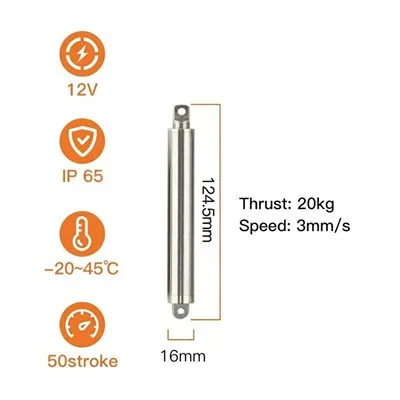
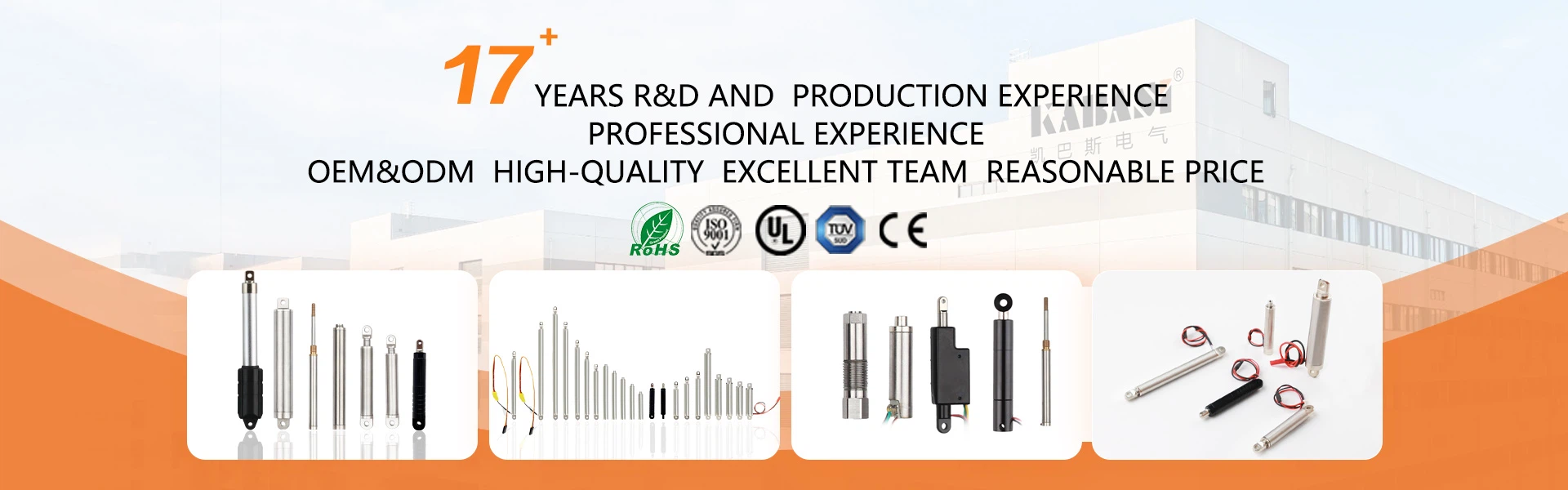
Case Study: Xiamen KABASI Electric Co., Ltd. produces micro-electric actuators using brushed DC motors paired with ultra-miniature planetary gearboxes and lead screw-and-nut transmission. Extension and retraction are controlled by switching the polarity of the DC power supply. These compact units function as miniature linear motors, supporting power-off stops at any position and providing self-locking capabilities.
Specialized Actuators: Used for high-precision applications, such as hydraulic flight control surfaces on large aircraft or ultra-fine machining equipment requiring positioning within 0.001 inches. In medical procedures like ophthalmic surgery, actuators drive micro-servo mechanisms for minute movements. Consumer printers use cost-effective stepper-driven actuators capable of pixel-level resolution.
Combination of Motion, Position, Speed, and Force: System integration requires balancing parameters based on application priorities. A printer head positioning system emphasizes positional accuracy over long strokes, whereas a brake cylinder focuses on generating high force over short strokes. Excavator hydraulic cylinders provide tens of thousands of pounds of force where inch-level precision is sufficient. Electronics assembly actuators prioritize rapid response and integrated sensor feedback (position, force, speed) via programmable controllers to ensure consistent performance.
Electromechanical Design: Most designs utilize lead screws (Acme) or ball screws. Gear sets are used to reduce the high RPM of smaller motors to provide the torque necessary to rotate the screw under heavy loads-effectively trading speed for thrust.
Mechanical Layouts:
Type A (Moving Nut): The motor is fixed to one end of the screw; as the motor rotates the screw, the nut is restricted from rotating and thus moves axially.
Type B (Moving Screw): The motor and gearbox "crawl" along a stationary lead screw that is restricted from rotation.
Multi-start Threads: Multiple parallel threads on the same shaft allow for adjustments between lead (extension speed) and contact area (load capacity).
7. Static Load Capacity
Static load capacity refers to the actuator's ability to support a push or pull load when the motor is stopped. This locking capability is determined by the thread's lead angle and coefficient of friction:
Acme Screws: Offer high self-locking capability, effectively supporting static loads.
Ball Screws: Due to extremely low friction, they are nearly free-floating and generally lack self-locking properties. Once a design is finalized, the static load limit is fixed by the screw lead and nut materials and cannot be dynamically adjusted.
8. Dynamic Load Capacity
Some designs integrate electromagnetic braking systems to enhance safety and load capacity:
Electromagnetic Brakes: Utilize spring pressure to apply friction to the drive nut or shaft when power is cut, locking it in place; an electromagnet releases the brake when power is applied.
Electromagnetic Ratchet: For high-load vertical lifting, these mechanisms mechanically lock the drive system when power is off to prevent load drops. Lowering the load requires an electromagnet to release the ratchet constraint.
Conclusion:
Linear actuators convert power into linear displacement to facilitate push-pull operations in industrial equipment. Core selection metrics include drive type, transmission efficiency, and load performance. Load safety is maintained through mechanical properties or electromagnetic mechanisms. Precise configuration of gear ratios and lead screw specifications provides the engineering foundation for optimizing integration costs and operational reliability in automated systems.