Precision in Miniaturization, Strength in Self-locking: A Guide to Automotive Micro Linear Actuator Selection and Protection
1. Background: Automotive Auxiliary Transmission
As the automotive industry evolves toward intelligence, micro linear actuators are primarily used to achieve "hidden" and "automated" vehicle components. Their core value lies in utilizing the vehicle's 12V/24V power supply to drive various auxiliary transmission mechanisms for precise linear displacement, enhancing both aerodynamic performance and user interaction.
2. Core Components and Material Advantages
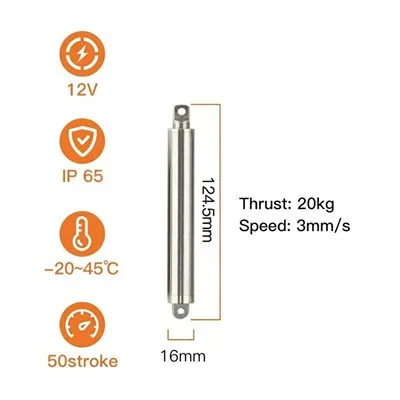
Outer Tube Material: The KABASI KT1610 series utilizes 304 stainless steel. In automotive applications, this material provides superior rigidity compared to aluminum alloys and possesses excellent anti-oxidation capabilities in humid environments.
Transmission Mechanism: The internal system features a copper alloy nut paired with a precision screw. This metal-to-metal transmission chain ensures that fatigue fractures do not occur during long-term vehicle vibration, maintaining a structural strength in the 200N class.
3. Key Technical Parameters
Power Specification: Supports 12V/24V DC power supply.
Power Output: Maximum rated thrust of 200N (approx. 20kg) with a reference travel speed of 3mm/s.
Physical Self-locking: Utilizing the reverse self-locking characteristics of the trapezoidal screw, the static self-locking force reaches 400N. In a power-off state, it can lock the mechanism's position to prevent sliding under load.
4. Protection Rating (IP65) and Installation Constraints
According to the IEC 60529 standard, IP65 is classified as "water-jet proof." The following installation boundaries must be strictly observed in automotive applications:
Permitted Installation Areas: Upper and middle vehicle sections (e.g., inner door panels, upper trunk sections, cabin interiors).
Prohibited Installation Areas: Strictly prohibited for vehicle chassis, near wheels, or any area prone to water immersion. IP65 cannot withstand the static water pressure of vehicle wading, nor can it resist direct impact from high-pressure water guns at car washes.
5. Typical Application Scenarios
Hidden Door Handle Drive: Installed inside the door sheet metal. The actuator drives the pop-out and retraction of the handle mechanism. Within the door's sealed layer, IP65 is sufficient to handle minor moisture ingress.
Mid-to-High Position Active Grille Shutter: Installed at the upper front of the engine compartment to adjust the angle of the grille blades.
Electric Adjustable Spoilers: Installed inside the trunk lid to drive the lifting and lowering of external spoilers.
Intelligent Cabin Hardware: Deployment of folding tables in MPVs, adjustment of ceiling screen angles, and electric sliding of central armrest boxes. In these dry environments, the Kabasi 50dB-60dB operating noise meets NVH (Noise, Vibration, and Harshness) requirements.
Charging Port Cover (Internal Actuator): Drives the pop-out of the charging cover. It must be installed on the inner side of the rain drainage channel to avoid direct exposure to high-pressure water flow.
6. Engineering Integration and Constraints
Limit Control: Due to size constraints, there is no built-in feedback. The manual recommends current-based limit control. Reference threshold: When the actuator reaches its physical limit, the current rises to approximately 0.32A (depending on the model), at which point the system must cut power.
Duty Cycle Restriction: Follows a 20% duty cycle (S2 short-term operation). In automotive scenarios, it is suitable for "intermittent open/close" tasks (e.g., handle deployment). Continuous high-frequency operation for demonstration purposes is strictly prohibited.
Physical Tolerance: A speed tolerance of ±3mm exists during multi-unit synchronous operation. For mechanisms requiring absolute parallelism, compensation must be added to the control algorithm.
7.FAQ
Q1: How is the noise performance during operation? Is there high-frequency noise?
A: The operating noise of KABASI micro actuators is controlled between 50dB-60dB. In automotive integration, where they are typically installed inside door panels or trunk trims, the metal casing provides effective shielding against high-frequency electromagnetic motor noise. It is recommended to add rubber bushings at the mounting brackets to block physical vibration transfer to the vehicle structure.
Q2: How is the "Position Memory" function achieved without internal Hall sensors?
A: When implementing seat memory or partial cover opening functions, Current Signature Recognition is used: the controller identifies the stall current (ref. threshold 0.32A) to serve as the zero-point calibration. Intermediate positions require external travel switches or displacement sensors.
Q3: Will wind resistance at high speeds (e.g., on active grilles or spoilers) cause the actuator to retract?
A: No. The KT1610 series uses a trapezoidal screw with physical reverse self-locking capabilities, reaching a static locking force of 400N (approx. 40kg). As long as the wind pressure load does not exceed twice the rated thrust, the actuator will remain locked in position when powered off.
Q4: Why must the 20% duty cycle be strictly followed? Does it change in extreme temperatures?
A: Micro actuators have an outer diameter of only 16mm, providing minimal space for heat dissipation. Continuous operation prevents motor heat from escaping through the stainless steel casing. The 20% duty cycle (S2) ensures the motor temperature rise does not exceed the limit in a 45°C environment. in summer exposure (where cabin temperatures can reach 60°C+), it is advised to further shorten the single run-time to prevent heat accumulation from aging the insulation.
Q5: If the vehicle battery is dead, can the actuator be manually pulled out or pushed back?
A: Extremely difficult. Due to the strong internal self-locking mechanism, the position cannot be changed by external force unless the mounting pins at both ends are removed. This must be carefully considered when designing hidden door handles; emergency manual release cables or emergency power interfaces must be pre-installed.