Selection Manual for Micro & Industrial Electric Linear Actuators: Drive Architecture, Grading, and Application Boundaries
1. The Core of Linear Displacement
In mechatronic systems, a linear actuator is the critical component for achieving precision displacement. Its defining characteristic is providing a "push" or "pull" force along a single axis. In contrast to rotary actuators, which deliver torque and circular motion, the linear actuator performs the essential dimensional conversion from rotation to translation-the mechanical foundation for all reciprocating mechanisms in industrial integration.
2. Why Choose "Electric"?
During the B2B selection phase, engineers typically evaluate three technical paths:
Pneumatic Actuators: Low cost and simple structure, but highly dependent on stable compressed air systems. They often underperform in positioning accuracy and motion smoothness.
Hydraulic Actuators: Offer extremely high power density, making them the first choice for heavy machinery. However, they come with high system complexity, maintenance costs, and the risk of oil leakage and contamination.
Electric Actuators: Recognized as the most flexible solution. Their advantages include high-precision control, smooth speed regulation, and nearly maintenance-free operation. They are the preferred choice for digital factories and precision instruments requiring closed-loop control.
3. Transmission Chain: The Electromechanical Logic
An electric linear actuator is essentially a high-efficiency energy conversion system. The underlying logic is as follows: When the internal motor starts, its rotary output is first amplified by a gearbox to increase torque. This amplified force then drives an internal lead screw. The rotation of the screw forces the drive nut (and the attached piston rod) to translate axially. By controlling the motor's direction, the piston rod achieves highly repeatable extension or retraction.
4. Specification Grading & Kabasi's Micro-Specialization
An actuator's specifications determine its integration capability in restricted spaces. KABASI provides differentiated solutions in the "Ultra-Narrow Drive" field:
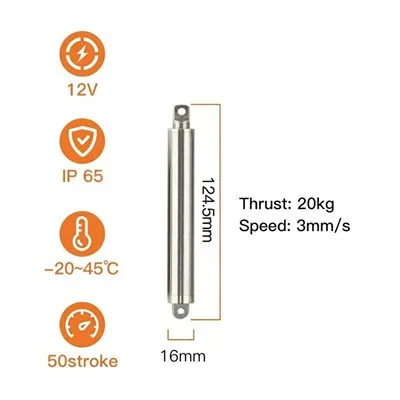
Micro Actuators: Typically feature strokes under 150mm, drive voltages of 6V/12V/24V, and thrust ranging from 3N to 200N.
KABASI's Engineering Logic: Our KT1610 and KT0805 series further compress the outer diameter to as low as 16mm and 8mm. To solve the structural challenges of miniaturization, we utilize 304 stainless steel outer tubes and high-quality copper alloy transmission parts, ensuring the actuators maintain extreme structural rigidity even in a micro-form factor.
Medium Actuators: The most common type, suitable for higher thrust where size is less critical. Strokes range from 1 to 60 inches, widely used for heavy load lifting in automated production lines.
Heavy-Duty Actuators: The powerhouses of the actuator family. They feature rugged structures with wear-resistant screws and high-power industrial motors. Some models even require external servo drives to handle dynamic thrusts in the tens of thousands of pounds.
5. Spatial Layouts & Integration Strategies
The mechanical layout of an actuator determines its adaptability to limited spaces:
Right-Angle Drive: The motor is perpendicular to the piston. Utilizing worm gear transmission, its primary technical advantage is the self-locking feature. This structure uses friction to resist unintended displacement from external forces, providing high static load capacity and quiet operation.
In-Line Drive: The motor is coaxial with the piston. Its slim, tube-like profile (e.g., the pencil actuator) usually employs a planetary gear set. This design offers high torque capacity and superior wear resistance, making it the best solution for avoiding mechanical interference, though gear noise is slightly higher than worm gear designs.
Parallel Drive: The motor is placed parallel to the side of the piston, balancing overall width and length. Typically using spur gears, this simple transmission allows manufacturers to provide a wide range of gear ratios to meet diverse speed and torque requirements.
6. Full-Scenario Applications
Material Handling & Flexible Packaging: Precise synchronization between actuators allows for efficient sorting and palletizing. Programmable control enables rapid switching between unique packaging operations, reducing cycle times and increasing machine efficiency.
Food & Beverage Manufacturing: Electric actuators are vital for high-volume production due to their cleanliness. Models with appropriate IP ratings are corrosion-resistant and can withstand high-pressure washdowns or even submerged cleaning, ensuring a sterile environment.
Heavy Agricultural Machinery: Electric solutions are replacing hydraulics for spray nozzle adjustment, tractor ventilation, and automated feeding. Electric actuators with high IP ratings reliably resist harsh weather, agrochemicals, and cleaning agents.
Medical & Home Automation: Includes surgical robot joints, precision injection pump control, hidden TV lifts, and window automation. Silence and precise position feedback are the core competitive advantages here.
Robotics: Serving as the core of joint drives, electric actuators-combined with advanced controllers-perfectly simulate muscle fibers to achieve precise closed-loop control of position, velocity, and acceleration.
7. Technical Summary
While the initial unit cost of electric linear actuators may be higher than pneumatic options, they offer a lower Total Cost of Ownership throughout their lifecycle due to high energy efficiency, minimal maintenance, and the absence of external air treatment systems. For B2B enterprises pursuing high reliability and Industry 4.0 integration, electric drives are the inevitable technical path.