Selection Guide for Micro Electric Linear Actuators: Brushed vs. Brushless DC Motors - Performance Comparison & Application Analysis
1. Industry Background: The Power Dynamics in Restricted Spaces
In the integrated design of micro electric linear actuators, the drive motor serves as more than just a power source-it defines the "power density" and "reliability boundaries" of the entire execution unit. As industrial automation penetrates increasingly narrow spaces, procurement engineers face a critical decision: should they opt for the mature, cost-optimized Brushed DC drive, or the high-precision Brushless DC solution? This article breaks down the selection logic based on bottom-level engineering and practical industrial data.
2. Brushed vs. Brushless Drives: Technical Trade-offs
■ Commutation Mechanism and System Complexity
In micro-actuator selection, motor type directly impacts integration logic and the Total Cost of Ownership .
Brushed DC Drive: Utilizes physical mechanical commutation via carbon brushes and a commutator. This "plug-and-play" characteristic significantly simplifies control logic, requiring only basic DC voltage polarity switching to reverse direction. For B2B projects with extreme space constraints and tight budgets, it remains the most stable solution for "rapid integration."
Brushless DC Drive: Relies on Hall sensors and electronic commutation. While performance is superior, it mandates a dedicated external driver or complex controller. This leads to an increase in total system cost and a larger installation footprint, requiring higher software and hardware expertise from the integrator.
■ Lifespan vs. Maintenance Cycles
Physical Wear-and-Tear: The lifespan of a brushed drive is limited by the physical wear of the brushes. Under standard industrial conditions, the effective life typically ranges from 1,000 to 3,000 hours. Thus, it is precisely positioned as a component for "intermittent, auxiliary adjustments."
Long-term Operational Advantage: Brushless drives have no friction-induced loss; their lifespan depends primarily on the bearings, often exceeding 10,000 hours. If your application involves 24/7 continuous operation, a brushless solution is key to reducing downtime and maintenance costs.
■ Electromagnetic Compatibility and Safety
EMI Risk: Brushed motors generate micro-arcs (sparks) during commutation. In environments sensitive to signal purity, such as precision medical devices or laboratory sensors, additional shielding must be considered.
Silent & Clean Operation: Brushless drives operate more quietly (typically <45dB) and do not produce carbon dust, making them the preferred choice for clean-room workshops and noise-sensitive office environments.
3. KABASI Practical Case Study:
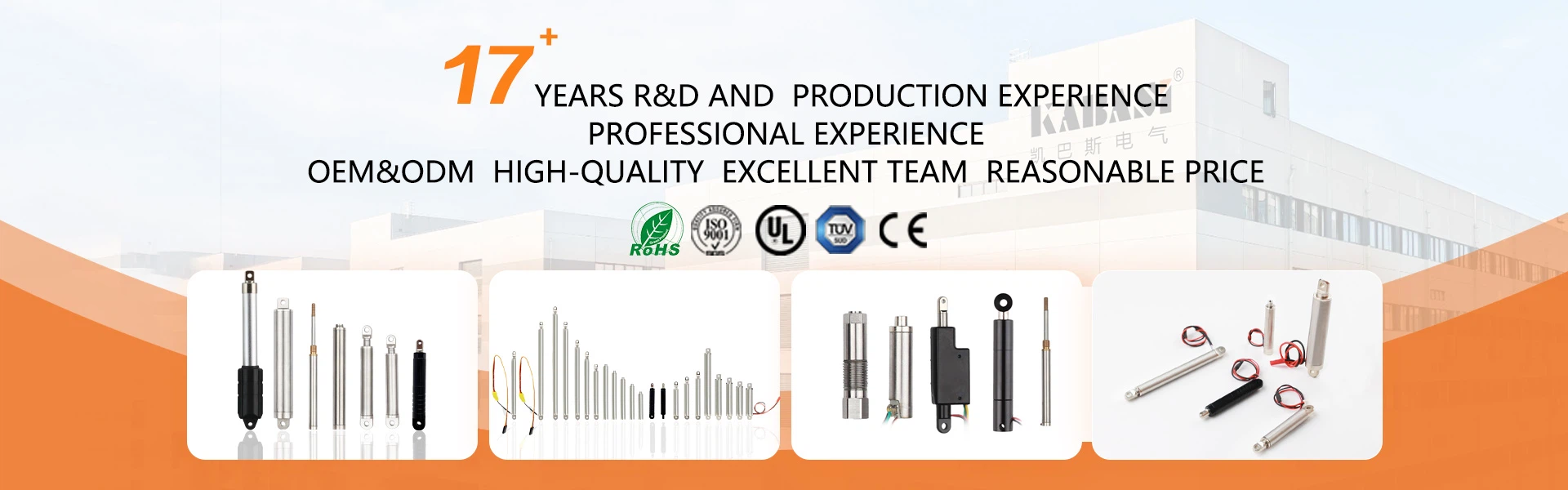
As a specialized manufacturer of micro linear actuators, Xiamen Kabasi Electric Co., Ltd. utilizes high-performance Brushed DC solutions for its core product lines, driven by practical industrial requirements:
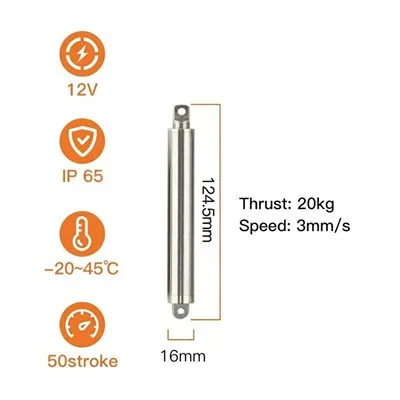
Torque Density in Restricted Diameters: In micro-tubes of 16mm or even 8mm, a brushed motor does not require space for an internal commutation circuit . This allows more volume to be allocated to the magnetic steel and high-strength gear sets, enabling the actuator to burst with high starting torque to overcome static friction.
Strict Intermittent Duty Cycle: Based on thermal equilibrium laws in enclosed micro-tubes, Kabasi explicitly specifies a 15-second forced cooling interval after every full cycle. This is not a performance flaw but a protective boundary that prevents thermal demagnetization, ensuring long-term stability in -20°C to 45°C environments.
Structural Redundancy & IP Protection: Despite the brushed structure, Kabasi employs 304 stainless steel housing and precision sealing, achieving an IP65 rating for the KT1610 (IP56 for the KT0805/KT0905 series). This ensures high reliability in outdoor, dusty, or splash-prone environments, challenging the misconception that brushed drives are "unreliable."
4. Buyer's Selection Guide: How to Decide Based on Load and Frequency
Low-Frequency & Intermittent Adjustment: For applications like medical bed adjustments, smart window actuators, or drone payload hatch control, the Kabasi Brushed Series offers the best ROI and the simplest system integration.
High-Frequency & Precision Servo: If the application requires dozens of cycles per minute or precise multi-point stopping, a high-level servo cylinder should be considered.
Harsh Environment Audit: In humid, freezing, or high-dust conditions, prioritize the IP rating and static self-locking force rather than just the motor type.
5. About Xiamen Kabasi Electric Co., Ltd.
We believe that in the B2B industrial sector, technical transparency is more valuable than any marketing tactic.
Transparency of Technical Boundaries: For multi-actuator synchronization, the limited space within micro-actuators prevents the inclusion of Hall feedback systems. We do not provide false synchronization promises. Instead, Kabasi adheres to "Manual Screening & Velocity Matching," providing pairs with the lowest possible physical deviation for our clients.
Material Integrity: All our series utilize 304 stainless steel and high-quality copper alloy transmission components. This ensures that the actuator will not suffer from structural creep under long-term static load, guaranteeing the safety and longevity of your equipment.