6V Micro Linear Actuator: A Compact Powerhouse
In the realm of modern engineering and automation, the 6V Micro Linear Actuator has emerged as a crucial component,, compactness, and versatility. This article delves into the features, working mechanism, applications, and advantages of this remarkable device.
I. Features of 6V Micro Linear Actuators
A. Compact Size
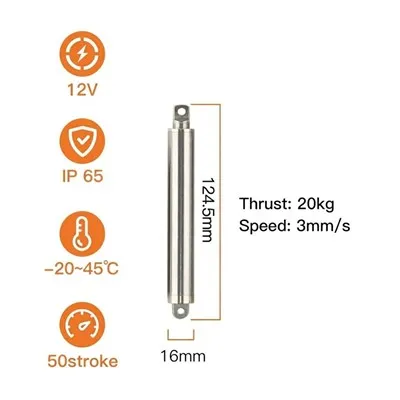
One of the most defining characteristics of 6V micro linear actuators is their diminutive size. These actuators are designed to fit into tight spaces where larger linear motion devices simply won't fit. With dimensions that are often only a few centimeters in length and width, they are ideal for applications in miniature robotics, medical devices, and small-scale automation systems. For example, in a small robotic arm designed for delicate tasks in a laboratory setting, the compact 6V micro linear actuator can be easily integrated into the joints, allowing for precise movement without taking up excessive space.
B. Power and Thrust
Despite their small size, 6V micro linear actuators pack a surprising amount of power. They are capable of generating significant thrust, typically ranging from a few newtons to over a hundred newtons, depending on the specific model. This enables them to perform tasks such as pushing, pulling, and lifting relatively heavy loads within their operational range. For instance, in a small-scale pick-and-place machine used in electronics manufacturing, the 6V micro linear actuator can effectively move small components with the required force, ensuring accurate placement.
C. Stroke Length Options
Micro linear actuators with a 6V power supply come in a variety of stroke lengths, typically ranging from as short as 10mm to as long as 200mm or more in some models. This wide range of stroke lengths makes them suitable for a diverse array of applications.
D. Speed and Control
These actuators offer variable speed capabilities. The speed of operation can be adjusted based on the application requirements, usually ranging from a few millimeters per second to over a hundred millimeters per second. Some models are equipped with advanced control systems that allow for accurate positioning, making them suitable for applications where precise linear motion is crucial, such as in 3D printers for controlling the movement of the print head or in automated microscopy for adjusting the sample stage.